- English
- French
- German
- Portuguese
- Spanish
- Russian
- Japanese
- Korean
- Arabic
- Greek
- German
- Turkish
- Italian
- Danish
- Romanian
- Indonesian
- Czech
- Afrikaans
- Swedish
- Polish
- Basque
- Catalan
- Esperanto
- Hindi
- Lao
- Albanian
- Amharic
- Armenian
- Azerbaijani
- Belarusian
- Bengali
- Bosnian
- Bulgarian
- Cebuano
- Chichewa
- Corsican
- Croatian
- Dutch
- Estonian
- Filipino
- Finnish
- Frisian
- Galician
- Georgian
- Gujarati
- Haitian
- Hausa
- Hawaiian
- Hebrew
- Hmong
- Hungarian
- Icelandic
- Igbo
- Javanese
- Kannada
- Kazakh
- Khmer
- Kurdish
- Kyrgyz
- Latin
- Latvian
- Lithuanian
- Luxembou..
- Macedonian
- Malagasy
- Malay
- Malayalam
- Maltese
- Maori
- Marathi
- Mongolian
- Burmese
- Nepali
- Norwegian
- Pashto
- Persian
- Punjabi
- Serbian
- Sesotho
- Sinhala
- Slovak
- Slovenian
- Somali
- Samoan
- Scots Gaelic
- Shona
- Sindhi
- Sundanese
- Swahili
- Tajik
- Tamil
- Telugu
- Thai
- Ukrainian
- Urdu
- Uzbek
- Vietnamese
- Welsh
- Xhosa
- Yiddish
- Yoruba
- Zulu

The right frozen food packaging depends on the product, the storage temperature, and the shipping route. For most frozen vegetables, seafood, and dumplings, a multilayer flexible pouch or rollstock film made from NY/PE or PET/PE gives the balance of low-temperature flexibility, moisture barrier, and seal strength that processors need. Rigid trays and cartons suit products that need shape retention or microwave heating. Before you decide, match the structure to the food, test it at -18°C, and confirm the documents your customers require. This guide explains each type, material, and test, and shows how we at Guoshengli Packaging approach the choice.
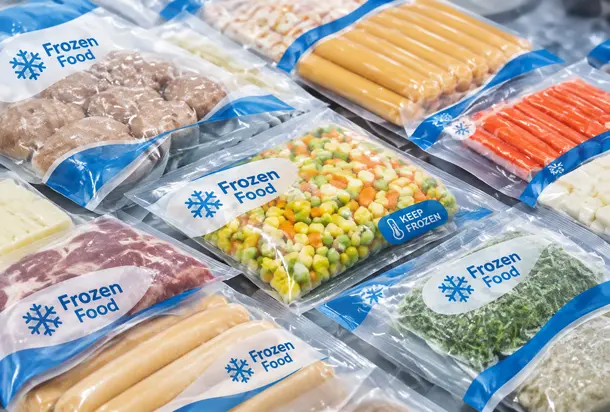
What Is Frozen Food Packaging and Why Does Material Selection Matter?
What Frozen Food Packaging Must Do
While it is being frozen, stored, shipped, and displayed in stores, frozen food packaging must contain, protect, and present the product. At -18°C (0°F), the film must stay flexible. The USDA Food Safety and Inspection Service says that food kept at that temperature is always safe, but the quality may decline over time. It is important that the seal does not leak and stays intact. The barrier needs to slow moisture loss. The structure must resist punctures from shells, bones, or ice crystals. Even after condensation and frost, the print must stay legible. You will pay for failure through a claim, a rejected shipment, or damage to your brand if these requirements are not met.
Freezer Burn and Why Barrier Matters
Freezer burn is a quality problem, not a safety problem. The USDA explains it occurs when air reaches the food surface and moisture evaporates, leaving dry, discolored patches. Packaging is the first defense. The product stays moist with a film that has low water vapor transmission, and a tight seal keeps air out. Laboratories use ASTM F1249 to measure these properties for water vapor and ASTM D3985 for oxygen. When we review a request, we ask for the product's moisture content and expected storage time, as those two details largely decide how much barrier the structure needs.
Why One Material Never Fits Every Product
Material selection depends on the food, the shelf-life target, the filling equipment, and the retail format. Frozen shrimp has sharp shells and glaze water. Frozen dumplings carry flour dust and may be steamed later. Vegetables release moisture when handled warm. A pouch that suits one of these can fail on another. Buyers who ship to the United States, Europe, Japan, or Korea also face different document requests from each customer. Treating selection as a matching exercise, not a catalog choice, lowers the risk of breakage claims and rework. The next sections cover types, materials, tests, and supplier checks in that order.
Main Types of Frozen Food Packaging
Flexible Pouches and Rollstock
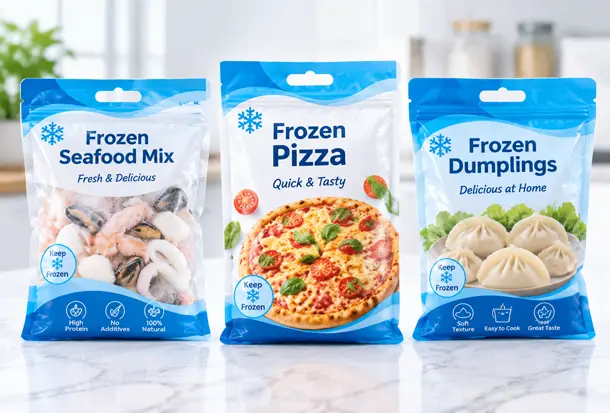
Flexible frozen food packaging dominates export programs because it is light and uses less material than rigid containers. We make stand-up pouches, flat bottom bags, pillow pouches, side gusset bags, and rollstock film for automatic form-fill-seal machines. Pillow pouches are common for frozen vegetables and seafood. Side gusset bags handle larger volumes. Flat bottom bags give strong shelf stability at retail. Rollstock suits processors who run form-fill-seal lines at speed. Lower pack weight also reduces freight weight per pallet, which helps on long ocean routes. Each format still needs its own film and seal specification.
Rigid Trays, Cartons, and Sleeves
Rigid trays, tubs, and paperboard cartons hold their shape better than a pouch. Ready-to-eat meals that go into a microwave often sit in trays, and pizza usually ships in a paperboard carton or printed wrap. Cartons also stack neatly in retail freezers and give a large print area. Their drawbacks are weight, bulk, and higher freight volume, and uncoated paperboard can soften under condensation. Many brands pair a flexible inner bag with a printed carton, so the bag handles moisture and the carton handles stacking. Because our work centers on flexible formats, we suggest sharing carton dimensions early so the inner bag fits.
Best Packaging for Frozen Food by Product
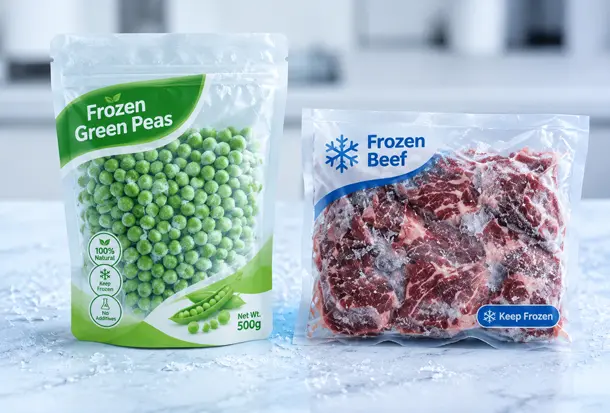
Product shape decides much of the answer. Vegetables and fruit usually go into pillow pouches or stand-up pouches with a zipper for repeat use. Seafood needs puncture resistance and a tight seal against glaze water, so a nylon layer is common. Meat and poultry often use vacuum pouches to limit air contact. Film for dumplings and bakery items needs enough stiffness to protect fragile edges. Ice cream usually calls for rigid tubs or cartons. Heating matters too. A structure built for the freezer does not automatically suit boiling or steaming, so confirm the heat-resistant structure in writing before you order.
Frozen Food Packaging Materials and Technical Requirements
Common Materials and Layer Structures
Single films rarely cover every need, so converters laminate layers. PE forms the heat-seal layer that touches the food. PET adds stiffness and a printable surface. Nylon (NY, also called PA) adds puncture resistance and flexibility. VMPET, a metallized PET, adds light and gas barrier. For frozen products, we supply PET/PE, PET/VMPET/PE, NY/PE, and other high-barrier laminates, chosen by product requirements. For sharp or heavy items such as seafood, NY/PE is the usual starting point because the nylon layer resists puncture. For lighter items, PET/PE may meet the need at lower cost.
Performance Requirements at -18°C
Frozen food packaging requirements fall into five groups: low-temperature flexibility, seal integrity, barrier performance, puncture and compression resistance, and print durability. Stiff film can crack at folds, so ask how a structure handles cold folding and cold drops. Seals face extra stress because food expands as it freezes. Stacked pallets add compression for weeks. Condensation forms each time a pack moves from the freezer to a warmer dock. Because results vary with product, fill weight, and freezer conditions, we recommend validating with your own product instead of relying on a datasheet alone.
Frozen Food Packaging Tests That Prove Performance
Testing turns claims into evidence. A cold drop test drops filled pouches at -18°C and checks for rupture. ASTM F1306 measures puncture resistance. ASTM F88 measures the force needed to pull a heat seal apart. ASTM D3985 and ASTM F1249 quantify oxygen and water vapor transmission. Gas chromatography screens for residual solvents so the pack stays within food-contact migration limits. Request the reports, then run a trial on your filling line. A pouch that passes in the lab but jams on the line, or opens in a truck, still costs money. Staged validation catches those problems before volume orders.
Comparing Formats, Sustainability, and Cost
Flexible vs. Rigid Frozen Food Packaging
Flexible packaging wins on weight, freight volume, and print area per dollar. Rigid trays and cartons win on shape protection, microwave use, and stack strength. Paper-based packs look natural but need coatings against moisture. Vacuum packs cut oxygen contact for meat and seafood. When procurement teams compare options, they should score each on moisture resistance, puncture protection, equipment compatibility, stackability, and total cost, not unit price alone. A cheaper pouch that causes more breakage can cost more than a stronger structure. Always weigh quotes against your claim history.
Sustainable Frozen Food Packaging Options
Sustainable frozen food packaging options start with using less material and preventing product loss, since a spoiled product wastes the food and the package together. We offer recyclable MONO-PE and MONO-PP pouch structures and lightweight designs that reduce transportation emissions. Compostable and biodegradable are different claims, and each needs certification and local collection to carry meaning. Ask for the structure, the certification scope, and the disposal instruction before you print any recycling claim. A mono-material pouch must pass the same cold-drop, seal, and barrier checks as a laminate. Our team reviews whether a mono-material option fits your product before recommending it.
What Drives Frozen Food Packaging Cost
Unit price reflects film thickness, layer count, print colors, pouch features, and order size. Gravure printing needs cylinders, so it favors large runs. Our gravure minimum is 20,000 pieces, with a typical lead time of 15–20 days. Digital printing starts at 500–1000 pieces with a typical lead time of 7–10 days, which suits trials, new flavors, and seasonal launches. Freight volume, compliance testing, zippers, and windows also add cost. For export processors, the larger cost often comes later, as a claim, a re-label, or a held container. We suggest comparing quotes on total landed cost and building validation time into your schedule.
How to Choose a Frozen Food Packaging Supplier
Build a Clear Procurement Brief
A good quote starts with a good brief. Share the product type, fill weight, pouch dimensions, storage temperature, shelf-life goal, filling equipment, annual volume, artwork, and destination markets. Add the documents your customers request. With that information, a supplier can recommend a structure instead of guessing. Without it, you receive a generic quote that may fail the first trial. Include any heating step, such as steaming or microwaving, because it changes the layer choice. If you sell under private label or to several buyers, list each buyer's requirements so the supplier can check them together.
Certifications and Document Chain
Frozen exporters are often held up by missing paperwork more than by film performance. Look for a food packaging facility with BRC certification, an ISO 9001 quality management system, FDA-compliant food-contact materials, and third-party testing such as SGS. In the United States, food-contact polymers fall under 21 CFR Part 177. In the EU, plastic food-contact materials follow Regulation (EU) No 10/2011. Ask for declarations of compliance, test reports, and batch traceability, then match them to your customer audits. A certificate name does not replace documents, so verify that the scope covers the product you buy.
Stable Supply and Design Features
Repeat orders reveal a supplier's real quality. Consistent color across batches protects your brand, and our rotogravure lines print up to 11 colors with in-house inspection at each stage. With 7 printing, 6 laminating, and 49 converting machines, we handle film, lamination, and pouch making in one place. Tear notches, zippers, transparent windows, hang holes, and matte or gloss finishes improve usability, but each must fit the seal area and filling tolerances. Air delivery takes 4–5 days for urgent needs. Most buyers move from sample to trial container to a quarterly or annual contract.
Conclusion
Frozen food packaging works when the structure matches the product, the temperature, and the supply chain. Flexible pouches and rollstock offer low weight and generous print area, while rigid trays and cartons provide shape protection and microwave use. Multilayer materials such as NY/PE, PET/PE, and PET/VMPET/PE combine sealing, puncture resistance, and barrier. Barrier and seal quality control freezer burn, which comes from moisture loss. Cold-drop, ASTM seal, puncture, and transmission tests measure performance, but only trials with the real product, especially where steaming or microwaving applies, prove fit. Recyclable mono-material options need the same validation as laminates. Cost is best judged by total landed cost, and supplier choice rests on documents, certifications, and consistent repeat batches.
FAQ
1. What is the best packaging for frozen food?
It depends on the product. NY/PE pouches suit sharp or heavy items such as seafood, PET/PE suits lighter products, and trays suit microwave meals.
2. Can one pouch handle freezing and steaming?
Not automatically. Confirm the heat-resistant structure in writing and test it before launch.
3. What are your minimum order quantities?
Gravure printing starts at 20,000 pieces with a 15–20 day lead time. Digital printing starts at 500–1000 pieces with 7–10 days.
4. Which documents should I request?
Ask for BRC and ISO 9001 certificates, FDA and EU food-contact compliance statements, and SGS test reports.
Request Custom Frozen Food Packaging from Guoshengli Packaging
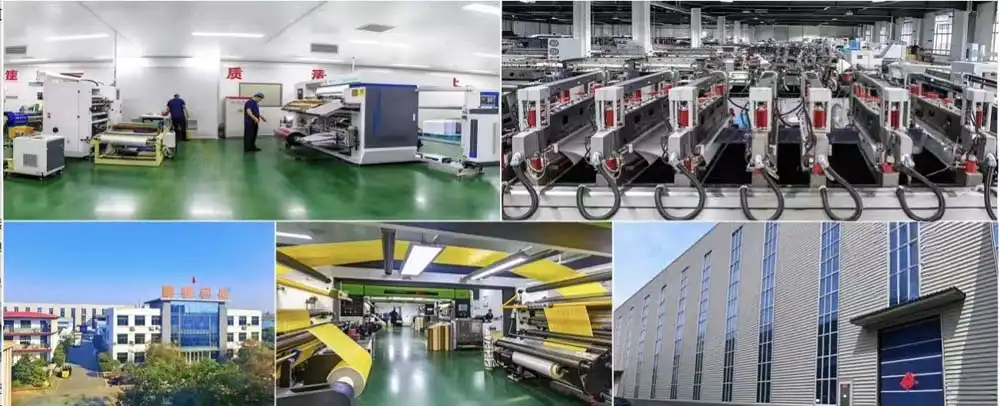
Guoshengli Packaging is a frozen food packaging manufacturer with 25+ years of flexible packaging experience, BRC, ISO 9001, FDA, and SGS credentials, and both gravure and digital printing. Send us your product type, pouch size, volume, and target market, and we will recommend a structure and prepare a quote. Email sales@guoshengpacking.com or visit guoshengpack.com for details.
References
1. USDA Food Safety and Inspection Service, Freezing and Food Safety, 2013
2. ASTM International, ASTM F88/F88M Standard Test Method for Seal Strength of Flexible Barrier Materials, 2021
3. ASTM International, ASTM F1249 Standard Test Method for Water Vapor Transmission Rate Through Plastic Film and Sheeting, 2020
4. U.S. Food and Drug Administration, Code of Federal Regulations Title 21 Part 177 Indirect Food Additives: Polymers, 2023
5. European Commission, Regulation (EU) No 10/2011 on Plastic Materials and Articles Intended to Come into Contact with Food, 2011
6. Gordon L. Robertson, Food Packaging: Principles and Practice, CRC Press, 2012