- English
- French
- German
- Portuguese
- Spanish
- Russian
- Japanese
- Korean
- Arabic
- Greek
- German
- Turkish
- Italian
- Danish
- Romanian
- Indonesian
- Czech
- Afrikaans
- Swedish
- Polish
- Basque
- Catalan
- Esperanto
- Hindi
- Lao
- Albanian
- Amharic
- Armenian
- Azerbaijani
- Belarusian
- Bengali
- Bosnian
- Bulgarian
- Cebuano
- Chichewa
- Corsican
- Croatian
- Dutch
- Estonian
- Filipino
- Finnish
- Frisian
- Galician
- Georgian
- Gujarati
- Haitian
- Hausa
- Hawaiian
- Hebrew
- Hmong
- Hungarian
- Icelandic
- Igbo
- Javanese
- Kannada
- Kazakh
- Khmer
- Kurdish
- Kyrgyz
- Latin
- Latvian
- Lithuanian
- Luxembou..
- Macedonian
- Malagasy
- Malay
- Malayalam
- Maltese
- Maori
- Marathi
- Mongolian
- Burmese
- Nepali
- Norwegian
- Pashto
- Persian
- Punjabi
- Serbian
- Sesotho
- Sinhala
- Slovak
- Slovenian
- Somali
- Samoan
- Scots Gaelic
- Shona
- Sindhi
- Sundanese
- Swahili
- Tajik
- Tamil
- Telugu
- Thai
- Ukrainian
- Urdu
- Uzbek
- Vietnamese
- Welsh
- Xhosa
- Yiddish
- Yoruba
- Zulu

Spout pouch packaging is one of the most convenient flexible packaging types available in the market in 2026 for those looking for packaging for sauces, condiments, infant food, or liquid personal care goods. A spout pouch combines a high barrier laminated body with an incorporated rigid thermoplastic spout, allowing for regulated dispensing, quick resealing and lightweight carrying. Spout pouches can reduce warehousing space by up to 90% when empty compared to glass jars or stiff plastic bottles and allow consumers to empty up to 99% of the contents. This format provides B2B procurement teams with real cost savings and excellent shelf appeal.


What Is Spout Pouch Packaging? A Comprehensive Overview
Structure and Core Components
A spout pouch comprises a body of multilayer laminated sheet heat sealed about a rigid thermoplastic fitting. Typically the film consists of PET for strength, aluminium foil or EVOH for oxygen and moisture barrier and PE or RCPP as the inner food contact layer. The spout is attached to the film using ultrasonic welding or precision heat-sealing using dedicated moulds. The achieved joint is leak-tight and can endure drop impact and stack pressure.
Material Options for Different Applications
Procurement teams have three main material paths. Standard multilayer structures with aluminium foil provide the maximum barrier protection for oil-based sauces, condiments and baby food purees. All-PE mono-material pouches with EVOH barrier layers can provide a balance between barrier performance and recyclability where appropriate collection and recycling systems are available. RCPP inner-layer constructions can withstand hot-fill operations at 85–95°C and may be designed for retort sterilisation at around 121°C when the complete pouch structure and process are properly validated, and hence are appropriate for shelf-stable items requiring high-temperature processing.
Spout Diameter and Sealing Specifications
Spouts are available in diameters ranging from 8.5mm for thin liquids such as drinks and soy sauce to 33mm for thick sauces, viscous products or certain granular items. Vacuum leak testing is performed to validate seal integrity in accordance with ASTM D3078, while burst pressure testing and drop testing from 1.2–1.5 meters can be performed to confirm the spout-to-film weld does not break under actual handling conditions.
Top 6 Uses of Spout Pouch Packaging in Various Industries
The great thing about this layout is that it works for a lot of different types of things. Six primary instances where flexible bags with spouts usually function well are as follows.
Food, Condiments, and Seasonings
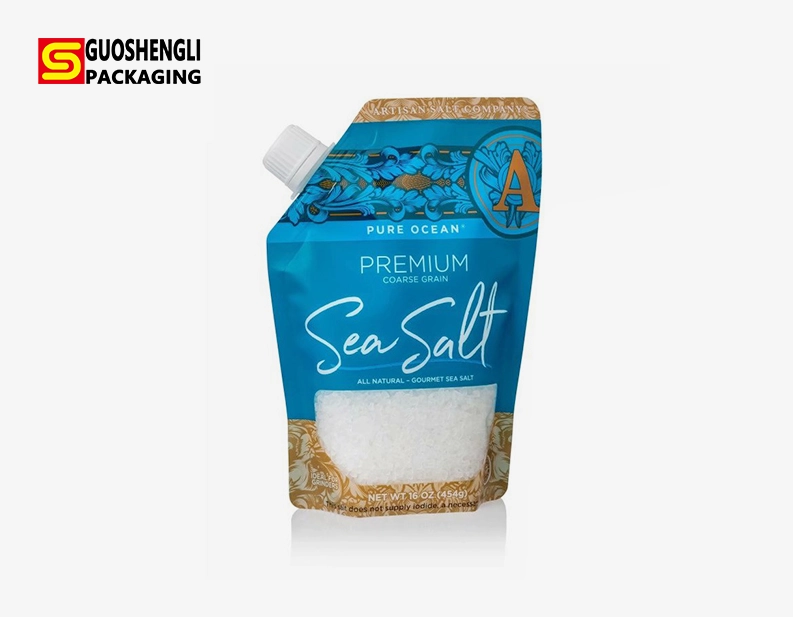
The mouth of the pouch is large enough to accommodate a variety of products, like salt, salad dressings, sauces, gravies, pureed baby food, olive oils, broths and energy gels. The frame is freestanding, so products stay upright on store shelves, and the transparent pouch structure can allow customers to view the product or its fill level. When packed in moisture resistant laminated structure, sea salt and other granular items can be protected from moisture pickup. This helps maintain product quality throughout the supply chain.
Personal Care and Home Chemical Products
Spout bags can be used for high-viscosity detergents, liquid soaps, shampoos, conditioners and laundry refills. This is because the shape of the spout helps control the flow of the product during dispensing. The controlled-pour fitting ensures waste-free dispensing, and the packaging is substantially lighter than rigid HDPE bottles, thanks to its lightweight design. Household chemicals brands with refill programs experience a direct reduction in the cost of shipping each product.
Industrial and Automotive Fluids
Packaging for lubricants, screen wash chemicals and car fluids has to endure high stack pressure at sea and mechanical stress in warehouses. Spout pouch packaging is laminated and can provide good puncture resistance when the appropriate material structure is selected, making it suitable for certain industrial and automotive fluid applications. Besides, the style allows you to control serving accurately at the job, where money is wasted on unnecessary things.
Baby Food and Infant Nutrition
One of the most significant uses in following the regulations is baby food purees. These types of pouches require FDA-compliant food-contact materials, BPA-free materials and chemicals that will not interact with food throughout the shelf life. The spout makes it possible to feed newborns directly from the package, saving you from mess and waste. RCPP structures designed for retort processing can be sterilised at around 121°C when the complete packaging system is properly validated, which can support shelf-stable infant food applications.
Health, Wellness, and Sports Nutrition
Spout pouches are so handy to take along functional drinks, protein concentrates and energy gels when you’re on the road. The fitting diameter should be selected according to the product viscosity and flow characteristics, so thick or sticky products can pass through the spout without excessive flow resistance. The product remains sealed between usage. That makes it a good alternative for sports nutrition applications that need portability and precise dose management.
Eco-Friendly and Refill Packaging Programs
Companies who are attempting to be more environmentally responsible sometimes use all-PE spouted pouches as refills for things like soaps, creams and cleaning goods. They are lighter than rigid bottles due to the shapes and can be found in many places. Also, switching to flexible packaging can reduce material use and transportation volume because empty, lighter pouches take up considerably less room when stacked flat.
So as you can see in these six usage, spout pouches aren’t simply a niche design, but can also be a lot of help in packaging a lot of various things.

Key Benefits of Spout Pouch Packaging for B2B Procurement
This structure always offers the same operational and financial benefits to buying managers. Here are the main reasons why people choose to adopt.
- Warehouse space reduction: Unfilled spouted pouches require 90% less space than comparable rigid containers, leading to lower storage costs and simplified inventory management for distribution networks.
- Logistics cost savings: Pouches are lighter than comparable glass or hard plastic, leading to lower per-unit freight costs for domestic and international shipments.
- High content evacuation rate: Consumers can evacuate up to 99% of the contents, eliminating product waste – a factor that resonates with both cost-conscious buyers and sustainability-oriented retail partners.
- Barrier protection: Aluminium foil or EVOH multilayer constructions provide ultra-low oxygen transmission rates (OTR) and water vapour transmission rates (WVTR), preserving oil-based, moisture-sensitive or oxidation-prone products through shelf life.
- Hot-fill & Retort Compatibility: RCPP inner layers can be suitable for filling at 85-95°C and, in validated structures, sterilisation at around 121°C, enabling brands to utilise normal food safety operations without modifying packaging shape.
- Full-surface branding: Up to 11-color rotogravure printing on the whole pouch surface provides businesses with a powerful canvas for retail differentiation, especially crucial in the competitive condiment and personal care industries.
Filled bags are lighter than glass or hard plastic alternatives reducing logistics expenses. Thus, the cost of shipping each device domestically and internationally is cheaper.
Spout Pouch Packaging vs. Other Packaging Types: Making the Right Choice
Depending on the sort of goods, your budget and how it will be filled, it will be either spouted pouches or something different.
Spout Pouches vs. Rigid Plastic Bottles
For some reason, bottles last longer when dropped on hard store floors. However, they cost more per unit and are harder to ship when they're empty. Spouted pouches can provide suitable barrier performance while being lighter. Also, since they ship flat, brands save money on freight costs when they bring in empty pouches.
Spout Pouches vs. Standard Stand-Up Pouches
A standard stand-up pouch that doesn't have a fitment can't be closed after being opened. By adding a spout fitment, this problem can be fixed. This makes the format much better for sauces, seasonings, and liquid personal care items that people use more than once.
Spout Pouches vs. Sachets
A sachet can only be used once and can't be sealed again. They help you control how much you eat, but each serve wastes more packing. Spout pouches can be used for both single-serve and multi-serve uses, depending on the size of the format. This gives teams that buy things more choices within the same type of packaging.
How to Source High-Quality Spout Pouch Packaging for Your Business
To find the best spouted pouch supplier, you need to think about a number of technical and business issues before you put in an order.
Certifications and Food Safety Compliance
Some important things that companies that sell food, baby food, or personal care items should have are ISO 9001 quality management certification, BRC food packaging certification, and FDA food-contact compliance documentation for spout pouch packaging. Brands that want to sell their goods in the EU must also follow EU food-contact rules. Before you buy something, make sure that the test result includes a study of the solvent residue and a statement that no printing ink components have moved into the product.
Sampling and Filling Line Compatibility
You should test the filling line and ask for samples before going into full production. The ASTM D3078 vacuum leakage test, the drop test from 1.2 to 1.5 meters, and the spout torque test are all important tests. It is important to make sure that the spout's width fits your filling head and that the pouch's construction can handle the temperature at which you are filling it.
Lead Time and MOQ Considerations
Bags printed digitally can be made in 7–10 days, which is good for making small amounts or putting out new products. It takes 15–20 days to finish rotogravure printing, and the colors are always the same on a large scale. You can send important things by air in 4–5 days. Minimum order amounts that are flexible let smaller brands test and improve their products before they start making a lot of them.
Latest Trends in Spout Pouch Packaging for 2026 and Beyond
Mono-Material and Recyclable Structures
People who care about the environment are quickly coming to expect all-PE constructions with EVOH barrier layers. These structures may be accepted in certain collection and recycling systems, depending on local requirements, and can help protect food and personal care items from air and moisture.
Smart Packaging Integration
By scanning the QR codes that are printed right on the spouted pouches, people can find out about products, make sure they are real, and see brand content. More and more, high-end condiment and baby food brands that want to reach buyers who are good with technology are using this function.
Automation and Filling Line Efficiency
Brands that make pouch filling tools are now making faster filling heads that fit pouches with spouts. Before, there was a production gap between the bag and bottle filling lines. This closes that gap. With this change, the format is better for production settings with medium to high volumes.

Conclusion
Spout pouch packaging is now a practical and cost-efficient way to handle baby food, liquid foods, personal care items, and commercial goods. Being able to control dispensing, being lightweight, and having full-surface branding make it a good choice for buying teams in 2026 that want to change the way packing is made. Spout pouches can be used instead of glass jars for flexible condiment bags or to start a refill program for household cleaners. This format has been used to measure operational and business value. Find a provider whose credentials have been checked, whose products have been proven to work with your filling line, and whose quality stays the same for repeat orders. This will help the change go smoothly.
FAQ
1. Why do spout pouches outperform traditional bottles for sauce and condiment brands?
If you empty a spouted bag, it takes up 90% less space in a warehouse and is lighter. Customers can also get up to 99% of the contents out. Shipping sauces abroad saves a lot of money on freight costs every time an order comes in because of the weight loss.
2. What spout diameter should I specify for my product?
The standard size for thin liquids like soy sauce and drinks is 8.5 mm. The normal size is 33 mm for thick soups, granular spices, or sea salt. The right fitting size relies on how thick your product is and what kind of filling tools you have.
3. How do I verify that a spouted pouch supplier meets food safety standards?
Make sure you have the ISO 9001, BRC, and FDA food-contact compliance paperwork before you take a sample. As for test results that show the ink has not migrated into the product, ask for them. ASTM D3078 can be used to evaluate package leak integrity, while drop tests from 1.2 meters and other appropriate leak tests should be completed before production can start.
4. Can spouted pouches handle hot-fill or retort processing?
Yes. RCPP-based pouch structures can be designed for hot-fill at 85–95°C and, when properly validated, for retort processing at around 121°C. Before setting up the structure for thermally processed goods, make sure the complete pouch construction and inner layer meet the requirements of your product and processing conditions.
5. Are recyclable spouted pouches commercially available?
There are spouted pouches that are made of only PE and have an EVOH barrier layer. These may be accepted by certain recycling systems depending on local infrastructure and requirements. This arrangement lets brands communicate their environmental efforts while maintaining the required barrier performance.
Partner With Guoshengli Packaging for Your Spouted Pouch Needs

Guoshengli Packaging has been making flexible packaging for 25 years and is a qualified spout pouch packaging maker. Their packaging can be supplied with ISO 9001 and BRC certifications, along with FDA food-contact compliance documentation and SGS-related testing or inspection documentation as applicable. Their 7 printing lines can make rotogravure output in 11 colors. We make pouches with spouts for baby food, personal care items, industrial liquids, and sauces. Lead times begin at 7 days, and shipping by air takes 4–5 days. Send our sales team an email at sales@guoshengpacking.com or visit www.guoshengpack.com to get samples and a price quote for your next order.
References
1. Flexible Packaging Association. Flexible Packaging: State of the Industry Report. Flexible Packaging Association, 2024.
2. Packaging World. Trends in Spouted Pouch Adoption for Food and Beverage. Packaging World, 2024.
3. Food and Drug Administration (FDA). Guidance for Industry: Food Contact Substance Notification Program. U.S. Department of Health and Human Services, 2023.
4. BRCGS. BRC Global Standard for Packaging and Packaging Materials, Issue 6. British Retail Consortium, 2023.
5. Smithers Pira. The Future of Flexible Packaging to 2027. Smithers, 2022.
6. Packaging Digest. Sustainable Packaging Innovations: Mono-Material Flexible Structures. Packaging Digest, 2024.