- English
- French
- German
- Portuguese
- Spanish
- Russian
- Japanese
- Korean
- Arabic
- Greek
- German
- Turkish
- Italian
- Danish
- Romanian
- Indonesian
- Czech
- Afrikaans
- Swedish
- Polish
- Basque
- Catalan
- Esperanto
- Hindi
- Lao
- Albanian
- Amharic
- Armenian
- Azerbaijani
- Belarusian
- Bengali
- Bosnian
- Bulgarian
- Cebuano
- Chichewa
- Corsican
- Croatian
- Dutch
- Estonian
- Filipino
- Finnish
- Frisian
- Galician
- Georgian
- Gujarati
- Haitian
- Hausa
- Hawaiian
- Hebrew
- Hmong
- Hungarian
- Icelandic
- Igbo
- Javanese
- Kannada
- Kazakh
- Khmer
- Kurdish
- Kyrgyz
- Latin
- Latvian
- Lithuanian
- Luxembou..
- Macedonian
- Malagasy
- Malay
- Malayalam
- Maltese
- Maori
- Marathi
- Mongolian
- Burmese
- Nepali
- Norwegian
- Pashto
- Persian
- Punjabi
- Serbian
- Sesotho
- Sinhala
- Slovak
- Slovenian
- Somali
- Samoan
- Scots Gaelic
- Shona
- Sindhi
- Sundanese
- Swahili
- Tajik
- Tamil
- Telugu
- Thai
- Ukrainian
- Urdu
- Uzbek
- Vietnamese
- Welsh
- Xhosa
- Yiddish
- Yoruba
- Zulu

In the fiercely competitive snack market, flexible packaging is not just a covering; it's your invisible salesperson, your quality commitment, and a critical factor in brand premiumization. For snack brands aiming for excellence, choosing the right packaging structure determines your product’s shelf life and market resilience.
This article serves as your authoritative guide for formulating your 2025 snack packaging strategy. We will conduct a deep analysis of material science, bag type selection, and provide a high-value supplier audit checklist focused on procurement needs, ensuring your products are both fresh and compliant in the marketplace.
1. Introduction: The Strategic Role of Flexible Snack Packaging
Flexible packaging is the dominant choice for snacks due to its cost-effectiveness, lightweight nature, and excellent print adaptability. Heading into 2025, the industry faces a dual challenge:
· Extreme Preservation Challenge: Increased consumer demand for natural, fewer-additive snacks requires packaging to deliver superior barrier properties against oxidation and moisture.
· Sustainability Challenge: Market demands and global regulations, especially the phased implementation of Extended Producer Responsibility (EPR) mandates, compel brands to switch to recyclable mono-material structures.
Neglecting these trends will leave your product vulnerable in the future market landscape.
2. Core Elements of Quality Snack Packaging
A high-quality flexible snack package must meet the following key functionalities:
The Science of Maximum Freshness: OTR vs. WVTR
The primary role of packaging is to prevent environmental factors from degrading the snack's flavor and texture. The two core metrics for measuring barrier properties are:
· OTR (Oxygen Transmission Rate): The amount of oxygen that permeates the material per unit of time. A lower OTR means better protection against fat oxidation and flavor loss (critical for nuts, chips, jerky).
· WVTR (Water Vapor Transmission Rate): The amount of water vapor that permeates the material per unit of time. A lower WVTR means better protection against the snack getting stale, soft, or moldy (critical for puffed snacks, cookies).
Safety and Compliance: Food-Grade Standards and Anti-Burst Design
All food packaging materials must comply with food contact standards such as FDA (US) or EU Regulation 10/2011 (EU), ensuring low migration of inks and adhesives. Simultaneously, the packaging’s heat seal strength must be rigorously tested to withstand transit pressures and prevent bag failure.
Meeting EPR (Extended Producer Responsibility) Mandates
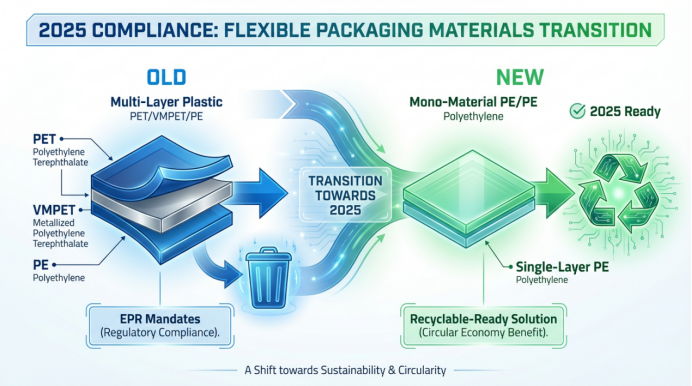
EPR legislation holds producers accountable for the end-of-life management of their packaging. For your packaging, this means: it must be recyclable. Brands must prioritize structures made of mono-materials (like PE/PE or PP/PP) to align with future recycling infrastructure requirements and avoid escalating non-compliance fees.
3. Snack Packaging Materials: Barrier Performance & Cost-Benefit Analysis
The composition of the multi-layer film is central to balancing barrier properties and cost.
|
Material Structure
|
Cost Comparison
|
Barrier Level (OTR/WVTR)
|
Recyclability
|
Applicable Snack Types
|
|
PET/PE
|
Medium
|
Basic
|
Poor (Multi-material)
|
Candies, Short shelf-life snacks
|
|
PET/VMPET/PE
|
Medium-High
|
Excellent
|
Poor (Multi-material)
|
Nuts, Chips, Dried fruit
|
|
Aluminum Foil Laminates
|
High
|
Highest (Near-zero)
|
Poor
|
Extremely long shelf-life or light-sensitive products
|
|
Recyclable Mono-PE/PE
|
High (New Technology)
|
Moderate to Excellent
|
Excellent (Mono-material)
|
Chips, Nuts (Eco-compliant)
|
Expert Recommendation: While PET/VMPET/PE remains the most cost-effective choice for high barriers, investing in Recyclable Mono-Materials is a strategic move to ensure long-term compliance and market viability, especially when targeting North American and European retailers.
4. Snack Packaging Bag Types: Maximizing Shelf Appeal and Functionality
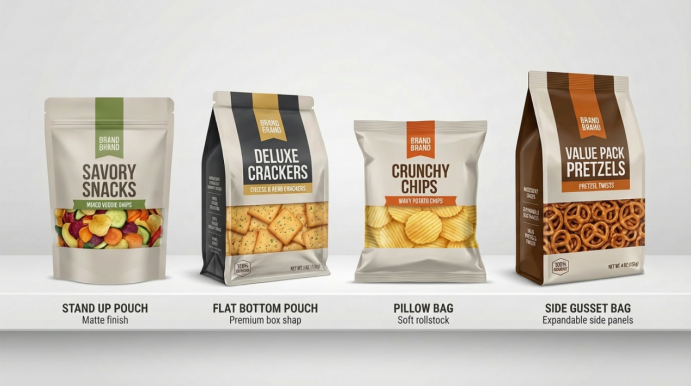
The bag type is the consumer's first physical interaction with the brand and must combine aesthetics with functionality.
· Stand Up Pouch: Highest market share. Self-standing capability, most suitable for snacks with zippers for reclosing, such as nuts and cereals. Typical thickness is around $120 \mu m$.
· Flat Bottom Pouch (Box Pouch): Best for premium display. Five printable panels, stable structure, gives the product a "gift-box" aesthetic, common for premium bakery items or specialty snacks.
· Pillow Bag (Rollstock): Most cost-efficient. Formed automatically on high-speed VFFS (Vertical Form Fill Seal) machines from roll film, it's the primary choice for large-volume, low-cost items like chips and puffed snacks.
· Side Gusset Bag: Maximum capacity. Often used for bulk or large-format snacks, where side folds allow for expanded volume.
· Added Feature: Easy-Open Functionality: Features like Laser Scoring (pre-cut lines), Tear Notches, or specialized zipper profiles are essential for improving the consumer experience and preventing frustration when opening the bag.
5. Choosing the Right Barrier Structure by Snack Category
Customize the packaging structure based on the snack's sensitivity to moisture and oxygen. For each category, we must consider the optimal flexible packaging film thickness to balance protection and cost.
|
Snack Category
|
Core Barrier Requirement
|
Recommended Material Structure
|
Recommended Total Thickness
|
Recommended Bag Type
|
|
Nuts & Seeds
|
High Anti-Oxidation (Very Low OTR)
|
PET/VMPET/PE or Recyclable PE/PE (High Barrier Film)
|
$130-140 \mu m$
|
Stand Up Pouch, Flat Bottom Pouch
|
|
Chips & Puffed Snacks
|
High Moisture Barrier (Very Low WVTR)
|
PET/VMPET/PE or BOPP/VMPET/PE
|
$100-120 \mu m$
|
Pillow Bag, Stand Up Pouch
|
|
Freeze-dried snacks
|
Extreme Moisture Challenge
|
PET/Alu/PE or KPET/PE
|
$110-130 \mu m$
|
Stand Up Pouch
|
|
Gummies & Candies
|
Moderate Moisture, Anti-Sticking
|
PET/PE or BOPP/CPP
|
$80-100 \mu m$
|
Small Sachets, Pillow Bag
|
6. Printing & Aesthetics: Brand Differentiation and Compliance
Printing technology is the main driver of brand differentiation, but ink safety must be prioritized.
· Rotogravure Printing: Ideal for large volume orders, offering the highest color saturation and precision. Once printing plates are made, the unit cost is very low, making it the choice for mass production by established brands.
· Digital Printing: Suitable for Low MOQ, multiple SKUs, or startup brands needing rapid market testing, with a key advantage in fast lead times.
Food-Safe Ink & Sustainability
To meet stringent food safety standards, professional manufacturers must use solvent-free adhesives and low-migration inks. This not only ensures food safety but is a crucial component of a sustainable production process.
7. Snack Packaging Supplier Checklist (2025 High-Value Procurement Focus)
Selecting the right supplier is paramount to product quality and supply chain resilience. This checklist helps you screen partners for high-value procurement:
|
Evaluation Focus
|
Key Question
|
Professional Consideration (Risk Mitigation)
|
|
Vendor Certification & Compliance
|
Do they hold BRC, FDA, or FSSC 22000 certifications?
|
Ensures the production environment and processes meet international food safety standards.
|
|
Sustainable Sourcing & Expertise
|
Do they have proven experience with Mono-Materials and familiarity with EPR mandates?
|
Prevents future packaging obsolescence due to non-compliance with environmental regulations.
|
|
Technical Support
|
Can they provide professional structural recommendations, shelf-life predictions, and barrier test reports?
|
Gauges the supplier's material science authority, not just printing capability.
|
|
Production Efficiency & Film Yield
|
How is the Film Yield controlled? What is their efficiency on high-speed lines?
|
Ensures the packaging runs efficiently on your production lines, lowering overall operational costs and waste.
|
|
Factory Status
|
Are they a manufacturer with full production lines, or a trading company?
|
Direct manufacturer engagement guarantees price transparency, quality control, and communication efficiency.
|
|
Quality Control
|
What is the range for Color Deviation ($\Delta E$) control? Is seal strength data-backed?
|
Ensures brand consistency across batches and minimizes catastrophic bag failure rates.
|
⭐ Soft CTA: Ready to vet your current supplier against these standards? Contact our technical team for a free benchmark audit today.
8. Common Mistakes to Avoid (The High Cost of Non-Compliance)
Common errors in snack packaging procurement often involve sacrificing quality for short-term cost savings, leading to catastrophic long-term consequences:
1. Wrong Material/Thickness: Incorrect structures (e.g., lacking VMPET or Aluminum Foil) will lead to premature spoilage, irrevocably damaging brand trust.
2. Ignoring Data-Backed Barrier Needs: Relying solely on experience rather than OTR/WVTR laboratory data for barrier selection is a high-risk gamble that leads to product failure.
3. Supplier Instability Trap: Choosing cheap, uncertified vendors results in issues like off-odors, ink rub-off, or indefinite lead time delays, paralyzing your production line.
4. Ignoring Global Mandates: The High Cost of Non-Compliance: Failure to transition to recyclable structures will soon incur punitive environmental taxes or risk immediate delisting by major retailers in EPR-active states/regions.
9. Conclusion + CTA
In the fast-paced snack market, high-quality, compliant packaging is your most reliable long-term investment. Choosing a professional food-grade flexible packaging manufacturer means partnering with a company that provides scientific assurance, market insight, and supply chain stability.
We are a specialized manufacturer of premium food-grade flexible packaging ([Your Company Name]), serving as your packaging structure consultant. We focus on high-barrier solutions, FDA/BRC certification standards, and future-proof Recyclable-Ready technology.
Final Call to Action: Your snacks deserve packaging that shines on the shelf and stays fresh throughout its shelf life.
Click Here to Contact Us! Receive a Free, Customized Packaging Structure Optimization Plan and 2025 Compliance Consultation to keep your packaging strategy ahead of the curve.