- English
- French
- German
- Portuguese
- Spanish
- Russian
- Japanese
- Korean
- Arabic
- Greek
- German
- Turkish
- Italian
- Danish
- Romanian
- Indonesian
- Czech
- Afrikaans
- Swedish
- Polish
- Basque
- Catalan
- Esperanto
- Hindi
- Lao
- Albanian
- Amharic
- Armenian
- Azerbaijani
- Belarusian
- Bengali
- Bosnian
- Bulgarian
- Cebuano
- Chichewa
- Corsican
- Croatian
- Dutch
- Estonian
- Filipino
- Finnish
- Frisian
- Galician
- Georgian
- Gujarati
- Haitian
- Hausa
- Hawaiian
- Hebrew
- Hmong
- Hungarian
- Icelandic
- Igbo
- Javanese
- Kannada
- Kazakh
- Khmer
- Kurdish
- Kyrgyz
- Latin
- Latvian
- Lithuanian
- Luxembou..
- Macedonian
- Malagasy
- Malay
- Malayalam
- Maltese
- Maori
- Marathi
- Mongolian
- Burmese
- Nepali
- Norwegian
- Pashto
- Persian
- Punjabi
- Serbian
- Sesotho
- Sinhala
- Slovak
- Slovenian
- Somali
- Samoan
- Scots Gaelic
- Shona
- Sindhi
- Sundanese
- Swahili
- Tajik
- Tamil
- Telugu
- Thai
- Ukrainian
- Urdu
- Uzbek
- Vietnamese
- Welsh
- Xhosa
- Yiddish
- Yoruba
- Zulu

Small businesses face a unique challenge when selecting packaging: how do you balance cost, quality, product protection, and environmental goals while creating a strong first impression? Brown kraft paper pouches offer a flexible solution that can address many of these priorities when the complete structure is properly specified. These natural-looking packages combine rustic authenticity with modern barrier technology, helping protect products while giving brands a distinctive paper-based appearance. At Guoshengli Packaging, we've seen many small businesses use kraft paper packaging to strengthen shelf presentation while tailoring the barrier, printing, and functional features to their actual product requirements.
Understanding Brown Kraft Paper Pouches: Materials, Types, and Benefits
What Makes Kraft Paper Packaging Different?
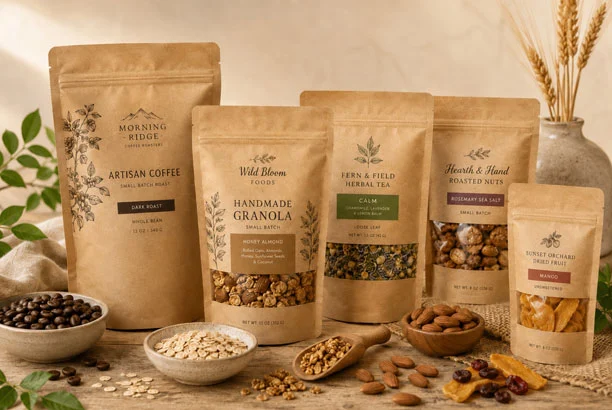
Brown kraft paper pouches are a flexible packaging format that combines kraft paper with one or more functional layers. Each layer can be selected to provide a different role within the package. The outer layer of brown kraft paper pouches, which is usually between 40 and 80 GSM (grams per square meter), can provide a natural appearance, surface strength, and a printable area for branding.
The multi-layer lamination system on these pouches is what allows the structure to deliver different levels of product protection. Materials such as metallized PET, aluminum foil, EVOH, nylon, PE, or CPP may be combined with the natural paper exterior depending on the product requirements. These layers can help control oxygen, moisture, aroma, grease, and light exposure. With the correct structure and sealing system, brown kraft paper pouches can support the target shelf life of products such as beef jerky, organic coffee, handmade snacks, and other dry or semi-dry foods.
Available Pouch Styles for Different Business Needs
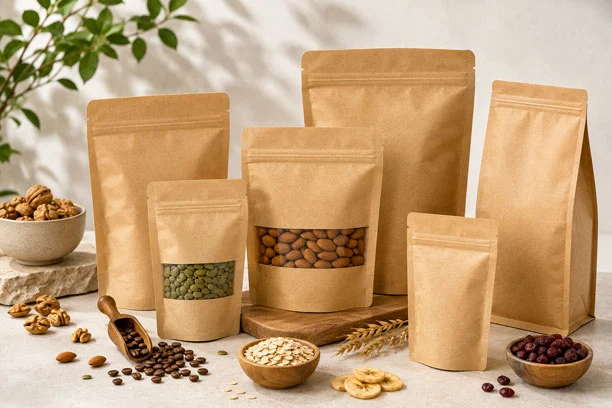
Picking the right bag type has a direct effect on both how well it works and how it looks on store shelves. Three-side seal bags can work well for dried meats, jerky, and sample products because they provide a flat, compact format with relatively simple construction. Their straightforward design can help control converting costs while still allowing the barrier structure to be tailored to the product.
Stand-up bags have bottom gussets that allow the package to stand upright on retail shelves. Coffee roasters and food brands often choose this format because it offers strong front-panel visibility and can incorporate features such as resealable zippers and degassing valves where appropriate.
Flat-bottom pouches offer a more structured presentation and multiple printable panels. This format can suit premium-positioned products and larger fill weights when pouch dimensions and material strength are correctly specified. Side gusset pouches provide additional internal volume and can work well for bulk powders, teas, coffee, and other products that require efficient use of pack space.
Core Benefits That Drive Business Results
Natural kraft can help a brand stand out immediately. Glossy plastic packaging can create a very different visual impression, while matte kraft can communicate a natural, artisanal, or premium identity. Brown kraft paper pouches therefore give small businesses a way to create a distinctive shelf appearance before the customer reads the label.
Barrier performance is another important advantage when the pouch is properly engineered. Multi-layer structures can help control oxygen and moisture exposure that may reduce product quality over time. Effective barrier protection can help reduce product deterioration and quality-related complaints when the packaging is matched to the actual food, shelf-life target, and storage route. For coffee, barrier performance can also help limit exposure to oxygen, moisture, and aroma loss.
Easy-to-use features can improve consumer convenience. Tear notches reduce the need for scissors when the pouch design supports easy opening. Hang holes allow selected pouch styles to work with hook-based retail displays. Resealable closures can help consumers close the package between uses, although they do not replace the primary factory heat seal.
Comparing Brown Kraft Paper Pouches with Other Packaging Options
Environmental Impact Assessment
Traditional plastic packaging remains widely used because it can provide strong product protection with relatively low material weight. At the same time, brands and regulators are placing greater attention on packaging reduction, recyclability, recycled content, responsible sourcing, and end-of-life management.
Brown kraft paper pouches can support different environmental strategies depending on their complete construction. Kraft paper itself is fibre-based, but conventional paper-plastic laminates should not automatically be described as biodegradable or recyclable. Some paper-plastic structures may require specialized recycling routes, while selected recyclable or compostable constructions should be evaluated separately according to the complete material structure and target-market infrastructure.
Brands that support circular-economy goals may also evaluate selected PLA- or PBAT-based structures where the complete package meets relevant compostability requirements and a suitable industrial-composting route exists. These materials should not be treated as automatically better for the environment simply because they are described as bio-based, biodegradable, or compostable. Their environmental performance depends on the complete packaging system, manufacturing process, product protection, and intended end-of-life route.
Durability and Performance Comparison
Buying professionals sometimes worry that brown kraft paper bags may not provide the same level of protection as other flexible packaging formats. In practice, performance depends primarily on the complete laminate rather than the kraft layer alone. Properly designed kraft-laminate pouches can achieve strong barrier and mechanical performance when the paper, polymer, and barrier layers are matched to the application.
Grease resistance is particularly important for products such as roasted nuts, nut butters, jerky, and other oily foods. For these applications, the complete pouch structure should be evaluated for grease resistance and resistance to oil migration or staining. Where grease-resistant paper treatments are used, applicable food-contact and chemical-compliance requirements should also be verified.
Puncture and tear performance also depend on the complete laminate. Paper strength, polymer layers, total thickness, seal design, and product geometry all influence how the pouch behaves during filling, transportation, and retail handling. Structures containing materials such as PA or suitable PE grades may be selected where additional toughness or puncture resistance is required.
Cost-Effectiveness Analysis
Brown kraft paper pouches may carry a higher material and converting cost than some all-plastic structures, depending on the kraft grade, barrier laminate, printing method, order size, pouch type, and added features. For small businesses, the relevant question is therefore not whether kraft packaging always costs more, but whether the total packaging value supports the product and brand strategy.
Effective product protection can help reduce quality losses, returns, and avoidable waste when the pouch structure is correctly matched to the product. The commercial value of that protection depends on the product category, shelf-life target, and distribution route rather than on the kraft paper layer alone.
The distinctive paper appearance may also support shelf differentiation and brand positioning. For small businesses competing with larger brands, this visual identity can be useful when it is consistent with the product, pricing, and target consumer. Packaging should therefore be evaluated as part of the overall product proposition rather than only as a per-unit material cost.
How Small Businesses Can Effectively Use Brown Kraft Paper Pouches
Optimizing Product Freshness and Shelf Life
Your product's shelf life depends on selecting barrier performance that matches its actual sensitivity. For oxygen-sensitive products such as coffee, nuts, and dried fruits, aluminium foil, metallized PET, EVOH, or other barrier technologies may be considered. OTR targets should be defined under specified test conditions and matched to the product, filling process, target shelf life, and distribution route rather than using one universal value.
Moisture-sensitive protein powders, supplement mixes, and dehydrated ingredients require structures with appropriate low-WVTR performance. EVOH may also be incorporated where additional oxygen barrier is required, but moisture protection should be evaluated through the complete laminate rather than attributed to EVOH alone.
Simpler kraft/PE or paper-laminate structures may suit selected dry products with modest barrier requirements and relatively stable storage conditions. We help clients compare barrier requirements with product needs so they can avoid both under-specifying a pouch and over-engineering a structure that adds unnecessary cost.
Enhancing Brand Perception Through Design
Custom printing turns brown kraft paper bags into strong brand surfaces. Rotogravure printing can reproduce up to 11 colours on suitable production runs and can support consistent colour reproduction when artwork, cylinders, inks, and process controls are properly managed.
Transparent windows can help consumers see the product, which can support confidence in categories where appearance matters. However, the window material and area should be evaluated because adding a clear section may change the overall oxygen, moisture, or light barrier compared with an opaque metallized or foil laminate.
High-end brands may use matte surfaces because they complement the natural texture of kraft paper. Spot UV, glossy details, embossing, or other specialty effects can also be considered where they are compatible with the material and converting process. These finishing techniques should be selected according to the actual pouch structure rather than treated as universal options.
Real-World Success Applications
Specialty coffee roasters often choose brown Kraft pouches because the natural paper appearance can support an artisanal or premium brand position. Where required, built-in degassing valves can allow carbon dioxide to escape from freshly roasted beans while helping limit outside air ingress. Final freshness still depends on the coffee, roast-to-pack timing, barrier structure, seal integrity, and storage conditions.
Pet treat manufacturers may also choose brown kraft paper pouches when a natural appearance fits the product positioning. For these applications, puncture resistance, grease resistance, seal performance, and barrier requirements should be evaluated using the actual treat rather than assuming that the kraft format alone provides the required protection.
Healthy snack companies can use brown kraft paper pouches to create a simple, natural, or premium shelf presentation. The packaging can support brand differentiation, but claims about consumer preference, price premiums, or sales increases should be based on actual market research or brand-specific evidence rather than assumed from the pouch material itself.
Buying Guide: How to Procure Brown Kraft Paper Pouches for Your Business
Selecting Qualified Suppliers
Supplier selection is an important procurement decision for long-term performance. Quality differences between samples and full production can create filling-line issues, returns, and delays for small businesses. Buyers should therefore evaluate suppliers using several core criteria before committing to repeat production.
Manufacturing certifications and compliance documentation can provide useful evidence of quality-system capability. ISO 9001 supports quality management, while BRCGS Packaging Materials certification applies specifically to packaging-material manufacturing sites. For products sold in the United States, food-contact materials should comply with applicable FDA requirements for their intended use rather than being described simply as "FDA-certified."
Production capacity affects whether a supplier can grow alongside the business. Guoshengli Packaging has annual flexible-packaging production capacity of approximately 20,000 tonnes and can support both smaller commercial programmes and high-volume repeat production, subject to the requirements of each project.
Technical knowledge distinguishes strategic partners from simple product suppliers. Instead of relying only on standard stock structures, our team reviews product sensitivity to moisture, oxygen, grease, aroma, and storage conditions to recommend barrier specifications that balance protection, manufacturability, and cost.
Understanding Minimum Orders and Pricing Structures
Minimum order quantities (MOQs) affect small businesses' cash flow and inventory planning. Rotogravure printing generally requires higher MOQs because of cylinder preparation and setup costs, although actual minimums depend on pouch size, material structure, number of designs, and production requirements.
Digital printing can help startups develop new products and serve smaller or more specialised markets. It can support lower MOQs for selected projects because conventional printing cylinders are not required. Digital printing may have a higher unit cost at larger volumes, while reducing tooling cost and inventory exposure for market testing or multi-SKU launches.
Larger commitments may reduce unit costs through more efficient production and material use. Businesses should compare annual consumption, number of designs, storage capacity, cash flow, and repeat-order needs before deciding whether one larger order or several smaller runs is commercially better.
Navigating the Customization Process
Product requirements and brand goals should guide customization. We recommend materials and structures according to product-protection needs without adding unnecessary complexity. Factors such as moisture sensitivity, fat content, filling method, target shelf life, and storage conditions can all influence the final recommendation.
Artwork preparation affects production speed and print quality. Vector artwork is generally preferred for logos and line graphics because it scales cleanly, although the final artwork format should follow the printer's technical requirements. Digital mock-ups can help visualize how artwork will sit on a three-dimensional pouch before production.
Sample production is an important part of testing before mass production. Depending on the project stage, suppliers may provide stock samples, material samples, printed mock-ups, or production samples. Customers can use these for filling, fit, handling, and preliminary storage evaluation, while final barrier and shelf-life performance should be validated under defined conditions using the actual product.
Printing technology and order complexity influence manufacturing lead times. Digital printing can support relatively fast short-run development for selected projects, while rotogravure orders require cylinder preparation and additional production steps. Actual lead time depends on artwork approval, material availability, pouch construction, curing requirements, production scheduling, and order complexity.
Why Brown Kraft Paper Pouches Are a Smart Choice for Sustainable Small Businesses
Supporting Circular Economy Principles
The circular economy focuses on reducing waste and keeping materials in use through reuse, recycling, and other appropriate recovery routes. Brown kraft paper pouches can support these objectives in selected applications, but their recyclability depends on the complete package rather than the kraft paper exterior alone.
Although paper recycling infrastructure is widely available in many regions, laminated kraft pouches should not automatically be placed in standard mixed-paper streams. Paper-plastic laminates may behave differently during pulping and sorting depending on fibre yield, polymer content, adhesives, coatings, windows, closures, and local recycling-system requirements.
Recyclable PE technologies can support circularity when the complete pouch is designed as a suitable mono-PE structure. However, simply adding a PE inner layer to a kraft-paper laminate does not make the entire package mono-material or fully recyclable. Brands interested in recyclable flexible packaging should evaluate the full construction against the relevant recycling guidelines and target-market collection system.
Meeting Regulatory Requirements and Consumer Expectations
Extended producer responsibility (EPR), packaging-reduction requirements, recycled-content rules, and recyclability requirements are evolving across Europe and parts of North America. These obligations vary by jurisdiction and should be reviewed according to the specific target market rather than assuming that one regional trend will automatically become a nationwide requirement elsewhere.
Businesses may use brown kraft paper pouches as part of a broader packaging strategy when the format, material construction, and environmental claims align with the applicable market. Early technical planning can also help brands avoid redesigning packaging later when regulations or retailer requirements change.
Some consumer segments show strong interest in sustainability-related packaging attributes, but purchase behaviour varies by market, product category, price sensitivity, and the credibility of the environmental claim. Brown kraft paper pouches can communicate a natural visual identity, but the environmental performance of the finished package should be supported by the actual structure and end-of-life route.
Innovations Enhancing Functionality
Modern barrier technology continues to improve the range of structures available for brown kraft paper pouches. Metallized films can provide strong barrier performance with a thin deposited metal layer, while aluminium foil can provide stronger opaque light and gas barrier for more demanding applications. Material selection should be based on the required protection rather than assuming that one barrier technology always matches another.
Selected mono-material barrier technologies are also being developed to improve recyclability compatibility while retaining required product protection. Their actual performance depends on barrier layers, coatings, adhesives, sealants, processing conditions, and the target shelf-life requirement, so product-specific testing remains important.
PLA, PBAT, and other compostable packaging materials may be tested and certified against standards such as EN 13432 or ASTM D6400 where applicable. Degradation conditions and time depend on the certified system and industrial composting environment. These materials should not be described as automatically recyclable or universally biodegradable simply because they contain compostable polymers.
Smart packaging can also add functionality to modern products. QR codes printed on kraft surfaces can link consumers to product information, sustainability documentation, traceability data, or loyalty programmes. Some brands may also evaluate NFC or other digital technologies for premium products or supply-chain applications where the added cost and functionality are justified.
Conclusion
Brown kraft paper pouches can help small businesses address several packaging priorities at once, including product protection, brand differentiation, flexible customization, and selected sustainability objectives. Their natural appearance can support artisanal, premium, or sustainability-oriented brand positioning, while functional barrier layers can be selected independently according to the product's oxygen, moisture, grease, light, and shelf-life requirements. Choosing the right pouch style, barrier specification, and customization options can turn packaging into an important part of the product experience rather than treating it only as a cost of doing business. Guoshengli Packaging has more than 25 years of flexible-packaging manufacturing experience and works with small businesses by providing technical recommendations, quality-management support, and scalable production options.
FAQ
1. Can brown kraft paper pouches be recycled properly?
It depends on the complete structure. Standard brown kraft paper pouches laminated with PE, PET, metallized film, foil, adhesives, windows, or zippers should not be assumed to be recyclable through ordinary paper streams simply because the outer layer is kraft paper. Fibre recovery, polymer content, adhesive systems, coatings, accessories, and local collection and recycling infrastructure all influence recyclability. Certified compostable structures are a separate end-of-life route and should not be described as recyclable unless they are also accepted in an appropriate recycling system.
2. How do these pouches handle grease-heavy products?
Brown kraft paper pouches for oily products can be designed with inner laminate structures that help resist oil migration and staining of the outer paper surface. The actual performance depends on the complete laminate rather than the kraft layer alone. For roasted nuts, nut butters, jerky, and other fatty foods, the structure should be evaluated for grease resistance, seal performance, and compatibility with the actual product over the intended storage period. Where grease-resistant paper treatments are used, applicable food-contact and chemical-compliance requirements should also be confirmed.
3. What shelf-life extension can I expect compared to basic plastic bags?
Shelf-life improvement cannot be predicted from pouch type alone. It depends on the product's sensitivity to oxygen, moisture, light, aroma loss, fat oxidation, initial product quality, filling conditions, seal integrity, storage temperature, and distribution route. A high-barrier kraft laminate may support a longer shelf-life target than a low-barrier structure, but actual shelf life should be validated using the specific product and defined storage conditions rather than estimated from the material name alone.
Get Started with Guoshengli Packaging—Your Trusted Brown Kraft Paper Pouches Manufacturer

Small businesses need packaging partners who understand the challenges of cash flow, inventory control, product protection, and the need to stand out in competitive markets. With brown kraft paper pouches designed around product requirements and shelf presentation, Guoshengli Packaging supports brands at different stages of growth. Our quality systems include ISO 9001 and BRCGS Packaging Materials certification, together with food-contact compliance documentation for applicable target markets.
We support both digital and rotogravure printing so customers can test markets with lower-volume projects and move into larger repeat production as demand grows. MOQ, material structure, printing method, lead time, and customization options depend on the specific project rather than one fixed specification.
Email our team at sales@guoshengpacking.com to discuss your product, target market, pouch style, material requirements, and branding goals. We can recommend suitable brown kraft paper pouches, barrier structures, printing options, and functional features based on the actual product and commercial requirements.
References
-
Robertson, Gordon L. Food Packaging: Principles and Practice. 3rd ed. CRC Press, 2012.
-
Marsh, Kenneth and Betty Bugusu. "Food Packaging—Roles, Materials, and Environmental Issues." Journal of Food Science, vol. 72, no. 3, 2007, pp. R39–R55.
-
Yam, Kit L. The Wiley Encyclopedia of Packaging Technology. 3rd ed. John Wiley & Sons, 2009.
-
Kirwan, Mark J. Paper and Paperboard Packaging Technology. Blackwell Publishing, 2005.
-
Selke, Susan E.M., John D. Cutler, and Ruben J. Hernandez. Plastics Packaging: Properties, Processing, Applications, and Regulations. 3rd ed. Hanser Publications, 2016.
-
Coles, Richard and Derek McDowell. Food Packaging Technology. Blackwell Publishing, 2003.