- English
- French
- German
- Portuguese
- Spanish
- Russian
- Japanese
- Korean
- Arabic
- Greek
- German
- Turkish
- Italian
- Danish
- Romanian
- Indonesian
- Czech
- Afrikaans
- Swedish
- Polish
- Basque
- Catalan
- Esperanto
- Hindi
- Lao
- Albanian
- Amharic
- Armenian
- Azerbaijani
- Belarusian
- Bengali
- Bosnian
- Bulgarian
- Cebuano
- Chichewa
- Corsican
- Croatian
- Dutch
- Estonian
- Filipino
- Finnish
- Frisian
- Galician
- Georgian
- Gujarati
- Haitian
- Hausa
- Hawaiian
- Hebrew
- Hmong
- Hungarian
- Icelandic
- Igbo
- Javanese
- Kannada
- Kazakh
- Khmer
- Kurdish
- Kyrgyz
- Latin
- Latvian
- Lithuanian
- Luxembou..
- Macedonian
- Malagasy
- Malay
- Malayalam
- Maltese
- Maori
- Marathi
- Mongolian
- Burmese
- Nepali
- Norwegian
- Pashto
- Persian
- Punjabi
- Serbian
- Sesotho
- Sinhala
- Slovak
- Slovenian
- Somali
- Samoan
- Scots Gaelic
- Shona
- Sindhi
- Sundanese
- Swahili
- Tajik
- Tamil
- Telugu
- Thai
- Ukrainian
- Urdu
- Uzbek
- Vietnamese
- Welsh
- Xhosa
- Yiddish
- Yoruba
- Zulu

Choosing the right bottle shape juice pouch for your brand involves evaluating barrier performance, structural design, printing capabilities, filling compatibility, and supplier reliability. These specialized flexible packages replicate some of the visual and handling appeal of rigid bottles while delivering lightweight convenience, distinctive shelf presence, and customizable branding opportunities. Procurement managers should prioritize laminate structures that match the required oxygen, moisture, and light protection, confirm compatibility with the actual filling and thermal process, and verify manufacturer certifications such as BRCGS Packaging Materials and ISO 9001 together with appropriate food-contact compliance documentation for the intended market.
Understanding Bottle Shape Juice Pouches and Their Advantages
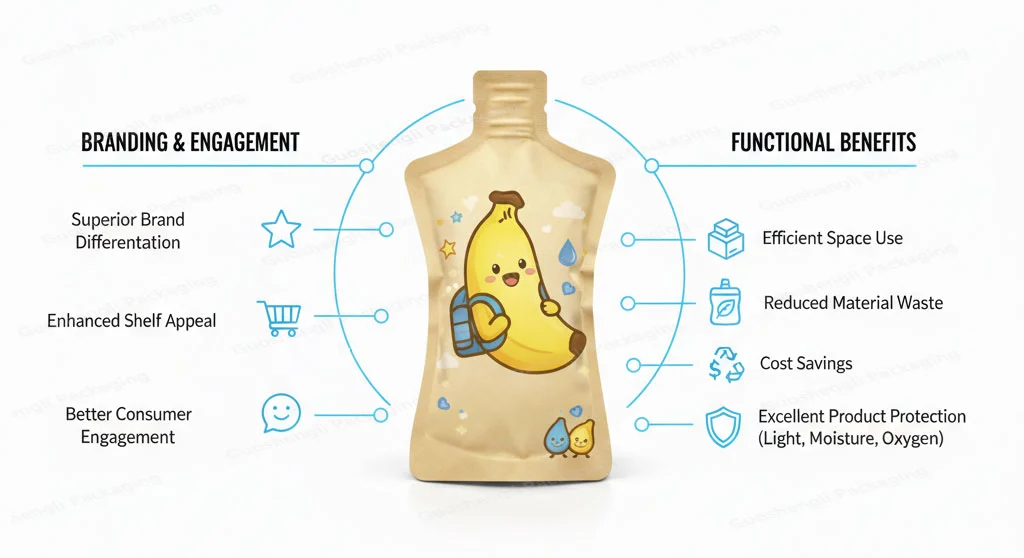
The world of drinks packaging has changed significantly. Standard rigid bottles and conventional flat pouches do not always meet the needs of brands that want distinctive presentation, efficient transport, convenient use, and flexible customization. Bottle shape juice pouches provide an alternative that combines a bottle-inspired appearance with the material efficiency and design flexibility of modern flexible packaging.
What Makes Bottle Shape Juice Pouches Different
Precision die-cutting technology is used to make bottle shape juice pouches that resemble rigid containers while retaining the advantages of flexible laminated packaging. Unlike standard stand-up pouches, these shaped pouches use a customized outline that can help products stand out on crowded retail shelves. The bottle-like shape can also provide a familiar holding area when the dimensions and pouch geometry are properly designed. This design approach helps beverage brands create stronger visual differentiation in competitive retail environments.
The multi-layer composite structure may range from PET/PE for applications with moderate barrier requirements to PET/NY/AL/PE or other high-barrier laminates where stronger oxygen, moisture, aroma, or light protection is required. A properly specified and sealed structure can help protect flavour, colour, and oxygen-sensitive nutrients, but final shelf life depends on the complete product formulation, filling process, thermal treatment, storage conditions, and package integrity. Bottle shape juice pouches can also use substantially less packaging mass than many rigid glass formats, potentially reducing transport weight and empty-package storage volume depending on the complete supply-chain configuration.
Core Advantages for Beverage Brands
One of their strongest advantages is their distinctive retail presentation. Large printable front and back areas allow brands to use bright graphics, product information, and visual storytelling to attract consumers at the point of sale. Up to 11-color rotogravure printing can support detailed graphics and consistent branding for suitable production runs.
Convenience features can also improve product usability. Easy-tear notches can help consumers open selected non-spouted formats without scissors or other tools. Compared with glass bottles, flexible pouches do not shatter, which can make them practical for lunchboxes, outdoor use, travel, and portable beverage applications. Their light weight and compact format can also make them convenient for backpacks, gym bags, and other mobile-use situations when the pouch construction is validated for the intended handling conditions.
Sustainability factors increasingly influence business-to-business and consumer purchasing decisions. Modern bottle-shaped juice pouches may be developed using "Recycle Ready" mono-material PE/PE structures for selected applications. However, barrier, sealing, thermal-process compatibility, filling-line performance, and shelf-life requirements must be validated for the actual product before replacing a conventional multi-material laminate.
Typical Applications Across Market Segments
Premium organic NFC (Not-From-Concentrate) juice brands may use bottle-shaped pouches to create distinctive presentation and communicate freshness or premium positioning. Where required, aluminium-foil or other high-barrier layers can reduce exposure to oxygen and light, which may help protect oxidation-sensitive flavour, colour, and nutrients during storage.
Kids' beverages can also benefit from shaped pouches. Parents may value the lightweight and non-shattering format for school lunches or outdoor activities, while children may respond positively to colourful and easy-to-hold designs. Suitability for children should still consider cap or spout design, pouch dimensions, opening method, and any applicable safety requirements.
Sports nutrition and portable beverages require packaging that can tolerate real handling conditions. Bottle-shaped juice pouches should therefore be validated for drop impact, compression, temperature changes, and internal pressure conditions that may occur during distribution and use. Product quality and package integrity should be confirmed using the actual filled pouch rather than an empty sample alone.
Smoothies and blended drinks present particular filling and flow challenges because of their higher viscosity and possible particulates. Bottle-shaped juice pouches can be designed for these products when the pouch opening, spout, seal system, and filling equipment are properly matched. Selected structures may also be suitable for elevated-temperature filling, but the maximum filling temperature, holding time, laminate, adhesive, sealant, spout system, and thermal process must be validated for the specific application.
Key Criteria to Consider When Choosing a Bottle Shape Juice Pouch
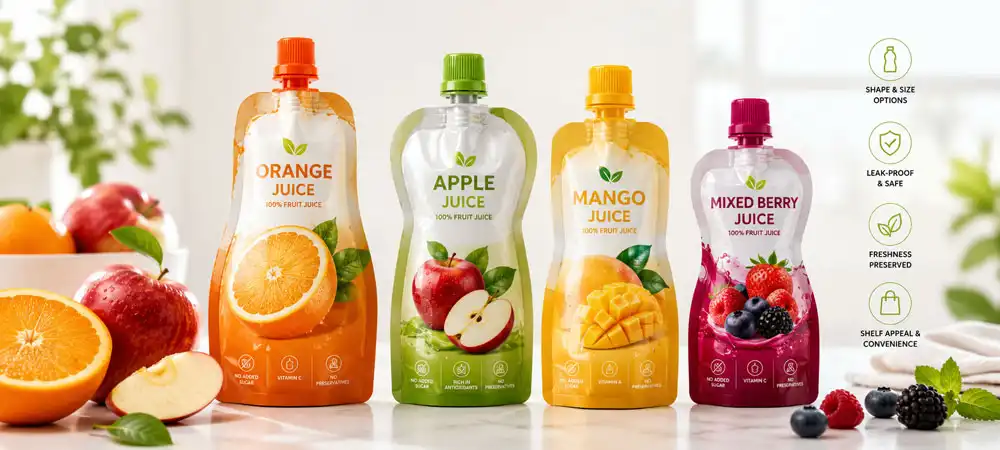
To choose the right packaging option such as a bottle shape juice pouch, buyers need to carefully consider the materials used, how the structure performs, how it will be filled, and how it meets applicable regulatory requirements. Each choice can affect product protection, consumer experience, production efficiency, and long-term brand reliability.
Material Selection and Barrier Performance
Ingredients influence taste, shelf life, colour, aroma, and nutrient stability. PET may be used as an outer layer for printability, dimensional stability, and mechanical performance, while food-contact polyethylene (PE) is often used as a sealant layer because of its heat-sealing properties and suitability for many beverage-contact applications.
For oxygen- or light-sensitive beverages, aluminium foil, metallised films, EVOH, or other barrier technologies may be considered depending on the shelf-life target and processing conditions. Barrier targets should be specified using OTR and WVTR values under defined test conditions rather than by material name alone. Aluminium foil can provide essentially opaque light protection when the foil layer remains intact, while the complete pouch structure should still be evaluated for flex resistance, seal integrity, and distribution performance.
Environmentally conscious brands may also consider selected PLA- or PBAT-based structures where a defined industrial-composting route and appropriate certification are available. These materials should not be assumed to provide the same barrier, sealing, or thermal performance as conventional beverage laminates. Sustainability claims should therefore be supported by appropriate testing, certification, and end-of-life infrastructure.
Structural Design and Functional Features
Choosing spouted or non-spouted layouts is an important design decision. Fitted spouted bottle juice pouches can support controlled pouring, reclosure, and repeated use when the fitment system is properly engineered. Spout retention and seal integrity should be validated using appropriate pull, torque, leak, and handling tests for the intended cap, pouch, and filling process. For aseptic applications, the pouch, fitment, and filling system must also be compatible with the validated sterilization and aseptic process used by the filler.
Simple single-serve designs without spouts may use easy-tear notches for lower-cost applications. The tear notch should be positioned and manufactured so that the pack remains secure during distribution while still opening predictably for the consumer. Poor notch design can contribute to premature tearing or difficult opening.
Seal width, seal temperature, pressure, dwell time, material compatibility, and quality control all affect leak resistance. With bottle-shaped juice pouches, manufacturers should use appropriate package-integrity testing for the die-cut profile and sealing geometry. Leak, burst, pressure-based, or other validated test methods may be used depending on the application. Burst testing can help assess package and seal strength, but distribution performance should also be validated through suitable filled-pack compression, drop, and transport testing.
Different consumers and use occasions may require different pack sizes. Single-serve formats such as 150–250 ml can suit children and on-the-go beverages, while larger 500–1000 ml formats may be suitable for selected multi-serve products when the pouch is designed for the required weight, handling, and reclosure needs. Custom die-cutting allows brands to develop simple bottle shapes or more distinctive outlines, although extreme shapes should still be evaluated for filling efficiency, seal geometry, and handling performance.
Regulatory Compliance and Certification Requirements
International food-contact requirements require appropriate material documentation, migration testing, and traceability. For products intended for the United States, food-contact layers and components should comply with applicable FDA requirements for their intended conditions of use. For products intended for the EU market, plastic food-contact layers should be assessed against Regulation (EU) No 10/2011 where applicable, together with the broader EU food-contact materials framework and relevant migration requirements.
BRCGS Packaging Materials certification can demonstrate that a packaging manufacturing site operates against recognized requirements covering product safety, quality, legality, and operational controls. Procurement managers can use certifications such as BRCGS Packaging Materials as part of a wider supplier-evaluation process that also reviews food-contact documentation, process controls, testing capability, and traceability.
Organizations with ISO 9001 quality management certification use structured quality-management processes intended to support consistent production and continual improvement. For growing brands and export programmes, repeatable quality controls and documented specifications are important for maintaining batch-to-batch consistency.
Independent SGS or similar third-party laboratory testing can support verification of material composition, migration, barrier, seal, or other agreed performance requirements. The required records should be defined by the product, target market, customer specification, and regulatory framework rather than assuming that one generic test report covers every application.
Comparing Different Bottle Shape Juice Pouch Options in the Market
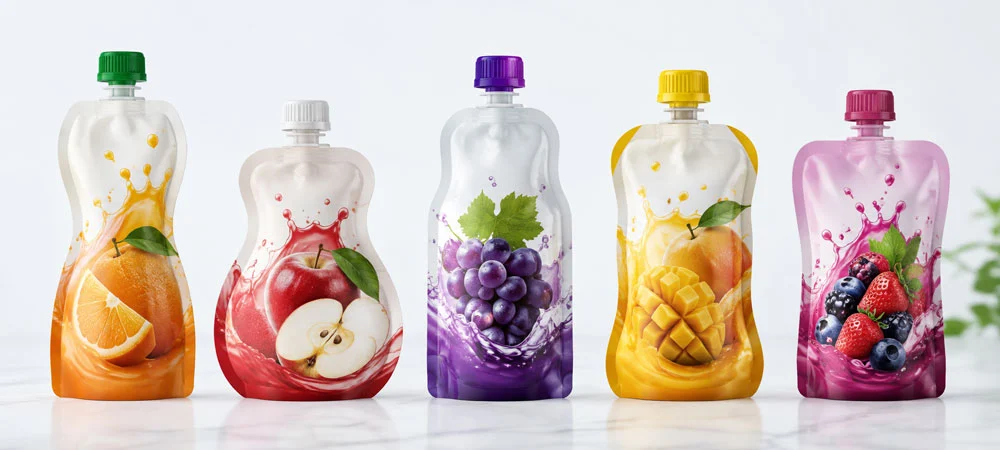
When buying teams understand how different packaging options perform, they can make better decisions that balance cost, functionality, visual impact, production efficiency, and strategic requirements.
Cost Efficiency Analysis
Bottle shape juice pouches can provide an efficient packaging option compared with some rigid formats, but the actual commercial advantage depends on the application. Glass bottles can involve higher package weight and breakage risk, while rigid PET bottles may require additional storage space and dedicated bottle-forming or sourcing arrangements. Carton systems and other rigid or semi-rigid formats may also involve specialized filling and equipment requirements.
Compared with many rigid alternatives, flexible bottle shape juice pouches can use less packaging mass and occupy less space before filling. Their lighter weight and compact unfilled format may reduce storage and transport costs, although actual savings depend on the filled product weight, carton utilization, pallet configuration, transport route, and distribution model.
Production lead times depend on the printing method, material structure, die-cutting requirements, artwork, and production schedule. Digital printing can support lower-volume launches, multiple SKUs, and market testing without conventional printing cylinders. Rotogravure printing requires cylinder preparation but is generally more suitable for larger-volume repeat production where high print consistency and efficient unit economics are important. The commercial break-even point depends on pouch dimensions, artwork, number of designs, tooling, and production volume rather than a single fixed quantity.
Evaluating Manufacturer Capabilities
Production capability affects a supplier's ability to support brand growth. Integrated printing, laminating, slitting, and converting equipment can help manufacturers manage large and repeat orders more consistently. Guoshengli Packaging operates multiple pouch-making machines together with seven printing machines and six laminating machines to support flexible packaging production across different formats.
Strategic suppliers can provide more than transactional production. Manufacturers with die-cutting and pouch-development capabilities can help brands develop bottle-shaped formats from design through sampling and production. Rotogravure printing with up to 11 colours can support detailed graphics and consistent brand presentation for suitable production runs.
MOQ requirements affect inventory and cash flow. Depending on pouch size, material structure, die-cut tooling, number of designs, and printing method, lower-volume projects may be possible through digital printing or selected production routes. Established bottle shape designs can also reduce some tooling and development requirements for new projects.
Expert filling-line coordination can reduce expensive production delays. Production teams should confirm compatibility with the actual premade-pouch filling, spout-filling, capping, or rotary filling equipment, including pouch dimensions, opening method, fitment position, sealing conditions, and handling sequence. Automated trials should verify pouch feeding, opening, positioning, filling, sealing, and discharge stability on the intended equipment.
Private Label and Customization Options
Private-label solutions can help brands enter new markets more efficiently when an existing validated bottle shape can be adapted to the new product. Using an established pouch shape can reduce tooling and development work, although artwork, material structure, food-contact requirements, and filling compatibility still need to be confirmed for each project.
Full customization programmes help brands differentiate through distinctive shapes, graphics, finishes, spouts, and functional details. Collaborative development should consider consumer use, technical feasibility, filling-line requirements, and production constraints. Prototypes and samples can be used to evaluate design concepts before committing to full production tooling, reducing development risk and helping confirm alignment with the intended brand presentation.
Procurement Best Practices and How to Find the Right Supplier
Strategic sourcing means evaluating a supplier's manufacturing capability, quality systems, compliance support, technical expertise, and long-term partnership potential in a structured way.
Identifying and Verifying Reliable Suppliers
Supplier evaluation should begin with relevant credentials and supporting documentation. Check ISO 9001 and BRCGS Packaging Materials certificates for validity and scope, and review applicable food-contact declarations, migration reports, or third-party laboratory testing where required. FDA should be treated as a regulatory compliance framework for applicable food-contact materials rather than as a general manufacturer certification.
Production facility inspections can provide useful information about manufacturing capability, quality control, housekeeping, personnel practices, and material handling. Buyers can review equipment, traceability, process controls, laboratory capability, and the consistency of sample and production runs.
Customer references or case examples may also help demonstrate supplier performance where customer confidentiality allows. Buyers can ask about experience with similar beverage applications, export markets, repeat-order consistency, delivery reliability, technical response, and the ability to scale production.
Sample requests are essential for validation. Order samples that reflect the intended material, size, printing, spout, and use conditions as closely as possible. Check seal integrity, barrier requirements, pouch dimensions, handling, and filling-equipment compatibility. Share samples with fillers or co-packers early so that machine and process requirements can be confirmed before production.
Negotiation Strategies and Contract Terms
Price varies according to order quantity, material structure, tooling, printing method, and order frequency. Larger repeat orders may improve unit economics and production planning, but the total cost of ownership should also consider freight, inventory, storage, tooling, waste, and the cost of non-conforming packaging.
Lead times should include artwork approval, cylinder or tooling preparation where applicable, material availability, printing, laminating, curing, converting, inspection, and production scheduling. Digital printing can support faster short-run development for selected projects, while rotogravure is generally used for larger repeat programmes.
Quality requirements should be defined as part of the purchasing specification. Where relevant, buyers may specify OTR, WVTR, seal strength, dimensions, tolerances, printing requirements, fitment performance, and package-integrity testing. Sampling plans, acceptance criteria, and procedures for handling non-conforming material should also be agreed in advance.
Logistics planning can help control supply and freight costs. Ocean freight can be economical for planned replenishment, while air freight may be used for urgent requirements when commercially justified. Actual transit time depends on origin, destination, carrier, customs clearance, and delivery terms, so logistics planning should use realistic route-specific information.
After-sales service can help distinguish strategic suppliers from transactional ones. Clear communication channels, response expectations, technical support, and structured corrective-action processes can reduce disruption when issues occur. Regular review of production, quality, and forecasting can also support more stable long-term cooperation.
Sustainable Sourcing Considerations
Manufacturers can support environmental management through documented systems, process controls, waste reduction, and emissions management. Where ISO 14001 certification is relevant, buyers can verify the current certificate and its scope. Printing and laminating processes may generate VOC emissions, and properly designed RTO systems can capture and thermally oxidize VOCs according to the equipment design, operating conditions, and applicable environmental requirements.
Packaging recyclability can also support corporate environmental objectives when the complete structure and local infrastructure are considered. Mono-material PE/PE designs may improve compatibility with suitable mechanical recycling systems for selected applications, but recyclability depends on the full structure, barrier layers, inks, adhesives, fitments, labels, and the target-market recycling system. Where environmental comparisons are important, a product-specific life-cycle assessment can provide a stronger basis for evaluating sourcing, manufacturing, distribution, use, and end-of-life impacts.
Companies increasingly focus on carbon reduction because of customer, investor, and regulatory expectations. Lightweight flexible juice pouches may reduce packaging mass and transport weight compared with some rigid formats, but actual emissions benefits should be evaluated using the complete supply chain. Buyers can also consider suppliers' energy efficiency, waste reduction, emissions management, and renewable-energy use where relevant.
Conclusion
Choosing the right bottle shape juice pouch requires more than selecting an attractive shape. Buyers should evaluate the beverage formulation, target shelf life, filling and thermal process, pouch or spout configuration, barrier structure, seal system, filling-equipment compatibility, and applicable food-contact requirements. These factors determine whether the package can perform reliably through production, storage, distribution, and consumer use.
Recyclable or lower-material structures can support sustainability objectives for selected applications, but they should be validated against barrier, sealing, mechanical, and shelf-life requirements before replacing conventional laminates. Environmental claims should also reflect the complete package and the actual collection, sorting, recycling, or other end-of-life route available in the target market.
Companies seeking long-term supply should evaluate manufacturers based on technical capability, quality systems, food-contact documentation, production consistency, testing support, and responsive communication. A well-specified bottle shape juice pouch should balance product protection, filling-line performance, brand differentiation, commercial cost, and sustainability goals rather than optimizing only one factor.
FAQ
1. What materials provide the best barrier protection for bottle shape juice pouches?
High-barrier structures may use aluminium foil, metallised films, EVOH, or other barrier technologies depending on the juice, filling process, and shelf-life target. PET can contribute printability and dimensional stability, PA may be selected where additional toughness or puncture resistance is required, and PE or CPP may serve as heat-seal layers. Barrier performance should be specified through OTR and WVTR values under defined test conditions rather than relying on material names or universal threshold values. Mono-material PE/PE structures may be suitable for selected applications, but their barrier, thermal, sealing, and shelf-life performance should be validated against the actual product and process.
2. How can I ensure leak-proof performance in bottle-shaped juice pouches?
Reliable leak performance depends on the laminate, seal geometry, pouch shape, fitment system, filling process, and quality controls. For each structure, seal temperature, pressure, dwell time, and seal width should be optimized and validated. Manufacturers should use appropriate package-integrity methods such as leak, burst, pressure-based, or other suitable testing according to the pouch design. For spouted formats, pull, torque, fitment-seal, and handling tests can help confirm retention performance. Buyers should request a defined quality-control plan and validate the actual filled pouch under representative distribution conditions.
3. What are typical minimum order quantities for custom-printed bottle shape juice pouches?
Minimum order quantities depend on pouch dimensions, die-cut tooling, material structure, number of designs, printing method, and required features. Digital printing can support lower-volume market tests, multiple SKUs, and selected limited-edition projects because conventional printing cylinders are not required. Rotogravure is generally more suitable for larger-volume production, although the commercial break-even point varies by artwork, pouch size, number of colours, and cylinder cost. Manufacturers with suitable equipment can recommend the most practical production route based on the project rather than applying one fixed MOQ to every bottle shape juice pouch.
Partner with a Trusted Bottle Shape Juice Pouch Manufacturer
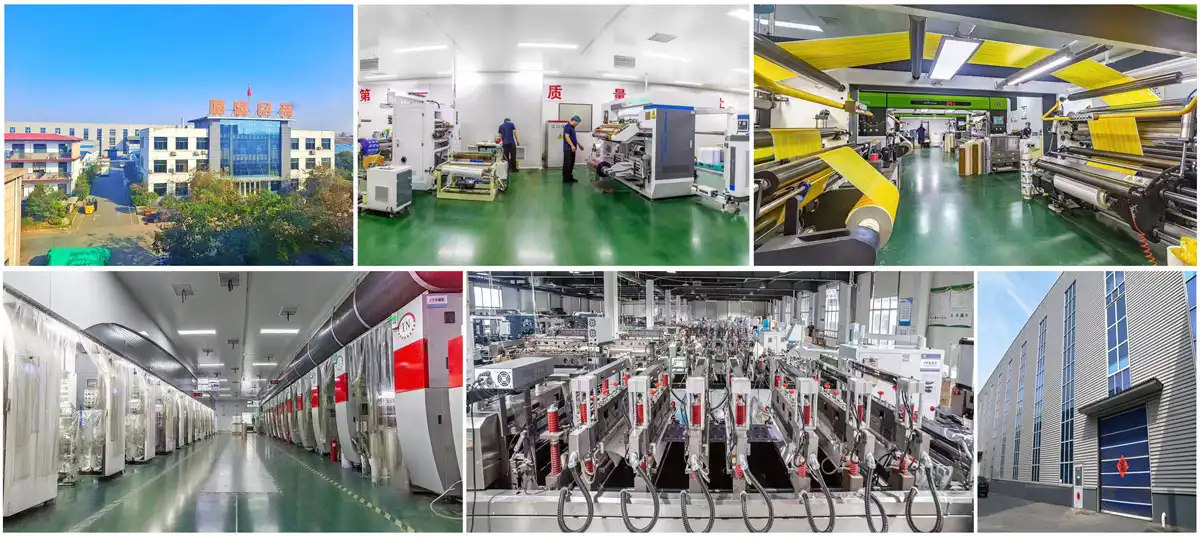
Guoshengli Packaging brings more than 25 years of experience in flexible packaging and works with beverage brands that need reliable bottle shape juice pouch solutions. Our quality systems include ISO 9001 and BRCGS Packaging Materials certification together with food-contact compliance documentation and third-party testing support for applicable target markets. Our production capabilities include seven printing machines and rotogravure printing in up to 11 colours, supporting detailed graphics and consistent branding across suitable production runs.
MOQ and lead time depend on pouch dimensions, material structure, die-cut requirements, printing method, number of designs, and functional features. Digital printing can support selected lower-volume projects and faster artwork changes, while rotogravure is suitable for larger repeat programmes. Recyclable material options can also be evaluated where they meet the required product protection, filling, sealing, and end-of-life criteria.
Get in touch with our technical team at sales@guoshengpacking.com to request samples, discuss customization options, and evaluate how our experience as a bottle shape juice pouch supplier can support your product. We can help review pouch structure, material selection, printing, fitment requirements, filling compatibility, and sampling before full production.
References
-
Robertson, G. L. (2016). Food Packaging: Principles and Practice (3rd ed.). CRC Press.
-
Marsh, K., & Bugusu, B. (2007). Food packaging—roles, materials, and environmental issues. Journal of Food Science, 72(3), R39–R55.
-
Yam, K. L. (Ed.). (2009). The Wiley Encyclopedia of Packaging Technology (3rd ed.). John Wiley & Sons.
-
Coles, R., McDowell, D., & Kirwan, M. J. (Eds.). (2003). Food Packaging Technology. Blackwell Publishing.
-
Brody, A. L., & Marsh, K. S. (Eds.). (1997). The Wiley Encyclopedia of Packaging Technology (2nd ed.). John Wiley & Sons.
-
Soroka, W. (2009). Fundamentals of Packaging Technology (4th ed.). Institute of Packaging Professionals.