- English
- French
- German
- Portuguese
- Spanish
- Russian
- Japanese
- Korean
- Arabic
- Greek
- German
- Turkish
- Italian
- Danish
- Romanian
- Indonesian
- Czech
- Afrikaans
- Swedish
- Polish
- Basque
- Catalan
- Esperanto
- Hindi
- Lao
- Albanian
- Amharic
- Armenian
- Azerbaijani
- Belarusian
- Bengali
- Bosnian
- Bulgarian
- Cebuano
- Chichewa
- Corsican
- Croatian
- Dutch
- Estonian
- Filipino
- Finnish
- Frisian
- Galician
- Georgian
- Gujarati
- Haitian
- Hausa
- Hawaiian
- Hebrew
- Hmong
- Hungarian
- Icelandic
- Igbo
- Javanese
- Kannada
- Kazakh
- Khmer
- Kurdish
- Kyrgyz
- Latin
- Latvian
- Lithuanian
- Luxembou..
- Macedonian
- Malagasy
- Malay
- Malayalam
- Maltese
- Maori
- Marathi
- Mongolian
- Burmese
- Nepali
- Norwegian
- Pashto
- Persian
- Punjabi
- Serbian
- Sesotho
- Sinhala
- Slovak
- Slovenian
- Somali
- Samoan
- Scots Gaelic
- Shona
- Sindhi
- Sundanese
- Swahili
- Tajik
- Tamil
- Telugu
- Thai
- Ukrainian
- Urdu
- Uzbek
- Vietnamese
- Welsh
- Xhosa
- Yiddish
- Yoruba
- Zulu

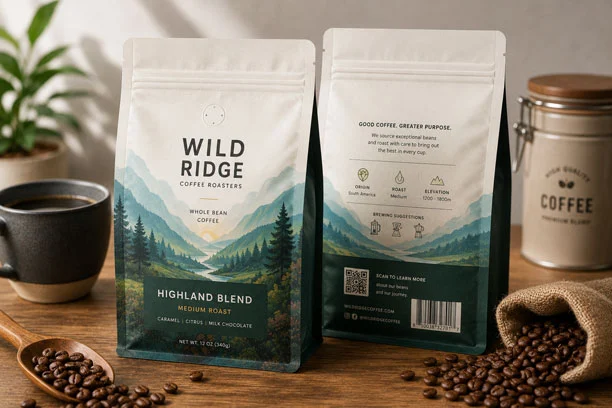
Specialty coffee roasters face a persistent dilemma: how to launch seasonal blends without committing to massive print runs or paying thousands in plate costs. Custom printed coffee pouches solve this by enabling brands to produce small batches with vivid, high-resolution graphics. Coffee pouch digital printing has transformed how micro-roasters and subscription brands approach packaging—delivering photo-quality artwork at resolutions exceeding 1200 dpi, with flexible MOQs starting at just 500 pieces and turnaround times of 7–10 working days. This guide explores how digital printing technology empowers coffee brands to test markets faster, reduce inventory risk, and maintain premium shelf presence.
Understanding Coffee Pouch Digital Printing: A Complete Overview
What Is Coffee Pouch Digital Printing?
Coffee pouch digital printing is a cutting-edge industrial technique that uses inkjet or electrographic technology to copy digital image files directly onto flexible packing substrates, removing the need for traditional printing plates. Digital printing lets you make things whenever you need them, while gravure and flexographic methods need expensive tubes that cost much and MOQs that are usually higher than 10,000 units. There are some big problems that specialty roasters have that this technology fixes. These problems include high setup costs, fixed order amounts, and slow response times for seasonal starts. By getting rid of mechanical plate-making, brands can run short production cycles, efficiently manage portfolios with multiple SKUs, and add variable data like batch numbers, roast dates, and traceability QR codes—all while keeping the high-barrier protection needed to protect volatile aromatic compounds.
How Digital Printing Differs from Traditional Methods
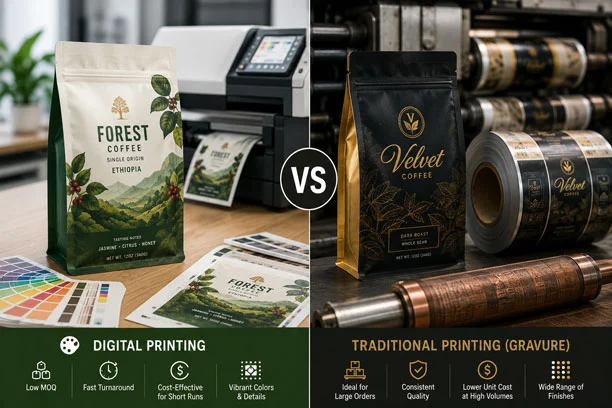
Rotogravure and flexography are two old ways of printing that work on the principle of economies of scale. Gravure printing is very consistent and reproduces colors very well, but you have to do a lot of work with it before you can afford to buy a cylinder. Flexo printing is somewhat flexible, but it has trouble with fine details and gradients that aren't smooth. Digital printing changes this by letting different content be used in the same production batch. Labels can print more than one SKU design at the same time without having to pay a lot of money for changes. Print sizes can go up to 1200 dpi, and colors can be accurate up to 97% of the Pantone range. This means that text is clear, gradients are smooth, and images look like photos. Modern inkjet presses can work with a wide range of materials, such as matte PET, shiny finishes, kraft paper, and even recyclable films. This gives artists more freedom to be creative than they had before in short-run situations.
The Digital Printing Process and Technology
The process starts with digital art files that are exactly what is needed. After proofreading, food-safe inks are put directly on multi-layer laminate films by special inkjet or HP Indigo presses. These inks stick strongly to primers or get stuck between protective layers during lamination, so they don't come into touch with the closing bars when the pouch is converted. The printing film is laminated to join the barrier, outer, and inner layers. This makes structures like PET/AL/PE or recyclable mono-PE ones. The material is laminated and then sent to machines that make pouches, where it is die-cut, sealed, and given useful features like tear notches, hang holes, and zippers that can be closed again. As part of quality control, spectrophotometric color checks (Delta E < 2.0), ink migration tests, rub and scratch resistance tests, and seal integrity checks are done on every pouch to make sure it meets strict standards for food safety and performance.
Digital Printing vs Traditional Printing: Making the Right Choice for Your Coffee Packaging
Limitations of Traditional Printing Methods
Gravure and flexo printing are rigid methods that make it hard to be flexible. When MOQs are high, brands are locked into stocking amounts that may be higher than what people want, especially for limited-edition or trial mixes. Plate costs add a big upfront cost that makes design changes and seasonal changes less likely. Lead times range from 4 to 6 weeks from acceptance of artwork to delivery, which makes it hard to respond quickly to the market. Design restrictions make it even harder to be creative: fine gradients, photographic details, and complex patterns often need more color stations, which drives up costs. These barriers hurt micro-roasters, subscription services, and private-label producers the most, since they need to offer a wide range of products and be quick to respond.
Advantages of Digital Printing for Coffee Brands
Coffee pouch digital printing gets rid of these problems by letting you make things without using plates. Brands can test out new blends without having to spend a lot of money by ordering as few as 500 pouches of each design. Time-to-market is sped up during busy times by cutting turnaround times to 7–10 working days. With variable data printing, each pouch can show different information, like batch numbers, roast profiles, or personalized messages. This makes it easier to track food and keeps customers interested. With multi-SKU, roasters can make different origin coffees, flavor profiles, or subscription tiers in the same production run. This makes logistics easier and cuts down on the cost of storage. The color accuracy is the same as or better than with traditional methods, and the CMYK plus extended gamut options make the products look bright and ready to sell.
Cost Analysis and Turnaround Time Comparison
With traditional ways, the cost per unit is cheaper when a lot of them are made. Usually, it's cost-effective to make more than 50,000 units. This equation is turned upside down by digital printing, which gets rid of the plate costs and setup fees, making small batches affordable. Brands save between $500 and $1,200 per design version, which they can then use to fund product development or marketing. When brands make less than 10,000 units of each SKU, digital printing gives them a better return on investment (ROI). This includes inventory keeping costs, failure risk, and speed-to-market benefits. Speed of turnaround increases worth even more. For example, releasing a limited-edition holiday mix in 10 days instead of six weeks can take advantage of seasonal demand spikes and bring in extra money.
Selecting the Best Materials and Designs for Digitally Printed Coffee Pouches
Compatible Films and Laminates
Choice of material has a direct effect on the quality of the print and the shelf life. Coffee pouch digital printing works best on surfaces that are smooth and uniform. Outer layers like PET or matte PET help the ink stick well and produce high-resolution images. Aluminum foil, metalized PET, EVOH, or nylon make up the middle barrier layers. These keep air and wetness out, keeping the coffee fresh for months. The PE or CPP sealant layers inside make sure that the food is safe to touch and that the heat seals well. Brands that care about the environment can use recyclable PE structures or PLA/PBAT films that can be broken down naturally to keep their barrier properties and help them reach their sustainability goals. The tactile finish is different depending on the material used. Glossy surfaces make colors stand out, while matte and soft-touch finishes give products a high-end, handmade look.
Creative Design Possibilities and Print Resolution
Digital printing with a high resolution lets you be more artistic than with older ways. Brands can show off photos of the coffee beans' origins, hand-drawn artwork, or elaborate hand-drawn pictures that look like photos. With variable data printing, QR codes that lead to roast profiles, brewing guides, or farm stories can be printed on a lot of packages to make them more unique. Subscription brands can put order numbers or customer names, which makes the relationship more personal. Print quality has a direct effect on how people think about a brand. At 1200 dpi, text stays clear, gradients look smooth, and small details show skill. This level of fidelity is very important in competitive retail settings where the appearance on the shelf affects decisions about what to buy.
Sustainability Trends and Eco-Friendly Options
Sourcing priorities change when customers want eco-friendly packaging. Digital printing helps the environment by cutting down on trash and allowing production to happen only when it's needed, which means less inventory and material use. Mono-PE laminates that can be recycled make it easier to recycle at the end of their useful life. Food safety rules are very strict, but low-migration inks and water-based pigments meet those rules without hurting the environment. Sustainability certificates and recycling directions can be displayed clearly on packages, which is in line with larger corporate responsibility promises and helps brands stand out in crowded markets.
Procuring Digital Printed Coffee Pouch Services: What B2B Buyers Should Know
Minimum Order Quantities and Pricing Structures
The appeal of coffee pouch digital printing lies in its flexible MOQs. With as few as 500 pieces of each design, brands can quickly test markets, see how customers react, and make changes. Pricing structures usually use tiered models, where unit costs go down as volume goes up. This allows for growth without making it too hard to get started. Clear pricing that includes film, printing, lamination, bag conversion, and useful add-ons helps you stick to your budget. To find the best solutions, procurement teams should get detailed quotes that compare digital and traditional methods for the expected annual volumes, taking into account storage costs and how often designs change.
Identifying Reputable Suppliers
To choose a skilled provider, you need to look at their technical skills and how reliable they are in their operations. Key factors include having the right certifications (ISO 9001, BRC, and FDA compliance), being able to produce a lot of goods, and having experience exporting. End-to-end control is provided by suppliers with modern digital presses (HP Indigo, high-speed inkjet systems) and their own conversion equipment. This lowers the risk of coordination. By looking at example portfolios, you can judge the print quality, color uniformity, and precision of the finishing. Performance claims are backed up by examples from names on the same size. Professional partners can be told apart from transactional vendors by their responsive communication, which includes clear technical advice, problem-solving that is proactive, and regular updates.
Logistics and Production Timelines
Knowing how production works makes planning more accurate. It usually takes 7–10 working days to complete everything from approval of the artwork to finished bags. Rush orders may cost more, but they can give you an edge when a new product comes out. When planning logistics, things to think about are the incoterms (FOB, CIF, DDP), the shipping method (air for speed, ocean for cost-effectiveness), and the customs paperwork. Buyers should get clear on lead times, production capacity during busy times, and backup plans to keep the supply chain running smoothly.
Overcoming Challenges and Ensuring Quality in Coffee Pouch Digital Printing
Common Technical Challenges and Solutions
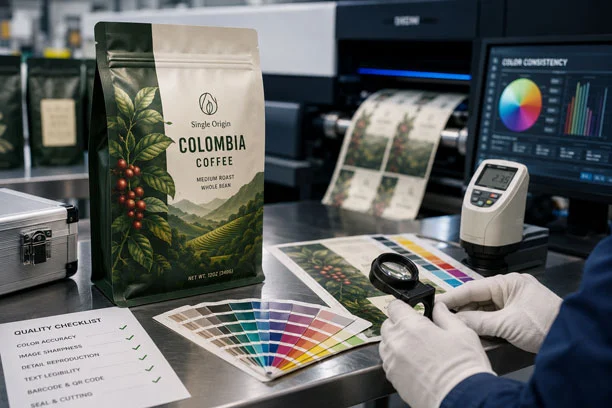
Even though technology has improved, digital printing has its own problems. Print registration mistakes happen when more than one layer is not lined up correctly, which makes pictures blurry or colors overlap. If you prepare your files and press correctly before printing, this risk is kept to a minimum. Different substrates or ink formulations can cause color differences. Spectrophotometric tracking makes sure that Delta E values stay below 2.0 across all runs. Problems with substrate compatibility, like ink not sticking or delamination, are caused by primers or lamination parameters that are not right. Failures that cost a lot of money can be avoided by working with skilled sources who test materials and make sure processes work.
Quality Control Measures and Inspection Processes
Strict quality control protects the reputation of a brand. Before full production, sampling methods check the accuracy of the artwork, the consistency of the colors, and the functionality of the product. Proofing stages let buyers approve physical samples, which makes sure that the printed pouches live up to their standards. During production, in-line review includes checking for print flaws visually, testing the stability of the seals automatically, and making sure the dimensions are correct. Post-production audits check the resistance to scratches and rubs (using Sutherland Rub Tests), the coefficient of friction (to make sure the filling line works smoothly), and the sealing integrity of the degassing valve. Traceability systems connect each batch to its raw materials, production dates, and inspection records. This lets problems be fixed quickly and quality kept rising.
Real-World Case Studies and Success Stories
When specialty roasters release limited-edition single-origin coffees, they use coffee pouch digital printing to make 1,000 to 2,000 pouches per release. This way, they can change their offers every three months without having to keep a lot of stock on hand. Variable data printing is used by subscription brands to personalize monthly shipments by printing customer names and personalized brewing tips. This keeps customers interested and helps them stay with the brand. Multiple retail clients are served at the same time by private-label manufacturers, who make different SKU designs in consolidated production runs that cut down on setup time and cost. These uses show how flexible digital printing is, letting brands adapt quickly to changes in the market, customer tastes, and competition pressures while still keeping high quality standards.
Conclusion
Custom-printed coffee pouches have changed how specialty brands buy packaging. Coffee pouch digital printing gives you freedom, speed, and quality that you couldn't get with older methods. It gets rid of the need for expensive plates, lowers the minimum order quantity to 500 pieces, and shortens the lead time to 7–10 days. Brands can be more creative, try markets with confidence, and make sure that their product fits with their goals for sustainability. New materials help with high-barrier security and eco-friendly options, and strict quality control makes sure that everything works the same way every time. Digital printing helps coffee brands stay flexible, cost-effective, and visually appealing in competitive markets, whether they're releasing seasonal blends, running subscription services, or making private-label products.
FAQ
1.How does coffee pouch digital printing compare to rotogravure in print quality?
At this point, coffee pouch digital printing is just as good as or better than gravure when it comes to detail and accuracy, especially when it comes to curves and photos. Gravure is still the most cost-effective option for runs over 50,000 units, but digital printing gives you the same vivid colors and sharp images at lower numbers without losing barrier performance or food safety compliance.
2.Are the inks used in coffee pouch digital printing safe for direct food contact?
Yes, as long as the inks are low migration and meet the standards set by Nestle Guidance or Swiss Ordinance. They should also be covered by a functional barrier layer. Reputable providers test for movement to make sure that no harmful substances get through the inner protection layer. This keeps the food safe throughout its shelf life.
3.Can I use sustainable materials with coffee pouch digital printing?
Of course. Digital printing works perfectly with PLA/PBAT films that can be broken down in a trash pile and reusable PE laminates made of a single material. These structures keep their ability to block oxygen and moisture while also being good for the environment. This way, brands can meet customer demands for eco-friendly packing without sacrificing product safety.
4.Will the digital ink peel off during the heat-sealing process?
Not at all. When you print high-quality coffee pouches digitally, you use primers or lamination methods that keep the ink between protective layers and away from the sealing bars. If you choose the right materials and keep an eye on the process, the ink will stick even when the pouch is being changed, filled, and sent out.
Partner with Guoshengli Packaging for Your Coffee Pouch Digital Printing Needs
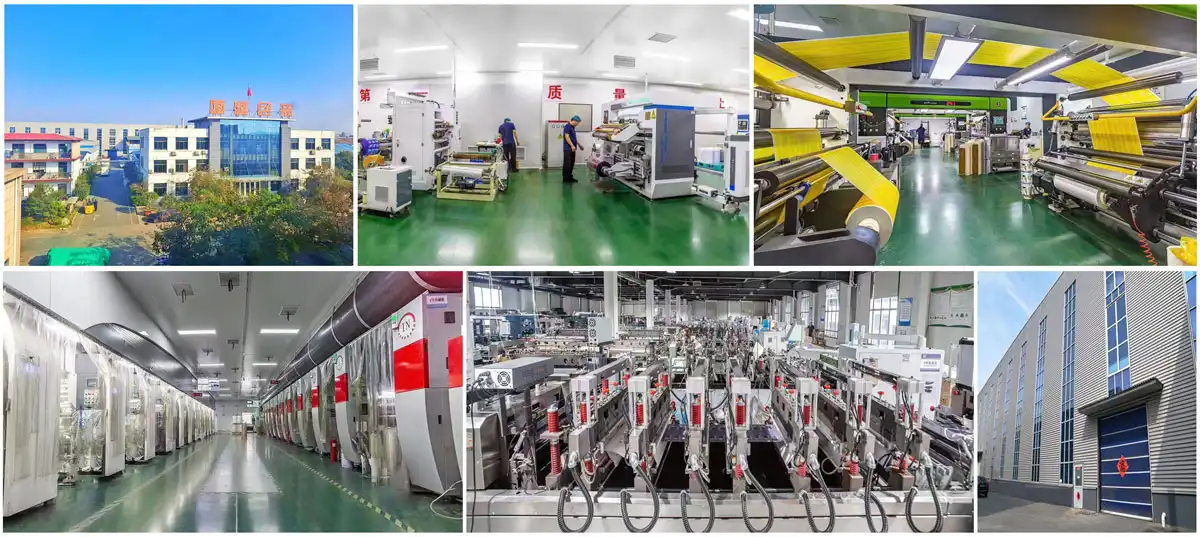
Packaging partners that understand the needs of low-MOQ, high-variety production are important for specialty roasters and subscription brands. Guoshengli Packaging is a reliable company that makes coffee pouch digital printing solutions. They offer unique solutions for small-batch roasters, brands with multiple SKUs, and private-label makers. We've been experts in flexible packaging for more than 25 years, so we don't have to follow the rules of traditional printing. Our minimum order quantities (MOQs) start at 500 pieces, and we offer free plate costs and 7–10 day turnaround times. Our facility is ISO 9001, BRC, and FDA-certified, and it uses high-tech digital presses with a resolution of 1200 dpi and 97% Pantone color accuracy to make sure that your brand artwork turns into high-quality products that are ready to be put on shelves. Whether you need flat-bottom bags with degassing valves, zippers that can be closed again to keep food fresh, or variable data printing to make sure that products can be tracked, our team is here to help you from the design meeting to the final delivery. Email us at sales@guoshengpacking.com right now to talk about how our digital printing services for coffee pouches can help you start your products faster, lower the risk of running out of stock, and improve your brand's visibility.
References
1. Smith, J. & Thompson, R. (2022). Flexible Packaging Innovations in the Specialty Coffee Industry. Journal of Food Packaging Technology, 18(3), 145-162.
2. Anderson, L. (2023). Digital Printing Technologies for Small-Batch Food Products. Packaging World Press, New York.
3. Martinez, C., Lee, S., & Patel, N. (2021). Sustainable Barrier Films for Coffee Preservation: A Comparative Study. International Journal of Food Science & Technology, 56(8), 3892-3905.
4. Wilson, K. (2023). The Economics of Low-MOQ Packaging for Emerging Coffee Brands. Coffee Business Journal, 12(2), 78-91.
5. Chen, H. & Roberts, D. (2022). Quality Control Standards in Digital Flexible Packaging Manufacturing. Packaging Engineering Quarterly, 29(4), 210-228.
6. Green, P., Foster, M., & Kumar, A. (2023). Consumer Perception of Packaging Quality in Premium Coffee Markets. Journal of Consumer Marketing, 40(1), 56-70.