- English
- French
- German
- Portuguese
- Spanish
- Russian
- Japanese
- Korean
- Arabic
- Greek
- German
- Turkish
- Italian
- Danish
- Romanian
- Indonesian
- Czech
- Afrikaans
- Swedish
- Polish
- Basque
- Catalan
- Esperanto
- Hindi
- Lao
- Albanian
- Amharic
- Armenian
- Azerbaijani
- Belarusian
- Bengali
- Bosnian
- Bulgarian
- Cebuano
- Chichewa
- Corsican
- Croatian
- Dutch
- Estonian
- Filipino
- Finnish
- Frisian
- Galician
- Georgian
- Gujarati
- Haitian
- Hausa
- Hawaiian
- Hebrew
- Hmong
- Hungarian
- Icelandic
- Igbo
- Javanese
- Kannada
- Kazakh
- Khmer
- Kurdish
- Kyrgyz
- Latin
- Latvian
- Lithuanian
- Luxembou..
- Macedonian
- Malagasy
- Malay
- Malayalam
- Maltese
- Maori
- Marathi
- Mongolian
- Burmese
- Nepali
- Norwegian
- Pashto
- Persian
- Punjabi
- Serbian
- Sesotho
- Sinhala
- Slovak
- Slovenian
- Somali
- Samoan
- Scots Gaelic
- Shona
- Sindhi
- Sundanese
- Swahili
- Tajik
- Tamil
- Telugu
- Thai
- Ukrainian
- Urdu
- Uzbek
- Vietnamese
- Welsh
- Xhosa
- Yiddish
- Yoruba
- Zulu

Choosing between Three Side Sealed and fin-sealed pouches can significantly impact your product presentation, filling efficiency, material use, and overall packaging costs. A fin seal pouch uses a longitudinal back seal where the inner sealant surfaces bond together, typically forming a raised "fin" on the back of a pillow-style pack. Three Side Sealed pouches, by contrast, are flat pouches with three sides sealed during converting and one side left open for filling before the final seal is made. Both formats serve important roles in B2B packaging, yet understanding their core differences helps procurement managers select the option that best aligns with product requirements, filling line compatibility, and market expectations.
Introduction
Flexible packaging impacts shelf life, production speed, shipping costs, and brand impression in today's competitive B2B market. Procurement managers, OEMs, and packaging buyers are working to protect products, control costs, meet regulatory requirements, and respond to sustainability expectations. Two common packaging formats are Three Side Sealed and fin-seal pouches. Each has advantages depending on the product, filling equipment, material structure, and market.
Buying teams can compare pouch construction, function, and pricing using this guidance. We examine seal placement, barrier requirements, customisation options, and total cost of ownership. Understanding these factors can help buyers reduce supply chain risks, improve product presentation, and make more informed decisions. This comparison will help you evaluate suitable packaging for snacks, pet treats, vitamins, household products, and other applications based on actual product and production requirements.
Understanding Three Side Sealed and Fin-Sealed Pouches
What Is a Three Side Sealed Pouch?
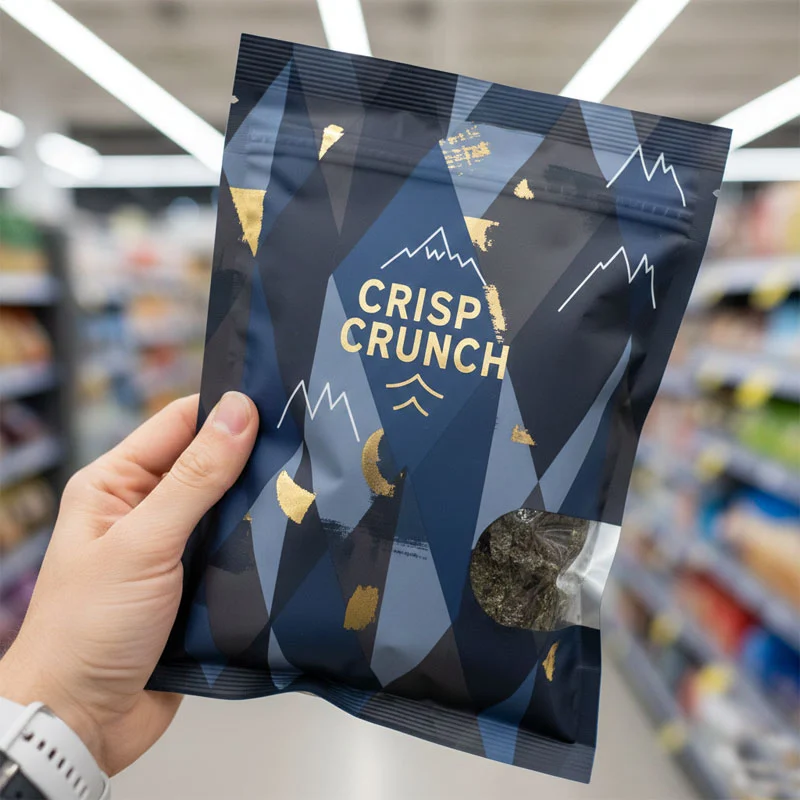
A Three Side Sealed pouch is a flat pouch with three sides sealed during pouch converting and one side left open for filling. After the product is filled, the remaining opening is heat sealed. Depending on the manufacturing method, the pouch may be produced from a folded film web or from separate film webs. This arrangement creates a flat, clean profile that works well for products requiring a uniform presentation and clearly defined front and back artwork areas. Three Side Sealed bags are often used in cosmetics, pharmaceuticals, food products, and other applications where compact packaging and shelf presentation are important. The structure also makes it possible to add features such as tear notches, euro holes, and selected resealable closures.
To achieve the required barrier performance, the pouch may use multilayer structures containing materials such as PET, metallised film, aluminium foil, PA, EVOH, PE, or CPP depending on the application. Three Side Sealed pouches can be produced in a wide range of sizes and material structures. They may be supplied as pre-made pouches or produced in suitable form-fill-seal configurations, depending on the equipment and package design. Because of this flexibility, they are widely used by brands that need consistent pouch appearance across different product formats and production volumes.
What Is a Fin Seal Pouch?
Fin seal bags are commonly produced from a continuous film web that is wrapped or folded around the product-forming area and sealed longitudinally at the back. The inner sealant surfaces are bonded together to create the raised "fin" associated with many pillow-style or back-seal packs. This seal configuration is widely used on vertical and horizontal form-fill-seal lines because it allows efficient continuous package formation.
Guoshengli Packaging provides multi-layer laminated fin seal pouches designed around the required barrier, mechanical, printing, and sealing performance. PET, matte PET, or BOPP may be used as outer layers for printability and surface performance. Depending on the product requirements, intermediate layers may include PA for toughness and puncture resistance, metallised PET or aluminium foil for additional barrier and light protection, or EVOH for enhanced oxygen barrier. PE, CPP, or suitable recyclable PE-based sealant layers may be used to provide heat-sealing performance for food packaging. Full-colour rotogravure printing with up to 11 colours is available for selected projects.
Fin seal formats are widely used for coffee, snacks, candies, frozen goods, pet treats, powders, and other products. Their continuous-web construction can support efficient material handling and high-speed production on compatible filling lines. Depending on the package design and equipment, features such as clear windows, euro holes, easy-tear notches, and selected resealable systems may also be incorporated.
Core Differences Between Three Side Sealed and Fin-Sealed Pouches
Structural Design and Seal Placement
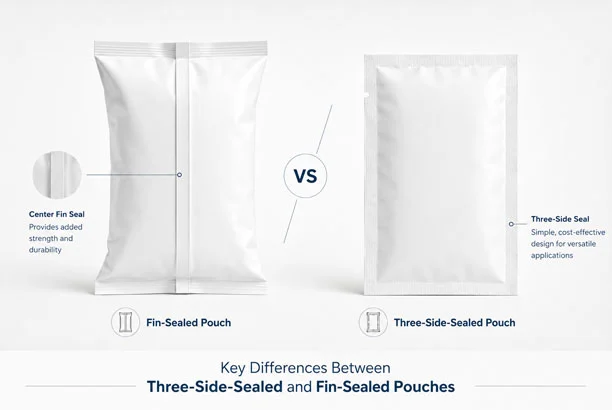
These pouches differ mainly in seal location and package construction. Three Side Sealed pouches have three edges sealed during pouch converting, leaving one side open for filling before the final heat seal. Their flat construction provides clearly defined front and back panels and can support compact stacking, display, and storage. The absence of a longitudinal back fin also gives designers a clean rear panel for branding, product information, or regulatory copy.
Fin seal pouches use a longitudinal back seal formed by joining the inner sealant surfaces of the film. This seal runs along the rear of the pack and is combined with transverse seals to create a pillow-style package. The sealant-to-sealant configuration is practical for many form-fill-seal applications and can provide reliable sealing when the material structure, seal geometry, temperature, pressure, dwell time, and contamination control are correctly matched to the product and machine.
Material Compatibility and Manufacturing Methods
Three Side Sealed pouches can be produced from folded film or multiple webs depending on the converting process. This gives manufacturers flexibility in selecting laminated structures for the required barrier, mechanical, print, and sealing performance. Three Side Sealed formats can be made using foil, metallised laminates, paper-containing structures, high-barrier films, and suitable mono-material structures when validated for the application.
Fin seal pouches are commonly produced from a continuous film web, which can simplify web handling and package formation on compatible form-fill-seal equipment. Material selection still depends on the product and process rather than the seal format alone. PA may be used where additional toughness or puncture resistance is required, while EVOH, metallised layers, aluminium foil, or other barrier technologies may be selected where additional oxygen, moisture, aroma, or light protection is needed. Mono-PE or mono-PP structures may also be considered where recyclability objectives and machine requirements justify their use.
Multi-layer laminates are available from Guoshengli Packaging for both pouch formats. Material selection can be based on factors such as tensile and puncture performance, seal compatibility, oxygen transmission rate, water vapour transmission rate, light protection, filling conditions, and intended shelf life.
Printing Techniques and Branding Opportunities
Both pouches can support high-quality rotogravure and digital printing, although seal placement affects artwork layout and usable panel areas. Three Side Sealed pouches provide flat front and back panels that can accommodate branding, product photography, nutrition information, ingredients, and regulatory copy. Their flat construction makes artwork planning straightforward, particularly when a clean front-and-back presentation is required.
Fin seal pouches also support full-colour printing across the available web area, with the rear fin and seal zones considered during artwork development. Brands can use the remaining front, back, and side areas for graphics, product information, and selected transparent windows. Glossy, matte, metallic, and soft-touch finishes may be used where compatible with the chosen structure and process.
Rotogravure printing can reproduce up to 11 colours on suitable production runs, while digital printing can support shorter runs, prototypes, multiple designs, and market tests without conventional printing cylinders. The appropriate printing method depends on quantity, artwork complexity, number of SKUs, cost target, and production schedule.
Barrier Protection and Resealability
Barrier performance influences shelf life, product quality, and customer satisfaction, but it is determined primarily by the material structure, package integrity, seal quality, and product requirements rather than by pouch style alone. Three Side Sealed bags can achieve high oxygen, moisture, aroma, or light barrier performance when produced with an appropriate laminate and properly sealed. Seal integrity should be validated using the intended product, filling conditions, and heat-sealing parameters.
Fin seal pouches can also provide high barrier performance when the correct laminate and sealing system are used. The sealant-to-sealant longitudinal fin seal is widely used in form-fill-seal packaging because it provides a practical and repeatable sealing interface. Applications such as coffee, nuts, dried fruits, and powdered products may also use nitrogen flushing or modified-atmosphere packaging when appropriate, but the final package performance depends on the complete material, sealing, filling, and gas-management system.
Both pouch formats may incorporate selected resealable features such as press-to-close zippers or other closure systems, depending on the package design and filling equipment. Resealable features can improve convenience for snacks, pet food, supplements, and other multi-use products. Compatibility should be confirmed during pouch and line trials so that the closure does not interfere with forming, filling, sealing, or final pack integrity.
Comparison of Three Side Sealed and Fin-Sealed Pouches for Procurement Decisions
Performance Under Logistics and Storage Conditions
Procurement teams need to consider packaging durability during transportation and storage. The flat profile of Three Side Sealed bags can support compact storage and efficient carton packing in many applications. Their suitability for handling depends on the pouch dimensions, material structure, fill volume, product geometry, and seal design rather than symmetry alone.
Fin seal pouches are typically pillow-shaped and may use carton space differently depending on product volume and pack geometry. Their continuous-web construction can be advantageous on compatible automated lines. For products with sharp, rigid, or irregular edges, puncture resistance should be engineered through the material structure and validated using the actual filled product rather than assumed from the pouch format.
Both technologies can perform effectively under normal logistics conditions when the material structure, seal design, and package dimensions are properly specified. Temperature, humidity, product movement, drop impact, and mechanical stress should be considered during package validation. Guoshengli Packaging can test seal, tensile, barrier, and other relevant performance characteristics according to the agreed specification.
Cost Comparisons and Customization Options
In B2B packaging, setup, tooling, printing, material use, order quantity, converting speed, filling-line efficiency, and waste all contribute to total packaging cost. Neither Three Side Sealed nor fin seal pouches are automatically cheaper in every application. Pre-made Three Side Sealed pouches can be economical for many flat-pack applications, while fin seal formats can offer efficient film use and high productivity on suitable form-fill-seal equipment.
Fin seal pouches can be cost-effective on high-volume lines because they are commonly formed from a continuous web and integrated directly into the filling process. However, actual cost depends on pouch dimensions, material structure, printing method, production volume, features, machine speed, and waste rate. Minimum order quantities also vary by specification. Rotogravure is generally more suitable for larger runs, while digital printing may support lower quantities for selected projects.
Euro holes, tear notches, selected zipper systems, and clear windows may be added to both pouch formats depending on the structure and equipment. Both can also vary in size, barrier construction, printing process, surface treatment, and other functional features. Our team can work with clients from material selection and artwork review through sampling and production to balance performance, branding, cost, and manufacturing requirements.
Eco-Friendly Materials and Recycling Considerations
Sustainability is becoming increasingly important in B2B procurement due to legislation, customer expectations, and corporate environmental goals. Recyclable, compostable, recycled-content, and bio-based packaging represent different environmental strategies and should not be treated as interchangeable claims. The end-of-life performance of a Three Side Sealed or fin-seal pouch depends on its complete material construction and the relevant collection, sorting, recycling, or composting system.
Both pouch formats may use mono-PE or mono-PP structures where these materials can meet the required product-protection and filling-line performance. Mono-material design can improve compatibility with suitable polyolefin recycling processes, but it does not automatically guarantee recyclability in every market. Barrier layers, coatings, inks, adhesives, closures, labels, and other components should be considered when evaluating the complete finished package.
Guoshengli Packaging can also evaluate selected PLA/PBAT-based compostable structures and recyclable mono-PE solutions where the product, target market, certification requirements, and end-of-life route justify their use. Compostable materials should be selected only where an appropriate composting pathway and claim basis exist. Our RTO exhaust-gas treatment system supports lower-emission production operations, while material recommendations focus on balancing environmental objectives with packaging performance.
Choosing the Right Pouch: Practical Guidelines for B2B Buyers
Matching Pouch Type to Product Requirements
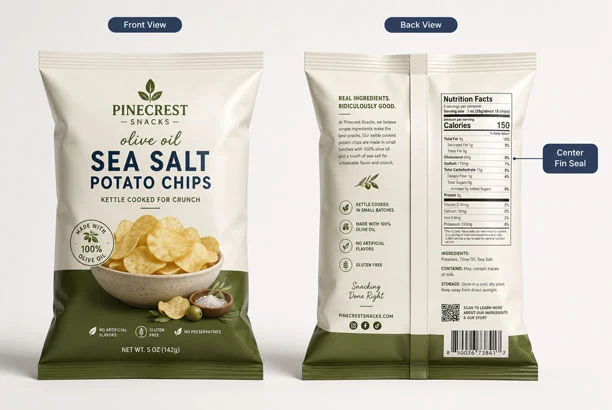
First, understand the product characteristics and packaging requirements before selecting a pouch style. Fin seal pouches can be an efficient option for products packed on compatible form-fill-seal equipment, including coffee, powdered products, snacks, and pet treats. Product protection should still be determined by the laminate structure, seal quality, filling method, and required shelf life rather than by the back-seal format itself.
Cosmetics, single-serve snacks, pharmaceutical products, and other flat-pack applications may benefit from Three Side Sealed bags because of their clean front and back panels, compact shape, and flexible presentation options. The flat format can make it easier to organise branding, product photography, ingredients, instructions, and regulatory information.
Filling-line compatibility is another crucial factor. Fin seal pouches are widely used on VFFS and HFFS systems where continuous package formation and production speed are important. Three Side Sealed pouches may be used as pre-made pouches or in suitable form-fill-seal configurations depending on the equipment. To reduce integration problems, buyers should evaluate pouch style together with machine type, filling method, seal geometry, production speed, and expected volume.
Vetting Suppliers Based on Certifications and OEM Capabilities
Choosing the right supplier is important for reducing supply chain risk and maintaining consistent packaging performance. Procurement teams should consider manufacturers with appropriate quality and packaging-management certifications, such as ISO 9001 and BRCGS Packaging Materials, together with food-contact compliance documentation suitable for the intended market. For products sold in the United States, food-contact materials should comply with applicable FDA regulatory requirements rather than being described simply as "FDA-certified."
OEM capabilities such as in-house design support, material engineering, printing, laminating, slitting, and pouch-making can help suppliers provide more integrated solutions and respond efficiently to changing requirements. Guoshengli Packaging has more than 25 years of flexible-packaging manufacturing experience and annual production capacity of approximately 20,000 tons. We support customers ranging from emerging brands to larger international programmes. Our quality-management and packaging certifications support consistent production and documentation for international customers.
Good communication and technical capability are equally important. Suppliers should be able to provide material specifications, relevant barrier data, production tolerances, lead times, and transparent cost information. Sampling, testing, and responsive production support can help buyers avoid specification errors and reduce delays during product launches.
Tips on Customization for Brand Differentiation
Customisation can improve brand recognition while adapting the pouch to the product, filling process, and retail presentation. Buyers can modify pouch dimensions, shape, artwork, and functional features according to fill weight, product volume, machine requirements, and display needs. High-resolution rotogravure printing with up to 11 colours can reproduce detailed graphics and product information for suitable production runs.
Clear windows, euro holes, tear notches, and selected resealable closures can improve functionality and presentation. Clear windows may help customers view products such as snacks, confectionery, or pet treats. Euro holes support hanging display, while tear notches and resealable features may improve opening and repeated use where appropriate.
Metallic, glossy, matte, and soft-touch finishes can create different shelf effects, provided they are compatible with the selected material and printing process. Guoshengli Packaging works with customers to develop solutions that balance cost, functionality, manufacturability, and visual impact so that the finished package performs consistently under real production and distribution conditions.
Future Trends and Innovations in Pouch Packaging
Emerging Materials and Advanced Barrier Technologies
Sustainability and changing market requirements continue to drive development in flexible-packaging materials and barrier technologies. Recyclable mono-material laminates are receiving greater attention, but their suitability still depends on whether they can meet the required barrier, sealing, mechanical, and machine-performance specifications. Transparent barrier technologies such as aluminium oxide (AlOx) and silicon oxide (SiOx) coatings can improve oxygen or moisture protection in selected film structures, although actual performance depends on the substrate, coating system, converting process, flex resistance, and intended application.
PLA, PBAT, and other bio-based or compostable materials are also being evaluated in selected applications. These materials should not be assumed to provide the same end-of-life route or performance as recyclable polyolefin packaging. Buyers need to review certification requirements, composting infrastructure, mechanical properties, barrier performance, and filling-equipment compatibility before selecting them.
Guoshengli Packaging continues to evaluate new materials and packaging technologies that may support both functional and environmental objectives. Recyclable mono-PE structures, selected compostable solutions, and other new material developments are assessed against product protection, filling-line compatibility, manufacturing requirements, and the intended target market.
Digital Printing Technologies for Cost-Effective Customization
Flexible packaging can now be produced in shorter quantities and with greater artwork flexibility through digital printing. Unlike rotogravure, digital printing does not require conventional printing cylinders, which can reduce setup requirements for selected short-run projects. This makes it useful for market tests, seasonal products, multiple SKUs, prototypes, and emerging brands.
Digital printing can also support variable data and artwork changes across selected projects, making it useful for personalised packaging, regional versions, and short-run design variation. Improvements in digital print quality and productivity continue to expand the range of applications where it can be commercially practical, although rotogravure remains highly suitable for many larger-volume jobs.
We provide both rotogravure and digital printing so customers can select the appropriate process according to production volume, artwork requirements, cost, and time to market. Digital printing can support flexible short-run development, while rotogravure can provide efficient repeat production and high colour consistency at larger volumes.
Shifting Market Demands and Supplier Adaptation
The global B2B packaging market is moving toward greater sustainability, traceability, supply-chain resilience, and technical transparency. Buyers increasingly expect suppliers to provide clear material information, relevant compliance documentation, consistent quality, and realistic sustainability guidance. In response, manufacturers are investing in recyclable structures, production efficiency, waste reduction, and improved quality-management systems.
Flexible-packaging production is also benefiting from increasing automation and data-based manufacturing control. Online inspection, process monitoring, maintenance systems, and digital production records can improve consistency and help identify waste or quality problems earlier. The actual level of automation varies by factory and production process, but these technologies can support more stable manufacturing and faster quality response.
Guoshengli Packaging continues to improve manufacturing systems, production responsibility, and long-term customer support. Brands looking for reliable fin seal pouch solutions can work with us to evaluate packaging according to product requirements, material performance, production volume, and filling-line conditions rather than relying on one pouch format as a universal solution.
Conclusion
Choosing between Three Side Sealed and fin seal pouches requires consideration of product characteristics, filling-line compatibility, branding objectives, material requirements, and total packaging cost. Three Side Sealed pouches provide a flat format with clean front and back panels and can suit products that benefit from compact presentation and defined artwork areas. Fin seal pouches are widely used on high-speed form-fill-seal lines and can provide efficient continuous package formation when matched to the correct material and equipment.
Neither format automatically provides superior barrier protection, seal strength, puncture resistance, recyclability, or lower cost in every application. These performance characteristics depend on the laminate structure, sealant system, dimensions, converting process, filling conditions, and distribution requirements. Understanding the structural and production differences between the two formats helps procurement managers reduce supply-chain risks, improve product presentation, and select a specification that works reliably in production. Partnering with an experienced packaging manufacturer can also help buyers validate material, filling, printing, and compliance requirements before full-scale production.
FAQ
1. Can Fin Seal Pouches Be Made Resealable?
Yes, selected fin seal formats can incorporate press-to-close zippers or other resealable systems. However, compatibility depends on the pouch design, zipper construction, material structure, and filling equipment. Adding a resealable feature can affect converting complexity, sealing conditions, machine setup, and production speed, so it should be validated before full production. At Guoshengli Packaging, we can evaluate resealable options for snack, pet food, supplement, and other applications based on the intended filling process and pack design.
2. What Are the Minimum Order Quantities for Custom Fin Seal Pouches?
The minimum order quantity depends on the printing method, material structure, pouch dimensions, number of designs, and level of customization. Rotogravure printing is generally more suitable for larger production runs because cylinder setup costs are distributed across the order volume. Digital printing can support lower quantities for selected projects, making it useful for market testing, new brands, seasonal products, or multiple SKUs. Guoshengli Packaging can help buyers compare printing and production routes according to order volume, lead-time requirements, and customization needs.
3. How Do Fin Seal Pouches Compare to Stand-Up Pouches in Durability?
When correctly designed, both formats can provide strong mechanical and seal performance, but neither is automatically more durable. Stand-up pouches use a bottom gusset to create a self-standing format for retail presentation, while fin seal pouches are commonly used in pillow-style packaging on high-speed form-fill-seal lines. Durability depends on material structure, thickness, seal design, product geometry, filling conditions, and distribution stress. The final choice should therefore be based on the product, display requirement, packaging equipment, and validated package performance.
Partner with Guoshengli Packaging for Your Custom Fin Seal Pouch Solutions
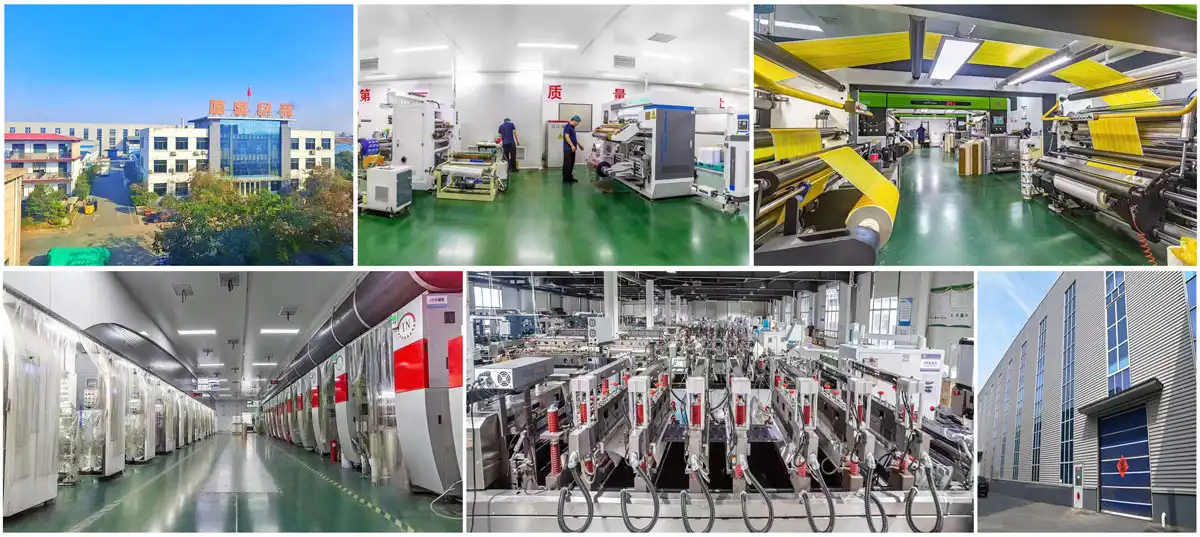
Ready to optimise your packaging performance and reduce supply-chain risk? Guoshengli Packaging has more than 25 years of flexible-packaging manufacturing experience and produces custom fin seal pouches for food, snacks, pet treats, supplements, and other applications. Our manufacturing and quality systems include ISO 9001 and BRCGS Packaging Materials certification, together with food-contact compliance support for applicable target markets. Material structures, printing methods, barrier requirements, and functional features can be customised according to the product and filling process.
We also support rotogravure and digital printing, recyclable material development, sampling, and production trials. MOQ and lead time depend on pouch size, material structure, printing method, number of designs, and required features, so our team can recommend a suitable production route for both new launches and repeat programmes.
You can email our team at sales@guoshengpacking.com to request samples, discuss your project requirements, or review our flexible-packaging options. We support both ongoing production programmes and new product launches with material recommendations, artwork review, sampling, and production planning.
References
Robertson, G. L. (2016). Food Packaging: Principles and Practice (3rd ed.). CRC Press.
Marsh, K., & Bugusu, B. (2007). Food Packaging—Roles, Materials, and Environmental Issues. Journal of Food Science, 72(3), R39–R55.
Selke, S. E., Cutler, J. D., & Hernandez, R. J. (2004). Plastics Packaging: Properties, Processing, Applications, and Regulations (2nd ed.). Hanser Publications.
Yam, K. L. (2009). The Wiley Encyclopedia of Packaging Technology (3rd ed.). Wiley-Interscience.
Kirwan, M. J., & Strawbridge, J. W. (2003). Plastics in Food Packaging. In Food Packaging Technology (pp. 174–240). Blackwell Publishing.
Coles, R., McDowell, D., & Kirwan, M. J. (2003). Food Packaging Technology. Blackwell Publishing.
CEFLEX. Designing for a Circular Economy: Design Choices and Design Principles for Flexible Packaging. Current guidance for recyclable flexible-packaging structures.