- English
- French
- German
- Portuguese
- Spanish
- Russian
- Japanese
- Korean
- Arabic
- Greek
- German
- Turkish
- Italian
- Danish
- Romanian
- Indonesian
- Czech
- Afrikaans
- Swedish
- Polish
- Basque
- Catalan
- Esperanto
- Hindi
- Lao
- Albanian
- Amharic
- Armenian
- Azerbaijani
- Belarusian
- Bengali
- Bosnian
- Bulgarian
- Cebuano
- Chichewa
- Corsican
- Croatian
- Dutch
- Estonian
- Filipino
- Finnish
- Frisian
- Galician
- Georgian
- Gujarati
- Haitian
- Hausa
- Hawaiian
- Hebrew
- Hmong
- Hungarian
- Icelandic
- Igbo
- Javanese
- Kannada
- Kazakh
- Khmer
- Kurdish
- Kyrgyz
- Latin
- Latvian
- Lithuanian
- Luxembou..
- Macedonian
- Malagasy
- Malay
- Malayalam
- Maltese
- Maori
- Marathi
- Mongolian
- Burmese
- Nepali
- Norwegian
- Pashto
- Persian
- Punjabi
- Serbian
- Sesotho
- Sinhala
- Slovak
- Slovenian
- Somali
- Samoan
- Scots Gaelic
- Shona
- Sindhi
- Sundanese
- Swahili
- Tajik
- Tamil
- Telugu
- Thai
- Ukrainian
- Urdu
- Uzbek
- Vietnamese
- Welsh
- Xhosa
- Yiddish
- Yoruba
- Zulu

Quad Seal Pouches & Bags have become indispensable across multiple industries seeking robust, shelf-stable packaging solutions. These four-corner sealed bags offer exceptional structural integrity through reinforced edge seals, making them ideal for heavy-duty applications. Industries ranging from food manufacturing and pet nutrition to health supplements and personal care rely on this packaging format for its superior load-bearing capacity, premium shelf presentation, and efficient volume utilization. The distinctive box-like structure stands firmly on retail shelves while maximizing internal capacity, addressing critical needs for bulk product protection and brand visibility.
Understanding Quad Seal Pouches and Their Packaging Benefits
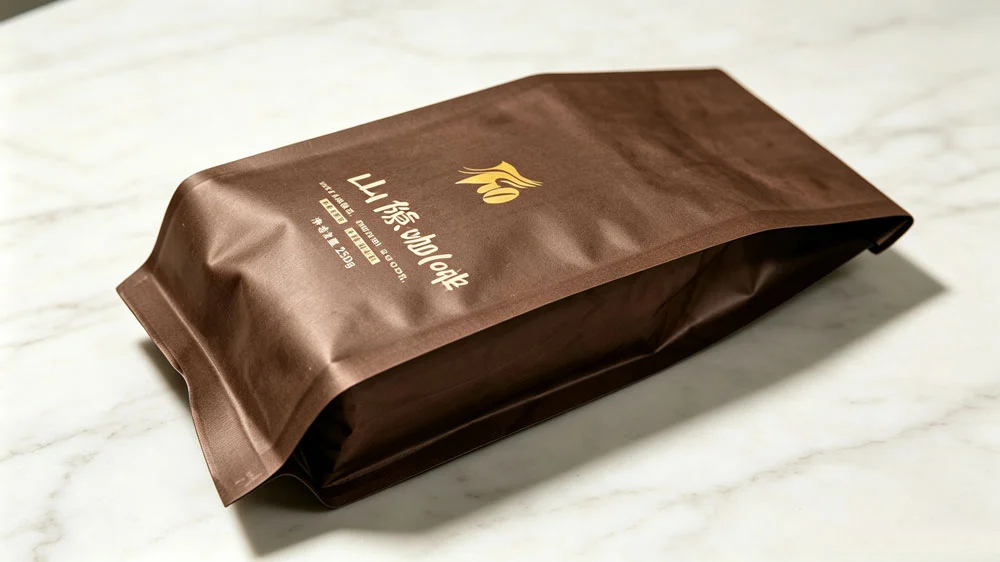
The engineering behind four-corner seal bags sets them apart from conventional flexible packaging. Unlike traditional three-side seal pouches where seals concentrate in the center back panel, quad seal designs position vertical seals at each corner. This architectural difference creates a reinforced square-shaped structure that eliminates package slouching—a common challenge with side-gusset formats carrying heavy fills.
Superior Structural Integrity Through Engineering
Multiple-layer laminate assembly using PET, metallized films, aluminum foil, and polyethylene is our production method. This combination targets OTR and WVTR to prolong shelf life. The four-corner seal distributes weight evenly across reinforced edges rather than stressing seams. Quad seal constructions generally provide higher burst resistance and load-bearing performance than conventional center-seal structures when designed with equivalent materials.
The dead-fold feature keeps bags form throughout use. As clients remove goods, the bag stays upright, ensuring brand visibility until empty. Precision heat-sealing procedures on our 49 conversion machines monitor temperature, pressure, and dwell time to achieve this performance.
Material Versatility Addressing Diverse Requirements
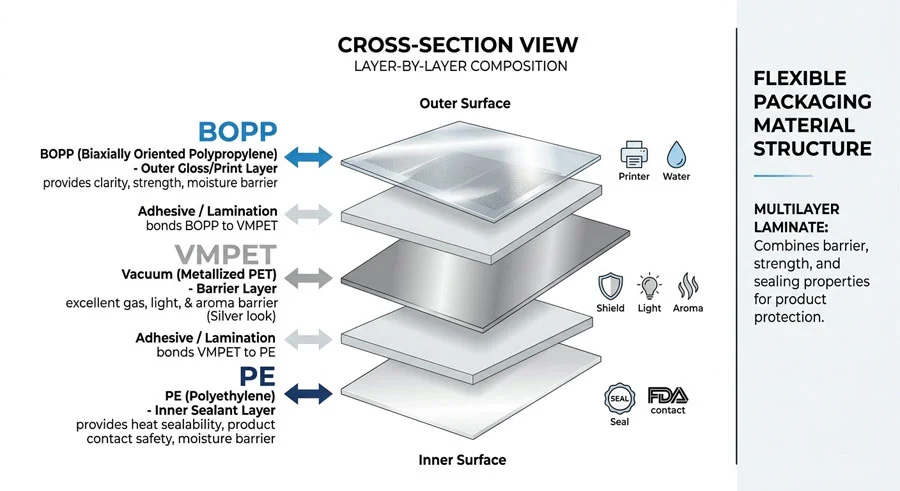
Material choice affects packaging performance across product categories. FDA and EU compliance and barrier properties are needed for food-grade applications. Coffee packaging needs one-way degassing valves to allow carbon dioxide out but not oxygen in. Manufacturers prioritize puncture resistance and moisture barriers to preserve nutritional quality during storage.
Standard PET/PE structures for dry materials and high-barrier aluminum foil laminates for moisture-sensitive powders are customizable. Mono-material polyethylene allows curbside recycling; however, barrier performance trade-offs exist. Compostable PLA/PBAT films assist circular economy brands if their shelf life meets permeability.
Rotogravure printing with 11 colors maintains brand consistency among runs. Our seven printers accurately capture complex pictures. Six laminating devices fuse film layers under controlled heat and pressure after printing to create unified structures with known mechanical properties. Pouches are tested for seal strength, layer adhesion, and size before filling lines.
Key Industries Utilizing Quad Seal Pouches for Packaging
Market analysis reveals concentrated adoption across sectors where product weight, shelf-life requirements, and premium positioning intersect. Understanding industry-specific applications of Quad Seal Pouches & Bags helps procurement managers match packaging attributes to operational needs.
Food and Beverage Applications
Most coffee roasters use quad seals. Ground and whole bean coffee produce carbon dioxide after roasting, requiring packaging that releases internal pressure without oxygen. Our pouches have one-way degassing valves to prevent bag expansion and preserve aromatic chemicals. Coffee brands can differentiate products with origin stories and brewing instructions on flat printable surfaces.
The format's 5-25 kilogram fill capacity benefits flour and grain mills. Distribution network handling stresses do not damage reinforced corner seals. Integrated lifting and carrying handles improve commercial kitchen ergonomics. Moisture barriers reduce humidity absorption that would clump or deteriorate bulk buyers.
These bags' shelf presence pleases snack makers. Boxes offer solid billboard area for graphics, enhancing visibility in congested retail settings. Zippers keep food fresh and reduce waste. Different dosage sizes and hygroscopic compounds in protein supplements and meal replacement powders are protected by the structure.
Pet Food and Treat Packaging
Pet feed packaging must be durable and appealing. Premium pet food businesses emphasize package quality, making structural integrity and print quality crucial. Quad seal bags can withstand 2-15 kg of feed and treats without bursting during transportation or shelf display.
Nutrient stability and palatability are protected by barriers. Oxygen and light may oxidize pet food fats and oils. Our multi-layer structures block UV transmission and significantly reduce oxygen transmission with metallized films or aluminum foil. This protection increases shelf life from months to years, depending on formulation.
Consumer sustainability demands are driving pet treat makers to use eco-friendly packaging. We provide recyclable polyethylene constructions and kraft paper laminates with barrier performance and environmental messaging. Material recyclability and moisture protection must be balanced, necessitating obvious performance trade-offs.
Health and Wellness Supplement Sector
Nutraceutical brands must meet performance and regulatory standards. Supplement powders, capsules, and tablets need moisture barriers to preserve active ingredients. Hygroscopic substances like vitamin C and probiotics lose effectiveness in humidity, making WVTR standards crucial for procurement.
Our quality management systems meet BRC food packaging and ISO 9001 standards, delivering regulatory compliance paperwork. Shipments include certificate of analysis reports validating food-contact and barrier performance. The paperwork simplifies importers' customs clearance and regulatory filings.
Supplement packaging uses resealable closures. Closures that last for weeks or months are needed since consumers open things regularly. Press-to-close zippers and tin-tie closures vary in ease and cost, depending on target market and price positioning.
Personal Care and Cosmetic Products
Powdered cosmetics, bath salts, and personal care products benefit from branding flexibility with Quad Seal Pouches & Bags. The five-panel printable surface—front, back, two sides, and bottom—provides ample space for ingredient lists, usage instructions, and lifestyle images. Matte and glossy finishes support premium market positioning through tactile differentiation.
For this category, moisture sensitivity determines material selection. Salt and clay bath products absorb ambient moisture, clumping and compromising user pleasure. High-barrier structures keep product texture intact during shelf life. Window panels with anti-fog coatings show products without condensation.
Quad seal bags ship more efficiently than rigid containers due to their small size. Reduced package weight saves freight costs and carbon impact, which sustainability-focused companies value. Dimensional efficiency increases pallet units, increasing supply chain economics.
Comparison of Quad Seal Pouches vs Other Packaging Solutions
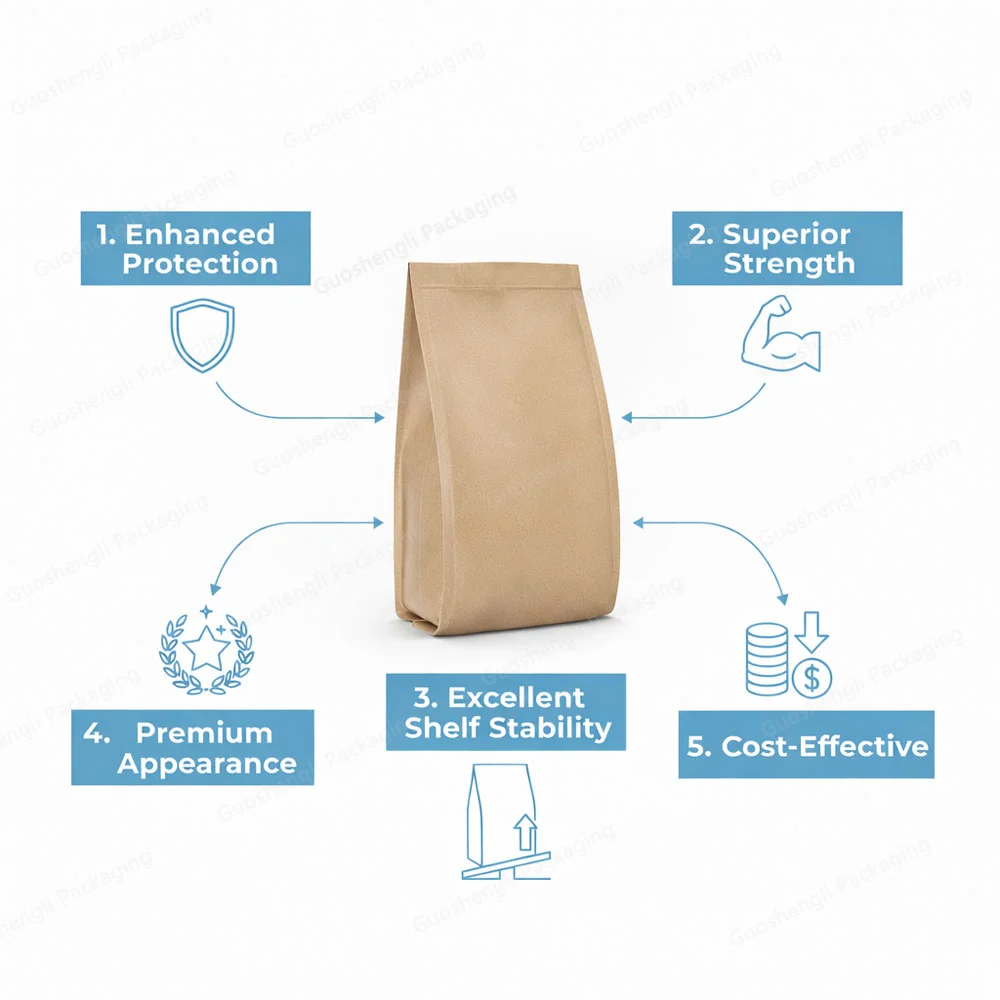
Procurement decisions benefit from understanding how different pouch formats address specific operational requirements. While multiple flexible packaging styles serve overlapping applications, each design offers distinct advantages and limitations.
Structural Stability and Load-Bearing Performance
Under heavy weights, quad seal bags are suitable for vertical stability. Corner seals form a self-supporting, shapely structure when half-filled. Unlike three-side seal bags, which flatten and lose shelf presence when consumed. Stand-up pouches are more commonly used for lighter products, although reinforced structures are also available for larger pack sizes.
Solid flat bottom pouches with gusseted folds create clean rectangular footprints for premium positioning. Complex manufacturing boosts per-unit costs compared to quad seal options. Quad seal forms work well at 3-20 kg for cost-effective applications.
Side gusset bags have center-back seals and expanded side panels. This design allows variable fill volumes; however, the center seal may conflict with visual schemes and be a weak place under stress. Quad seal designs remove the middle seam, providing continuous branding and mechanical stress distribution over four reinforced corners.
Cost Implications and Manufacturing Efficiency
Material consumption, manufacturing complexity, and production speed affect unit costs. Quad seal bags are cheaper than flat bottom pouches but more expensive than three-side seal bags. Improved shelf presence and structural performance justify modest cost premiums.
Manufacturing efficiency affects order flexibility and lead times. Our 49 converting machines allow rapid specification changes, allowing smaller minimum order quantities than competitors requiring dedicated production runs. Digital printing produces bespoke images in 7-10 days for orders under 10,000, whereas rotogravure printing takes 15-20 days.
Material optimization cuts expenses without sacrificing performance for Quad Seal Pouches & Bags. Our technicians propose film gauges and barrier levels based on product parameters including particle size, density, and moisture sensitivity. Over-specifying materials wastes money, while under-specifying risks product failure. This conversation ensures packaging parameters match performance needs, not assumptions.
Procurement Considerations for B2B Buyers in Quad Seal Pouch Sourcing
Successful sourcing extends beyond unit pricing to encompass supplier capabilities, quality systems, and partnership reliability. Procurement managers evaluating quad seal bag suppliers should assess multiple factors influencing long-term relationship viability.
Supplier Evaluation Criteria
How suppliers expand with company expansion depends on production capability. Our production facilities can handle 500 million pouches per year in various specifications. This capacity allows customer growth without secondary supplier relationships that vary in quality.
Certification portfolios demonstrate quality and regulatory compliance. ISO 9001 accreditation signifies rigorous quality controls, whereas BRC food packaging certification verifies worldwide food safety. FDA compliance assures products fulfill U.S. food-contact rules, essential for North American importers. Barrier characteristics and material composition claims are independently verified by SGS testing.
Customization sets providers apart in competitive sourcing. Buyers increasingly want custom sizes to fit filling equipment. Our design support team helps customers optimise pouch dimensions for automated filling lines to reduce material waste and maintain seal integrity. Variable data printing allows lot coding, QR codes, and promotions without labeling.
Cost Management and Pricing Transparency
Instead of volume breaks, bulk order pricing should reflect economies of scale. Our transparent pricing frameworks predictably lower unit costs with order quantities. MOQ flexibility lets smaller firms use quad seal packaging without investing in inventory, while volume savings help bigger purchasers compete at retail.
Cost against lead time and logistical complexity are considered in geographical sourcing. Chinese manufacturing is cheaper due to integrated supply networks and specialized industrial facilities. Our 25+ years of export experience have improved logistics coordination, documentation, and communication protocols to reduce international sourcing friction points.
Financial stability and payment conditions affect supplier dependability. Buyer cash flow improves with longer payment terms, but supplier finances may suffer. We have robust operating capital to provide flexible terms to existing clients and seek deposits from new accounts, managing risk for both sides.
Sustainability Verification and Environmental Claims
Environmental responsibility affects buying decisions as companies adapt to customer demands and sustainability regulations. Complex packaging sustainability trade-offs need careful study beyond marketing claims.
Material composition and municipal collection infrastructure affect recycling. Flexible film collection methods recycle mono-material polyethylene; however, barrier characteristics may not fit all applications. Multi-layer laminates with aluminum or metallized films are stronger but require rare recycling streams.
Compostable materials are appealing but require performance and end-of-life infrastructure testing. Industrial composting decomposes PLA/PBAT films, but not at home. Packaging benefits may be negated by barrier properties reducing shelf life and food loss.
We advise on material selection honestly, including recyclability infrastructure and performance trade-offs. Buyers may consider environmental goals, product protection, and market realities with this consulting.
Customization and Innovation Trends in Quad Seal Pouch Packaging
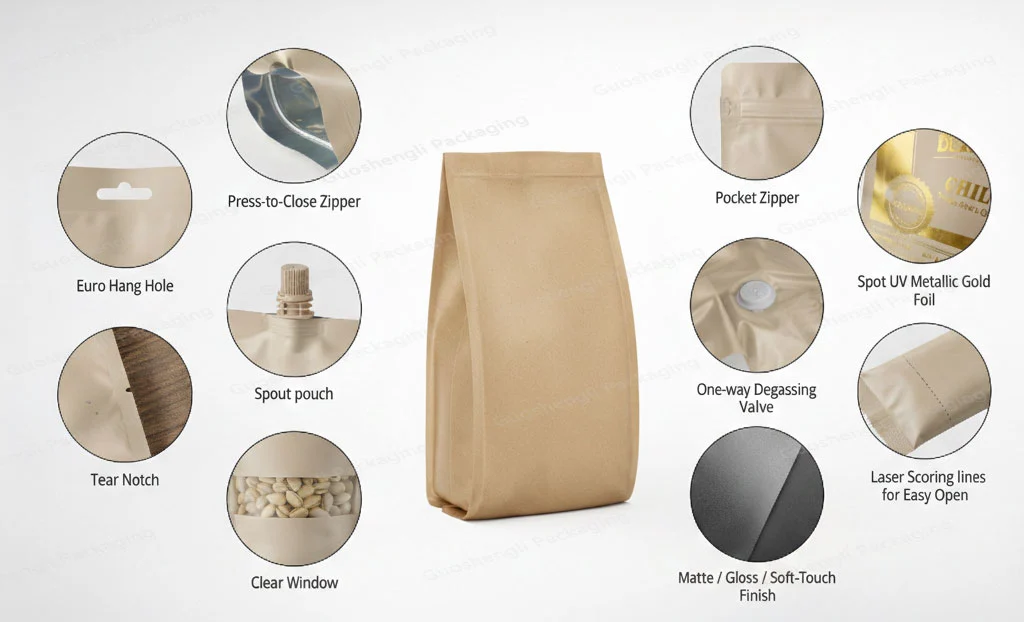
Market needs for convenience, sustainability, and customer interaction drive packaging innovation. Understanding emerging trends helps procurement managers predict needs and position brands competitively.
Advanced Printing and Branding Capabilities
Rotogravure printing produces photographic-quality designs with consistent color. Our 11-color printing allows complex gradients, fine typography, and detailed imagery that boost brand perception. For brands where packaging recognition drives purchase decisions, color matching protocols ensure batch-to-batch consistency.
The tactile difference of matte and soft-touch finishes supports premium positioning. These surface treatments decrease store lighting glare and express quality via touch. Visual depth from spot UV coatings draws attention to logos or key messaging on crowded shelves.
Digital printing is used for short-run and test-market applications where rotogravure setup is too expensive. Digital printing removes plate-making costs and allows runs as small as 1,000 units, but per-unit prices surpass rotogravure rates. This flexibility allows product launches, seasonal offerings, and regional variations without inventory risk.
Functional Enhancements Improving User Experience
Sealing keeps products fresh and convenient. Integrated press-to-close zippers during pouch manufacturing secure resealing after multiple open-close cycles. Tin-tie closures are cost-effective for occasional access applications. Closure selection considers cost, functionality, and market expectations.
One-way degassing valves are used in coffee packaging and gas-generating products. These valves release internal pressure without letting air in, limiting bag expansion and protecting the barrier. Side panels with proper valve placement work independent of product fill level.
Integrated handles make bulkier products easier to carry. Die-cut pouch handles replace attachments, keeping the pouch clean and making lifting and transport easier. Handle reinforcement prevents tearing under load, especially for packages over 5 kg.
Transparent window panels display products without compromising barrier integrity. Strategically placed windows showcase product quality without compromising moisture or oxygen protection. Anti-fog treatments keep contents clear throughout shelf life.
Sustainable Material Development
Material science advances allow environmentally friendly packaging without sacrificing performance. High-barrier mono-material constructions made of particular polyethylene grades increase oxygen barriers and recyclability. Although not as effective as aluminum foil, these materials are suitable for mild barrier applications.
Post-consumer recycled (PCR) content supports the circular economy. PCR films that meet food-contact regulations allow brands to communicate recycled content percentages for sustainability. Compare material availability and cost premiums to marketing value and corporate responsibility goals.
Bio-based films from renewable feedstocks minimize fossil fuel use. Bio-based origin doesn't guarantee biodegradability or compostability—a prevalent fallacy that needs clarification. Bio-polyethylene performed similarly to petroleum-based PE but used renewable sugarcane.
Through gauge optimization and structural engineering, lightweighting reduces material usage. Our technical team studies product attributes and distribution strains to reduce film thickness without affecting performance. Even small gauge reductions add up to economic and environmental savings over high manufacturing volumes.
Conclusion
Quad Seal Pouches & Bags are increasingly used in businesses that value structural integrity, premium appearance, and volume efficiency. This container type meets the needs of coffee roasters, wheat processors, pet food makers, and supplement companies with configurable materials, barrier qualities, and functional elements. Suppliers with production capacity, quality certifications, and technical skills supporting long-term partnership goals are essential for procurement success. Transparent conversation regarding material possibilities, performance trade-offs, and environmental claims is vital as sustainability influences sourcing decisions. Understanding how quad seal bags compare to other formats—cost, structural, and application suitability—helps optimize packaging strategies across product portfolios.
FAQ
1. Can quad seal pouches package liquid products effectively?
Quad seal bags primarily serve dry and semi-dry applications including powders, granules, kibble, and whole beans. While technically feasible to package liquids using appropriate seal configurations and spout fittings, stand-up pouches with bottom gussets typically prove more cost-effective for liquid applications. The four-corner seal design optimizes structural performance for products exerting vertical rather than hydrostatic pressure.
2. How do I verify food-grade safety certifications for packaging materials?
Request supplier documentation including FDA compliance letters, EU 10/2011 declarations, and material safety data sheets (MSDS) specifying food-contact suitability. Reputable suppliers provide certificates of analysis confirming materials meet regulatory standards. Third-party testing through SGS or similar laboratories offers independent verification. Our BRC certification and ISO 9001 quality management system ensure systematic compliance across production batches.
3. What lead times should I expect for custom-printed quad seal bags?
Lead times vary based on printing method and order complexity. Digital printing delivers finished pouches within 7-10 days for orders under 10,000 units, ideal for product launches and test markets. Rotogravure printing requires 15-20 days including plate preparation but offers superior print quality and lower per-unit costs for volumes exceeding 20,000 units. Rush production accommodates urgent requirements, with air freight delivery reaching North American destinations within 4-5 days of production completion.
Partner with a Trusted Quad Seal Pouch Manufacturer
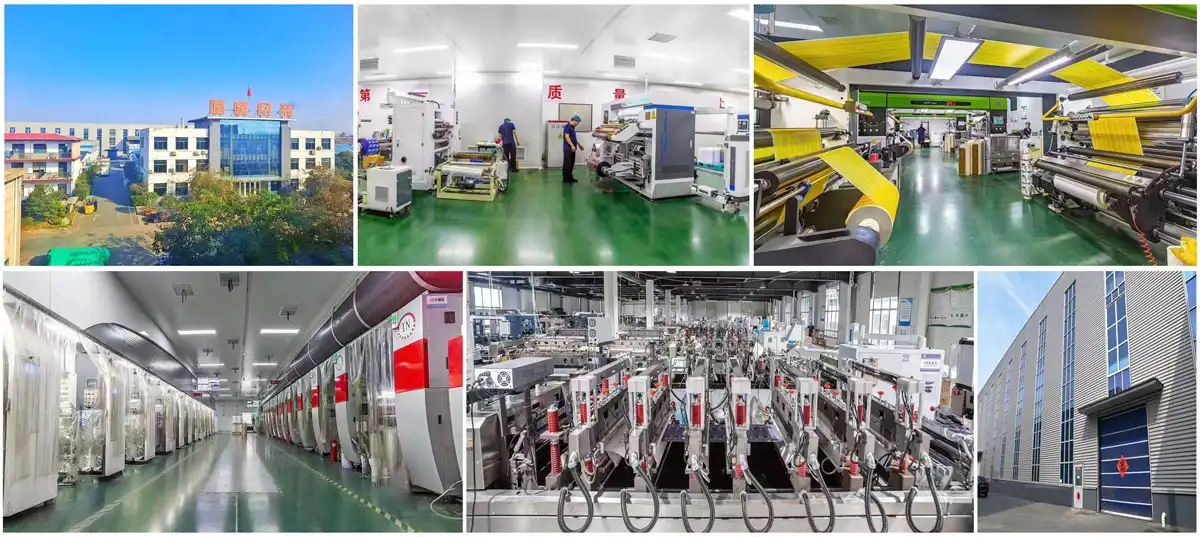
Guoshengli Packaging brings over 25 years of flexible packaging expertise to B2B clients seeking reliable, high-performance quad seal solutions. As an experienced manufacturer, we understand the operational challenges procurement managers face—balancing quality requirements, cost pressures, and sustainability objectives. Our comprehensive capabilities span material selection, custom printing, barrier optimization, and functional enhancements tailored to your specific applications. Whether you're packaging premium coffee, bulk flour, pet nutrition products, or health supplements, our quad seal bags deliver the structural integrity and shelf presence your brand deserves. Our ISO 9001, BRC, FDA, and SGS certifications provide assurance that quality controls meet international standards. Sustainable packaging options include recyclable structures and bio-based materials supporting corporate environmental commitments without compromising product protection. Contact our packaging consultants at sales@guoshengpacking.com to discuss your Quad Seal Pouches & Bags requirements. We'll provide technical guidance, competitive pricing for bulk orders, and customization options positioning your products for market success.
References
1. Robertson, G.L. (2016). Food Packaging: Principles and Practice (3rd Edition). CRC Press, Boca Raton.
2. Marsh, K. & Bugusu, B. (2007). Food Packaging—Roles, Materials, and Environmental Issues. Journal of Food Science, Vol. 72, Issue 3, pp. R39-R55.
3. Selke, S.E., Culter, J.D., & Hernandez, R.J. (2004). Plastics Packaging: Properties, Processing, Applications, and Regulations (2nd Edition). Hanser Publications, Munich.
4. Coles, R., McDowell, D., & Kirwan, M.J. (2003). Food Packaging Technology. Blackwell Publishing, Oxford.
5. Yam, K.L. (2009). The Wiley Encyclopedia of Packaging Technology (3rd Edition). John Wiley & Sons, Hoboken.
6. Soroka, W. (2009). Fundamentals of Packaging Technology (4th Edition). Institute of Packaging Professionals, Naperville.