- English
- French
- German
- Portuguese
- Spanish
- Russian
- Japanese
- Korean
- Arabic
- Greek
- German
- Turkish
- Italian
- Danish
- Romanian
- Indonesian
- Czech
- Afrikaans
- Swedish
- Polish
- Basque
- Catalan
- Esperanto
- Hindi
- Lao
- Albanian
- Amharic
- Armenian
- Azerbaijani
- Belarusian
- Bengali
- Bosnian
- Bulgarian
- Cebuano
- Chichewa
- Corsican
- Croatian
- Dutch
- Estonian
- Filipino
- Finnish
- Frisian
- Galician
- Georgian
- Gujarati
- Haitian
- Hausa
- Hawaiian
- Hebrew
- Hmong
- Hungarian
- Icelandic
- Igbo
- Javanese
- Kannada
- Kazakh
- Khmer
- Kurdish
- Kyrgyz
- Latin
- Latvian
- Lithuanian
- Luxembou..
- Macedonian
- Malagasy
- Malay
- Malayalam
- Maltese
- Maori
- Marathi
- Mongolian
- Burmese
- Nepali
- Norwegian
- Pashto
- Persian
- Punjabi
- Serbian
- Sesotho
- Sinhala
- Slovak
- Slovenian
- Somali
- Samoan
- Scots Gaelic
- Shona
- Sindhi
- Sundanese
- Swahili
- Tajik
- Tamil
- Telugu
- Thai
- Ukrainian
- Urdu
- Uzbek
- Vietnamese
- Welsh
- Xhosa
- Yiddish
- Yoruba
- Zulu

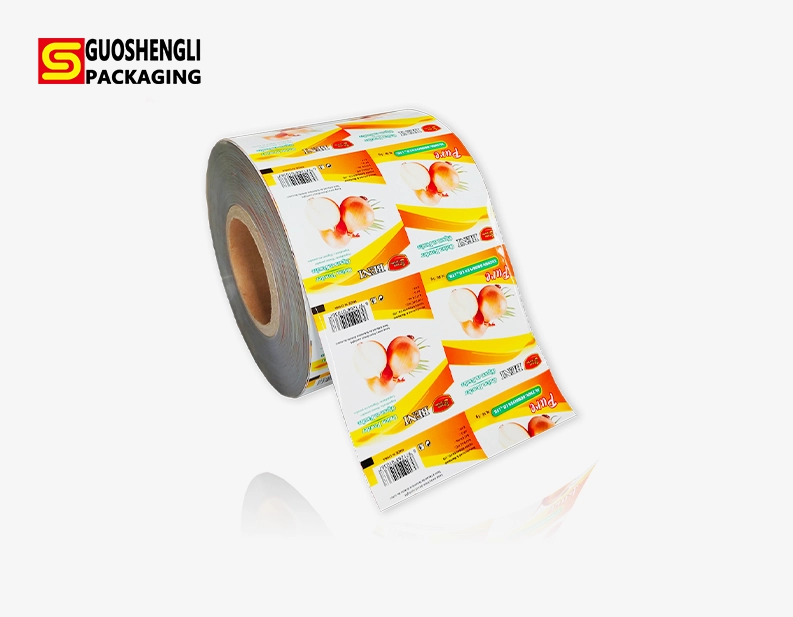
Roll stock packaging is flexible film supplied on a continuous roll and fed into a vertical or horizontal form-fill-seal (VFFS or HFFS) machine. The machine shapes the web, fills the product, seals the package, and cuts it in one pass, so you do not need premade pouches. Roll stock film can be clear, printed, laminated, metallized, high-barrier, or recyclable, depending on the product. Guoshengli Packaging has made flexible packaging for more than 25 years. In this guide, we explain how roll stock film works, how we make it, and how to choose it.

How Roll Stock Film Works in a Packaging Line
Forming, Filling, and Sealing in One Pass
A VFFS line has a machine that pulls roll stock film over a belt and wraps it into a tube. The back is sealed, the item is dropped through the tube, the top and bottom are sealed, and then the bag is cut. A HFFS machine moves the film flat, which is good for drinks, bars, frozen foods, and medical things. VFFS lines are often used for snacks, grains, powders, and pet food. The machine makes each box, so you don't need to order a new size of pouch. You change the length of the bag instead by setting it. Our roll stock film can fit most unwinders because it is wound on either a 3 or 6 inch core.
Film Properties That Control Machine Behavior
The film and the machine must agree. The web moves over the making tube based on the coefficient of friction (COF). We keep ours between 0.2 and 0.3 so that nothing gets stuck. When the web width is within ±1 mm, registration marks and seals stay put. If the film is stiff, it will go around the collar in a different way. You can tell what temperature range your sealing jaws can work in by how hot they are and what temperature they start to seal at. After each batch, if any of these numbers changes, the speed and temperature of all of them have to be changed too. That's why we check the strength of the seal and lamination on every batch, not only the good sample.
Core Size, Winding, and Tension
Roll stock film can fail even if it is well made if it is wound wrong. The print can look off if the tension isn't even. Telescoping, edge weaving, and wrinkles are all signs of this. The width, core size, outer diameter, and winding direction of the roll must all match those of the unwinder and register eye. Our high-barrier roll stock film starts at 50 mm, and our roll widths range from 200 mm to 1200 mm. If you send us your machine model and specification sheet, we can make sure the rolls fit before the first one is sent out. A quick check at the start can save hours of time on the floor during changeovers.
Types of Roll Stock Film and How We Make It
Common Structures and Layer Counts
Rollstock Film is 50 to 200 microns thick and has two to eleven layers. Structures that are easy to understand, like OPP/CPP or PE/PE, can meet modest needs for safety. Structures that are laminated or coextruded have a single web that can print, be strong, block, and seal. It is common for structures to be made of PET/AL/PE, BOPP/VMCPP, PET/NY/PE, PA/PE/LLDPE, PET/VMPET/PE, and PET/Foil/PE. People often pick blown film because it is tough and doesn't tear easily. Cast film is often chosen because it is always the same thickness and clear. You shouldn't choose a structure based on how it looks or how much it costs. Instead, you should use technical data, samples, and a machine trial to get a feel for it.
Barrier Options: EVOH, Foil, Metallized PET, and AlOx/SiOx
What your product is scared of will help you decide what kind of barrier to use. Light, oxygen, and water are hard to get through aluminum foil. A good shield that is also light and cheap is made of metallized PET. The EVOH keeps the film clear, which is good for shoppers who want to see the item. A simple way to use only one material is to use AlOx or SiOx layers that are deposited by vacuum. It takes less than 1 cc/m² of oxygen to pass through our barrier grades every 24 hours, and it takes less than 0.5 cc/m² of oxygen to pass through our AlOx/SiOx film every day. You should decide how long you want the product to last and then test it with your own product when it comes to snacks, coffee, and powders.
The Manufacturing Process and Quality Checks
First, we pick the right plastics, coverings, inks, glues, and covers for your product and how it will be filled. To print, people use rotogravure presses with up to 11 colors or computer presses. The layers are cured to make sure they stick together well after they have been laminated. Finally, we test the master rolls after they have been cut and rewound. We check for things like tensile strength to ASTM D882 and color stability with Delta E below 2.0 between batches. We also use gas chromatography to find solvents that are less than 10 mg/m². As per ISO 9001, our plant has 49 machines for converting, 7 lines for printing, and 6 machines for laminating. The plant also has support from BRC, FDA, and SGS.
Roll Stock Film Applications and Other Packaging Formats

Food, Beverage, and Pet Food Applications
Roll stock film is most often used to cover sweets and snacks like candy, cookies, crisps, jerky, and chocolate. There are valves on some coffee and tea packs that only let air out one way. It's important to keep dried foods like pasta, grains, spices, and fruit from getting too much oxygen or water. Clear windows can be used in bakery lines, and sauces and other condiments need strong seals. A lot of frozen foods are made from PA/PE/LLDPE because it can bend at low temperatures and has an MVTR below 1. Because pet food and treats are heavy or rough, they need strong lids and containers that can't be punctured.
Household, Industrial, and Medical Uses
The material BOPP/PE is often used for laundry detergent and other home goods. Powders that are used in science and industry need to be able to handle acids and being punctured. The stamp and seals on personal care things need to be clean. Medical devices have frames that are made of PET, foil, or PE and can be sterilized. Our films can be used in temperatures between -18°C and 121°C. If your job is a pharmaceutical one, please let us know right away so we can better manage things like moving, keeping things clean, keeping track of things, and paperwork. We make sure the film doesn't move before putting food on it, and we make sure it works with the settings you give us for filling.
Roll Stock Film vs. Premade Pouches, Shrink Film, and Stretch Film
You need to store the finished bags because pre-made pouches are made first and then filled. This makes them good for small runs and odd shapes. Roll stock film can be produced on your own machine, which is good for lines with a lot of work and boxes of different sizes. People say that when used on a large scale, roll stock film costs 30–50% less per unit than pre-formed pouches. This is because finished bags don't need to be stored, and accurate cutting makes less trash. Shrink film wraps or covers things and leaves marks of tampering. Stretch film holds the boxes together. These aren't main food boxes. You can protect and print on more types of laminated roll stock film, and moving the material can be easy with simple film made of one material.
How to Choose Roll Stock Film and Evaluate a Supplier
Product and Machine Details to Share
You need to know about the product's weight, fill temperature, oil or moisture content, sharp edges, chemical exposure, and whether you vacuum or gas flush it before you choose roll stock film. Next, make a list of your machine's speed, web width, core size, roll diameter, registration method, and how the rolls are bound. Then, make sure the structure fits your needs for air flow, moisture, light, smell, or grease. Before you say yes, make sure you have samples, technical data, compliance papers, and trial results. Our process goes like this: we look at samples, make sure they are correct, test the machine, and then start mass production. Before moving on to the next step, your engineers can look over the data from the last one.
What to Check in a Roll Stock Film Supplier
A good seller of roll stock film has enough film, knows a lot about it, and can talk to you clearly. For VFFS or HFFS, make sure the provider can give you the structure, print method, barrier level, and sealer you need. Find out the minimum order size, unique width, thickness, roll length, winding direction, core size, and core form. What is the minimum order quantity? Find out how the quality system handles the supplies, prints, laminates, cures, slits, inspects, and keeps track of each batch. Take a look at our certificates. We have records from FDA and SGS, as well as ISO 9001 and BRC. Consider the total cost, wait time, documents, experience with exporting, and help with fixing problems, not just the price per kilogram.
Common Roll Stock Film Problems and How to Prevent Them
When things go wrong, they often have tracking drift, wrinkles, curling, delamination, print flaws, and bags that don't look even. Messy surfaces, low wound tension, uneven thickness, fast-curing glue, and tools that aren't lined up right are some of the things that can go wrong. Curling is often a sign that the laminate strain hasn't been adjusted or that there hasn't been enough time to age the material. Get the tolerances set and run a controlled test to make sure nothing goes wrong before you start full production. Check how strong the seal is (ASTM F88), how well the print sticks, how strong the bond is, and how well the roll tacks. Before you start, agree on what needs to be done to fix the problem and keep a reference sample. Store rolls somewhere cool and dry.
Cost, Sustainability, and Long-Term Procurement for Roll Stock Film
What Drives Roll Stock Film Cost
The price depends on the type of material, the thickness, the number of layers, the level of barrier, the complexity of the print, the order volume, the roll size, the tools used, the quality standards, and the shipping. The lowest unit price doesn't always mean the lowest total cost. Because of leaks, slowdowns, and waste, a small savings per kilogram can be lost. Find out how much you can get from each roll, how well the machine works, and how often it provides. Less waste is made when the film is cut correctly and the thickness is matched to the size of the package. Because you make each package on your own line, you don't need to store finished bag stock. This makes money and floor space available.
Recyclable and Mono-Material Options
Our roll stock film, which is only made of PE or PP, can be reused over and over. As a safety measure, we keep the EVOH content below 5% by weight or cover things with AlOx/SiOx. With machine-direction orientation (MDO), these films made of a single material are three times less likely to get holes in them. The rules in each U.S. community, how the package is made, and claims that it can be recycled are still taken into account. Check these things out before you claim the pack. The most durable barrier for your product can still be made with standard metallized and multi-layer designs. Less pollution is made at our plant thanks to an imported RTO exhaust system.
Lead Times and Long-Term Supply
Think about how you'll print when you're getting ready. In fifteen to twenty days, rotary printing is done. In seven to ten days, digital printing is done. When you need to plan ahead, sea freight is better than air freight because it takes longer (4–5 days). Our plant in Linyi, Shandong, has worked with clients from North America, Europe, and the Asia-Pacific area for more than 25 years. We've worked with people in Europe, the US, and Australia for a long time. We recommend that you lock down the standard, keep a reference sample, and agree on test limits for the next supply. This way, each time you reorder, it will be the same as the last time.
Conclusion

When you package with roll stock film, you use continuous film. This type of machine can cut, fill, seal, and shape the film all at the same time. What makes a film safe and how well it works as a line depend on things like its COF, thickness range, seal strength, and barrier level. Different kinds of structures exist, such as simple PE/PE laminates, foil, metallized, EVOH, and AlOx/SiOx laminates. The product, the machine, and the shelf life goal should all affect the type of structure that is chosen. Then, tests and samples should be used to back up the choice. When purchased in bulk, roll stock film can be used for more than just pet food; it can also be used for food, household things, business, medicine, and more. Provider checks, batch testing, and clear acceptance limits all help cut down on downtime. What kinds of single-materials you can recycle depend on how they are collected and the rules in your area. The whole cost is more important than the price per kilogram.
FAQ
1. What Is Roll Stock Film Used For?
It's what VFFS and HFFS machines use to make the main boxes for coffee, grains, powders, frozen foods, pet food, household items, medical devices, and more. The machine makes each box from a long web that it cuts, fills, closes, and shapes.
2. How Is Roll Stock Film Different from Stretch Film?
Stretch film wrapped around the pallets keeps them in place. Roll stock film is what makes the package, so it needs to be able to print, seal, and block things that stretch film can't.
3. Do You Offer Recyclable Options?
Yes. Our models, which are only made of PE and PP, can be reused over and over. It still depends on how it is packaged, how it is picked up locally, and the rules that are in place on how easy something is to recycle.
4. What Should I Send for a Quote?
Send an email to sales@guoshengpacking.com with the type of product, package size, fill weight, machine model, print needs, barrier target, compliance needs, quantity, delivery date, and where the package needs to go.
Request a Roll Stock Film Sample or Custom Quote

Guoshengli Packaging has been making roll stock film for more than 25 years and has 49 machines for turning, 7 lines for printing, and 6 machines for sealing. We'll give you a price for your custom order after you send us information about your product and the machine you want to use. We'll also suggest a structure and set up models for testing on the machine. If you email sales@guoshengpacking.com or go to guoshengpack.com, you can get a detailed data sheet, a sample, or a trial order.
References
1. Robertson, G. L. Food Packaging: Principles and Practice, 2012
2. Selke, S. E. M. and Culter, J. D. Plastics Packaging: Properties, Processing, Applications, and Regulations, 2016
3. ASTM International. ASTM F88/F88M, Standard Test Method for Seal Strength of Flexible Barrier Materials, 2021
4. ASTM International. ASTM D882, Standard Test Method for Tensile Properties of Thin Plastic Sheeting, 2018
5. ASTM International. ASTM D3985, Standard Test Method for Oxygen Gas Transmission Rate Through Plastic Film and Sheeting, 2017
6. Association of Plastic Recyclers. APR Design Guide for Plastics Recyclability, 2023