- English
- French
- German
- Portuguese
- Spanish
- Russian
- Japanese
- Korean
- Arabic
- Greek
- German
- Turkish
- Italian
- Danish
- Romanian
- Indonesian
- Czech
- Afrikaans
- Swedish
- Polish
- Basque
- Catalan
- Esperanto
- Hindi
- Lao
- Albanian
- Amharic
- Armenian
- Azerbaijani
- Belarusian
- Bengali
- Bosnian
- Bulgarian
- Cebuano
- Chichewa
- Corsican
- Croatian
- Dutch
- Estonian
- Filipino
- Finnish
- Frisian
- Galician
- Georgian
- Gujarati
- Haitian
- Hausa
- Hawaiian
- Hebrew
- Hmong
- Hungarian
- Icelandic
- Igbo
- Javanese
- Kannada
- Kazakh
- Khmer
- Kurdish
- Kyrgyz
- Latin
- Latvian
- Lithuanian
- Luxembou..
- Macedonian
- Malagasy
- Malay
- Malayalam
- Maltese
- Maori
- Marathi
- Mongolian
- Burmese
- Nepali
- Norwegian
- Pashto
- Persian
- Punjabi
- Serbian
- Sesotho
- Sinhala
- Slovak
- Slovenian
- Somali
- Samoan
- Scots Gaelic
- Shona
- Sindhi
- Sundanese
- Swahili
- Tajik
- Tamil
- Telugu
- Thai
- Ukrainian
- Urdu
- Uzbek
- Vietnamese
- Welsh
- Xhosa
- Yiddish
- Yoruba
- Zulu
BLOG LIST
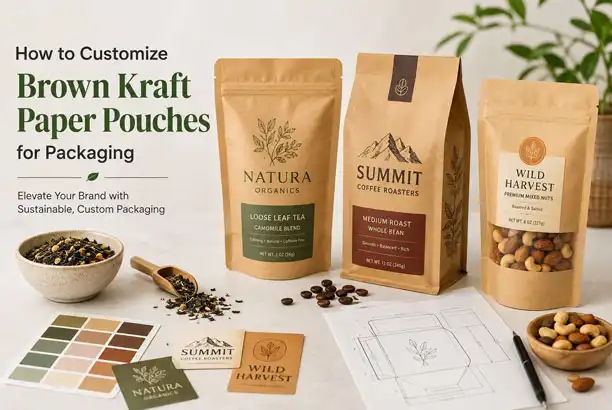
Customizing brown kraft paper pouches for packaging involves selecting the right material structure, choosing functional features like tear notches and hang holes, determining print specifications, and working with an experienced manufacturer who understands barrier requirements and retail presentation. These pouches blend natural aesthetics with protective performance, making them ideal for organic foods, specialty coffee, dried meats, and pet treats. The customization process requires careful attention to material layers, printing techniques, closure systems, and compliance standards to ensure your packaging protects products while communicating brand values effectively.
Understanding Brown Kraft Paper Pouches and Their Benefits
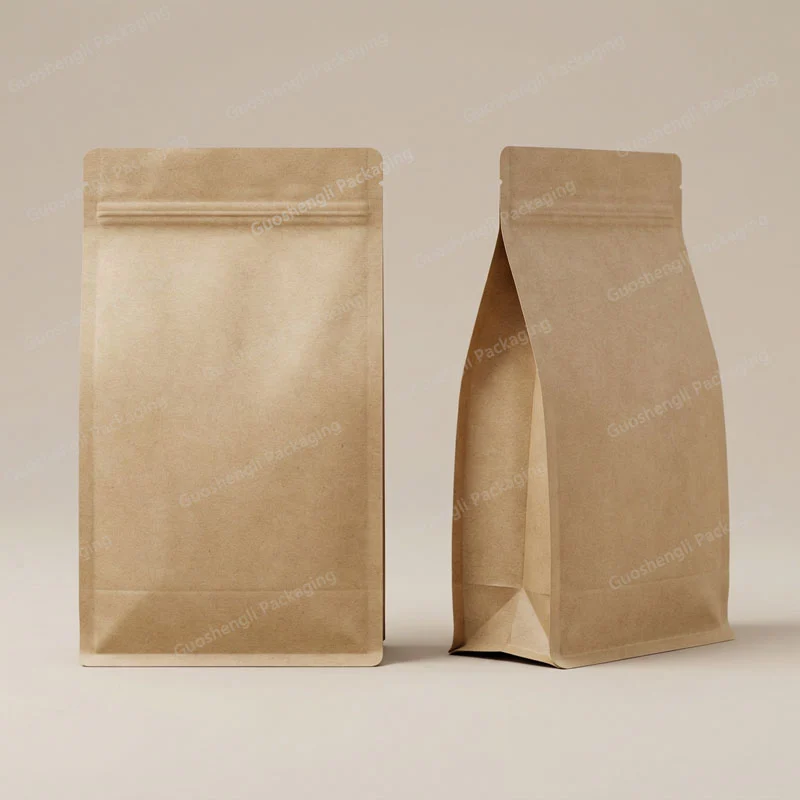
Brown kraft paper pouches are engineered packaging solutions made of advanced barrier laminations and unbleached kraft paper on the outside. These pouches are different from regular paper bags because they can resist water. They have multiple layers, including kraft paper (40–80 GSM), barrier films like aluminum foil or metallized PET, and inner layers that can be sealed with heat. Organic and specialty brands face a big problem: they need to keep their natural, earthy look while also providing the protection needed for longer shelf life. This hybrid construction solves that problem.
Why Natural Kraft Packaging Appeals to Modern Consumers
Kraft paper has a matte, textured surface that tells you it’s genuine without having to say it explicitly, or use words like “environmentally friendly.” For the consumer, kraft packaging always means clarity, little processing and being good for the environment. But when your organic snack or artisan coffee is packaged in brown kraft paper pouches and is prominently displayed in shops, shoppers can instantly recognise that the ingredients are excellent and the brand is trustworthy. The visual shorthand works particularly effectively for products targeted at health-conscious consumers in North America and Europe, where “clean label” branding is the key to getting people to purchase.
Barrier Performance Meets Eco-Conscious Branding
Today’s brown kraft paper pouches are more than ordinary paper bags. The barrier layers formed beneath the kraft surface block air, moisture and UV radiation, the three major elements that degrade products. Our three side seal structure using aluminium foil or EVOH barrier films may extend the shelf life of oxygen sensitive products like roasted coffee beans and dried fruits. For beef jerky and cat treats moisture and scent prevention is highly essential, so they don’t go bad while being delivered and exhibited in shops. This technological performance enables the brands to reach their environmental aims and their practical preserving demands.
Functional Features That Enhance User Experience
The frequency of repeat purchases is directly affected by simplicity of use. Customers prefer it when they don’t need tools to open products and can rip them open easily. Pouches may be converted to retail-ready displays with hang hole options to place on pegboard hooks or display on a table. The resealable zippers keep food fresh once you open it, which is great for foods you eat more than once. Transparent windows allow you to view the goods while preserving the barrier, fulfilling the client demand to see what they purchase. Each beneficial aspect may be introduced depending on the characteristics of the product and the preferences of the target market.
Core Principles of Customizing Brown Kraft Paper Pouches
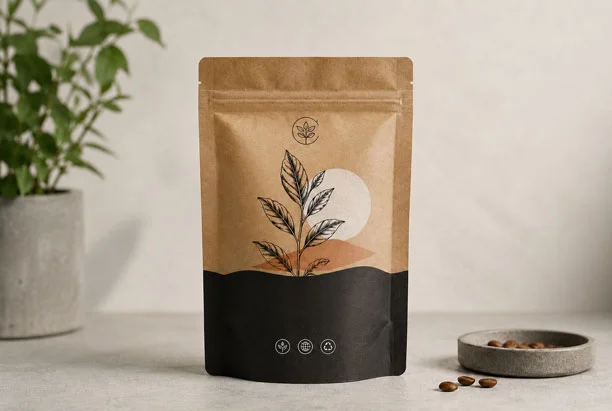
The first stage of good design is to clarify package objectives. Are you primarily speaking about sustainability, product longevity, differentiation on shop shelves, or compliance? Most businesses are trying to achieve many goals at the same time, so they have to make judgements on materials, printing processes, and design features that are fair to all.
Material Structure Engineering for Product Protection
Customised pouch construction incorporates kraft paper for printability and strength, barrier layers like aluminium foil, metalized PET, nylon or EVOH for moisture and oxygen protection, and PE, CPP or LLDPE sealant layers for airtight sealing and filling compatibility. The thickness is typically 120-160 microns. Burst and seal testing ensures consistent performance.
Printing Technologies and Brand Presentation
Rotogravure printing is ideal for long runs on kraft paper up to 11 colours with intricate designs and uniformity. Digital printing is ideal for small orders (less than 20,000 pieces), seasonal products and customisation. Matte, partial UV, and glossy finishes may add to the retail appeal, giving it a natural, accentuated, or luxury look.
Closure Systems and Convenience Features
Heat seals provide robust tamper-evident security for single-use products, while resealable zippers and tin-tie closures facilitate repeated use and enhance kraft-style packaging. Freshly roasted coffee releases CO₂ and degassing valves allow it to escape while keeping air out to maintain quality. Clear windows allow clients to see the products while yet providing the needed barrier protection.
Step-by-Step Guide to Ordering Customized Kraft Paper Pouches
Getting thru the customization process quickly and easily avoids delays that cost a lot of money and makes sure that the packaging meets all technical and marketing needs. Here's how Guoshengli Packaging helps brands along this path.
Supplier Evaluation and Partnership Criteria
Evaluate vendors on certifications, manufacturing capacity, lead times, logistics and technical know-how. Compliance: ISO 9001, BRC, FDA show quality and food-contact safety. Guoshengli Packaging has an annual capacity of 20,000 tons and can handle orders from 20,000 to 20 million bags. Experienced providers should also be able to offer knowledgeable advice on barrier films, kraft-paper lamination and coatings.
Defining Specifications and Requirements
Clear specifications should include product, shelf life, transportation and display circumstances, filling technique, size and needed headspace. The quantity planning should account the demand, storage and order size. Standard sizes save money, bespoke sizes provide you efficiency and a better presence on the shelf. Rotogravure often needs 20,000+ units; digital printing is better for lower runs.
Artwork Preparation and Design Mockups
Vector artwork with outlined fonts, CMYK colours and high definition photos for perfect manufacturing. You may see graphics, gussets, zippers and windows with digital 3D mockups before manufacture and tangible samples confirm materials, printing, filling performance, durability and look.
Production Timeline and Quality Assurance
Production lead times depend on how the order is printed and how complicated it is. Rotogravure printing usually takes 15 to 20 days after the artwork is approved. This includes cutting on the cylinder, printing, laminating, turning, and checking for quality. Digital printing can be done faster (7–10 days), which is good when speed is more important than the extra cost for smaller quantities.
At Guoshengli Packaging, quality control doesn't just happen at the end of the process; it happens all the way thru production. Before packaging, we make sure that the printing colors are consistent with accepted standards, that the lamination bond is strong, that the seal is intact by testing it under pressure, and that the dimensions are correct. Every pouch is looked at visually for flaws to make sure that only packaging that meets the requirements gets to your facility.
Delivery logistics require careful planning for international shipments. Air freight (4-5 days) is best for pressing needs or first trial orders. Ocean shipping, on the other hand, is more cost-effective for bigger numbers and longer planning periods. When suppliers put carton count ahead of pouch protection, compression damage during transit is common. This can be avoided by properly packaging finished brown kraft paper pouches. We use strong boxes and smart bin placement to make sure that the pouches arrive ready to be filled.
Comparison and Decision-Making for Customized Kraft Paper Pouches
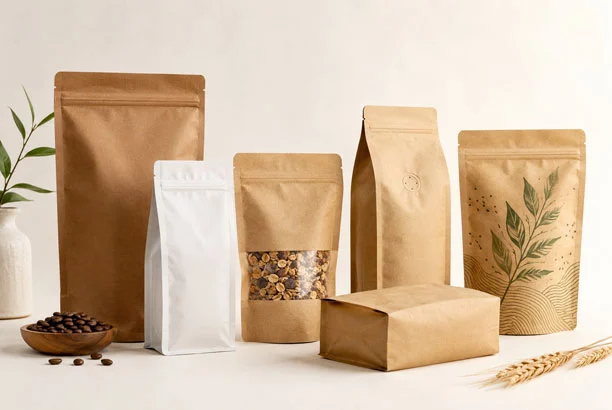
For strategic packaging decisions, you need to know what the trade-offs are between the different choices. How do different options affect performance, cost, and how the business is positioned?
Kraft Paper Versus Plastic Film Pouches
Brown kraft paper pouches make it possible to stand out visually and in the environment in ways that clear or white plastic films can't. Without any extra labels, the natural dark color shows that the product is organic, has been processed minimally, and is committed to sustainability. Plastic pouches have a wider range of protection choices and slightly lower material costs, but they don't stand out on the shelf like kraft does.
Biodegradability claims require careful consideration. Even tho kraft paper breaks down naturally, the aluminum and PE barrier layers that are laminated on top of it stop it from breaking down completely in most situations. Recyclability relies on how well local processes can separate materials. Paper-based barrier technologies are used in fully recyclable kraft bags, but they may not offer as much protection as metal foil structures. When you're honest about the real environmental effects of your products, you can avoid being accused of greenwashing and keep your reputation with knowledgeable customers.
Closure System Selection
When compared to heat-seal-only designs, zipper closures add 15–30% to the cost of pouches, but this investment pays off when the products are used more than once. Resealable bags are great for keeping coffee, nuts, dried fruits, and pet treats fresh and improving the user experience. For single-serving products or products that are eaten right away after opening, the higher cost of the zipper may not be worth it.
The strength of a heat seal depends on the type of caulk layer used and the sealing factors. The PE inner layers close well at a lot of different temperatures and work with most filling machines. CPP is useful when the inner surface appearance is important because it makes things clearer and stiffer. LLDPE is better at keeping things from getting punctured when they have sharp edges.
Plain Versus Custom Printed Kraft Pouches
Custom printing helps people remember your brand and follows the rules by printing information directly on the product. The prices of rotogravure printing include the one-time cost of cutting the cylinder and the cost of printing each unit. This arrangement works best for bigger production runs because the cost of the cylinders is spread out over a lot of units. Digital printing doesn't charge for tools, so even tho it costs more per unit, it's still a good deal for smaller orders.
When designs change a lot or when testing different versions of a product, plain brown kraft paper pouches with labels already on them are flexible. Labels add extra steps to the process of filling and may make fully printed bags look less uniform. This method works well for small production runs or lines of products that change quickly.
Best Practices and Industry Applications
By looking at how big brands create brown kraft paper pouches, we can learn useful strategies that can be used in many different types of products.
Specialty Coffee and Tea Packaging
Coffee roasters always choose brown kraft paper pouches because the natural look goes well with their artisanal positioning. Degassing valves are very important because newly roasted beans keep releasing CO2 for days after they're roasted, and packages that don't have enough air flow can swell or burst. The one-way valve lets out air inside the container while stopping oxygen that would make the coffee go bad in weeks.
With their narrow profile and increased capacity, side gusset pouches make the best use of shelf space. This style can hold anywhere from 12 oz to 5 lb of coffee and stay stable when standing upright. Matte painting keeps the look of handicrafts while giving you bright brand images. A lot of roasters have small clear screens that let customers see the color and level of roasting of the beans. This is a great way to sell specialty grades.
Organic Snacks and Dried Foods
Brown kraft paper pouches are used by natural and organic snack brands to support their stories about using clean ingredients. The package itself becomes a brand statement, so there's no need for clear comments about sustainability that could be seen as greenwashing. Three-side seal pouches are a cheap option for trial sizes and sampling programs, while stand-up styles give products more shelf presence in retail channels.
For nut and seed goods, grease protection is very important. This stops oil from moving inside and staining the paper outer, which makes it look bad. With this technical ability, brands can show off natural looks without sacrificing functionality.
Pet Treat and Freeze-Dried Food Packaging
Pet food brands that use brown kraft paper pouches stand out in a market where most of the packaging is made of plastic. More and more pet owners want natural, barely made foods for their animals, and the way a product is packaged has a big impact on how good people think it is. The natural brown paper look makes you think of healthy foods and responsible production.
For thick, hard treats, being able to prevent punctures is very important. Heavy-gauge kraft paper (70–80 GSM) and strengthened barrier films keep the paper from tearing while it is being handled and displayed. Hang holes let pegboards be put up in places where they will get a lot of attention, like in pet stores where vertical display space is very important. Resealable zippers keep treats fresh so they don't go bad while they're being eaten, which would disappoint customers and get bad reviews.
Personal Care and Wellness Products
Brown kraft paper pouches are used by natural personal care brands to package bath salts, organic soaps, and health vitamins. Before people read the ingredient lists, the packaging tells them about the product's philosophy. Moisture barrier protection is very important—bath goods can't be exposed to humidity that would make them clump or dissolve before they are used.
Transparent windows let you see the colorful bath salts or botanical ingredients inside, and the natural look of the packaging is kept. This way of visual merchandising combines the realness of kraft with the product visibility that customers expect. It works especially well for handcrafted or expensive products that are worth seeing more than paying more for.
Conclusion
When customizing brown kraft paper pouches, you have to find a balance between how they look and how well they work. The natural look successfully expresses brand values, and multi-layer barrier structures safeguard goods during distribution and show in stores. Customization works best when specifications are clear, manufacturing partners are experienced, and prints, closures, and useful features are planned ahead of time. At Guoshengli Packaging, we help brands choose materials, make artwork look its best, do samples, and start production. Our quality systems make sure that all orders get the same results. Personalized brown kraft paper pouches give your new organic snacks, specialty coffee, pet treats, or health goods a unique look on the shelf and fit in with today's environmentally aware customers.
FAQ
1.Can brown kraft paper pouches be fully recycled in municipal systems?
How well brown kraft paper pouches can be recycled depends on the materials that are used as a barrier layer underneath the paper. Pouches with paper-based barrier technologies or PE layers that are easy to separate are better for recycling than structures made of aluminum foil, tho how well they recycle depends on the facilities in your area. In many places, mixed products have to be separated before they can be processed. There are versions that are fully compostable and use PLA liners, but they don't work as well as regular structures as barriers. We suggest being clear about your unique pouch structure instead of making broad claims about how recyclable it is.
2.How do kraft pouches handle greasy or oily products without staining?
For grease protection, you need special inner barrier layers that stop oil from moving thru the layered structure. This keeps oils from nuts, seeds, or fried snacks inside without staining the outside of the kraft. This engineering keeps the product's clean, natural look throughout its shelf life while also protecting it in the way it needs to be protected.
3.What printing methods work best for small production runs?
When printing less than 20,000 units, digital printing is the most cost-effective option because it doesn't require the expensive cylinder engraving that rotogravure printing does. Digital ways have higher costs per unit, but because there are no setup fees, small runs can be done affordably. Professional standards are met for color accuracy and detail quality, but rotogravure works better for large-scale production where setup costs are spread out over many units.
Partner with a Trusted Brown Kraft Paper Pouches Manufacturer
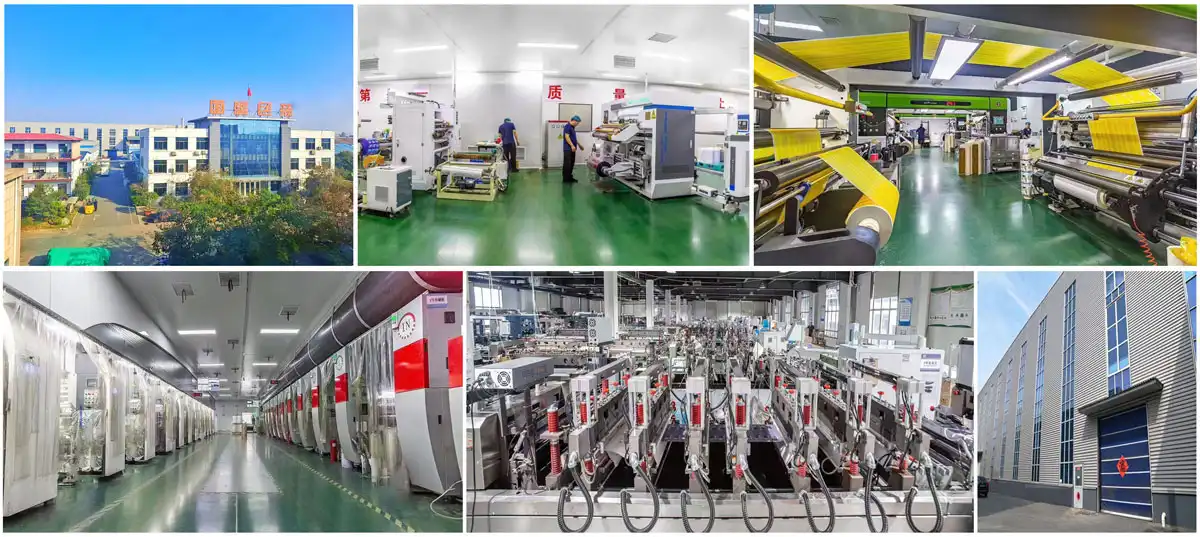
Every customization project that Guoshengli Packaging works on is backed by more than 25 years of experience in flexible packaging. Our rotogravure printing can produce up to 11 colors that stay the same from one production run to the next. Meanwhile, our material research team makes sure that the barrier performance is perfect for your product. We keep our ISO 9001, BRC, and FDA certifications up to date, which makes sure we follow all North American and European food contact rules. Our team gives you expert advice that helps your packaging work reliably from the time you come up with the first specifications to the time you send the finished product. Our 20,000-ton annual capacity can grow with your business, so you don't have to worry about running out of pouches when you need 20 million for national distribution. Our packaging experts can be reached at sales@guoshengpacking.com to talk about your needs for brown kraft paper pouches and get personalized suggestions based on your product and market goals.
References
1. Anderson, M.R. (2021). Sustainable Packaging Materials: Environmental Performance and Consumer Perception. Journal of Packaging Technology and Research, 5(3), 187-203.
2. Chen, L. & Roberts, K.D. (2022). Barrier Technologies in Kraft Paper Laminations: Oxygen and Moisture Transmission Rates. Packaging Science and Technology International, 18(2), 94-112.
3. European Flexible Packaging Association. (2023). Guidelines for Food Contact Compliance in Multi-Layer Pouches. Brussels: EFPA Publications.
4. Morrison, J.T., Phillips, S.E., & Kumar, R. (2020). Printing Techniques for Textured Paper Substrates: Rotogravure and Digital Comparison. International Journal of Print Technology, 12(4), 276-291.
5. Sustainable Packaging Coalition. (2023). Recyclability and Compostability Claims: Best Practices for Laminated Structures. Charlottesville: SPC Technical Reports.
6. Williams, H.A. & Zhang, Q. (2022). Consumer Response to Natural Kraft Packaging in Organic Food Categories. Journal of Marketing Research and Consumer Behavior, 29(1), 45-68.
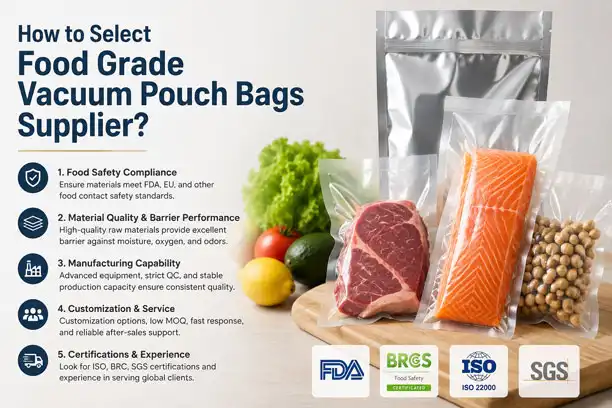
Selecting the right food grade vacuum pouch bags supplier requires evaluating technical specifications, compliance certifications, and manufacturing reliability. Vacuum pouch bags must deliver superior barrier protection, puncture resistance, and sealing integrity to extend shelf life for meat, seafood, and dairy products. The ideal supplier should demonstrate FDA and EU compliance, offer flexible customization, maintain consistent quality across repeat orders, and provide transparent communication. When sourcing packaging for cold chain applications, prioritize suppliers with proven expertise in high-barrier multilayer structures, rigorous testing protocols, and responsive technical support to minimize supply chain risks and protect product quality.
Understanding the Importance of Food Grade Vacuum Pouch Bags
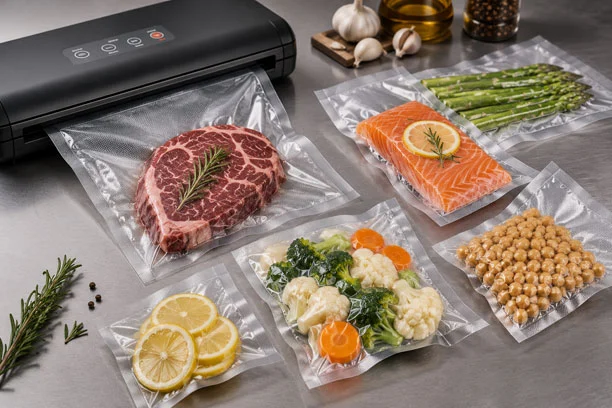
Food grade vacuum pouch bags are an important part of modern food preparation and cold chain operations. These bespoke packaging choices are constructed from recognised safe materials such as Polyamide (PA), Polyethylene (PE) to keep food fresh and make it last longer. Vacuum packaging reduces oxygen exposure and can slow oxidation and the growth of some aerobic spoilage organisms.
Why Material Safety Matters
When we talk about food packaging, material safety is a prerequisite. All films are BPA free and meet all international food handling standards. In the United States, FDA regulations require that packaging materials be suitable for direct food contact. EC 1935/2004 sets forth guidelines on materials which are intended to come into contact with food on the European market. These credentials safeguard your customers’ health and your brand’s reputation.
Barrier Performance and Shelf Life Extension
The efficacy of vacuum pouch bags is based on their ability to keep air out. The low oxygen transmission rate (OTR) and the low water vapour transmission rate (WVTR) are important to keep products fresh. Bags of excellent quality are manufactured using co-extrusion technique with 7-9 layers to provide a strong buffer which prevents delicate proteins from exposure to the outside world. This framework is particularly crucial for enterprises who prepare meat and fish, since they lose a lot of money due to spoiling.
Vacuum packing is more than simply a means to extend the life of products. It uses transparent films to enhance the appearance of objects and display their quality. This creates confidence with consumers and enables companies to operate more sustainably by reducing food waste and without having to use artificial preservatives.
Key Criteria to Evaluate When Selecting a Vacuum Pouch Bags Supplier
Procurement professionals should use a multi-criteria screening method when looking at possible suppliers. To make sure that products always work well, the right provider must meet strict technical, operating, and compliance standards.
Quality and Material Compliance
The quality of the materials used is what makes packaging reliable. Suppliers should give full scientific details, such as the structure of the film, its width range (usually 65–120 microns), and information on how well it acts as a barrier. Ask for test results from a third party that confirm OTR, WVTR, and puncture protection. Food safety standards and quality management systems must be followed, as shown by certifications like ISO 9001, BRC, and FDA compliance.
Quality control goes beyond the first tests. It is very important that performance stays the same for repeat orders. Ask providers about the steps they take for in-process inspections, such as trying the strength of the seal, looking for leaks, and judging the haze. Migration testing proves that films are safe even when they are exposed to high temperatures or acids, which is required by strict food safety rules.
Product Variety and Customization Options
There are different rules for wrapping different kinds of food. Meats that still have bones need films that are thicker and more resistant to punctures. Seafood that is more delicate may do well with standard 65–80 micron pouches. You can meet your production needs with the help of suppliers who offer different types of pouches, such as flat pouches, side gusset pouches, and pouches with embossed or smooth finishes.
Customization options are also very important. Suppliers should be able to meet your specific needs, whether they are for specific sizes, printing options, or custom structures for the materials. Low minimum order quantities (MOQ) make it possible for new brands and smaller processors to get custom solutions without having to pay huge amounts of money up front.
Supply Capacity and Lead Times
A steady source is needed to keep production going. Check a supplier's ability to make things by looking at their inventory of tools, production lines, and output number. When demand goes up, suppliers with more than one printing, laminating, and turning machine can increase production without lowering quality.
Lead times have a direct effect on how quickly you can meet market needs. Standard orders should be finished in one to two weeks, but there are faster choices for those who need them right away. Production delays that cost a lot of money can be avoided with clear scheduling and proactive communication. Suppliers who know about foreign operations can also make sure that shipping, clearing customs, and delivery go smoothly and on time.
Competitive Pricing and Cost-Effectiveness
Prices must strike a balance between quality and affordability. The lowest price usually means that the materials aren't very good or the production isn't very consistent. Instead, look at the total cost of ownership, taking into account things like longer shelf life, less waste, and fewer problems in the supply chain.
Ask for specific quotes that break down the prices of materials, printing, customization, and shipping. Long-term contracts and volume deals can lower the cost per unit without lowering efficiency. When suppliers improve the designs of materials based on your application, you can save money while still getting barrier protection.
These factors help purchasing teams find suppliers who provide consistent quality, operational dependability, and long-term value. Using a systematic review method lowers risks and helps people make smart choices.
Comparing Vacuum Pouch Bags from Top Brands and Suppliers
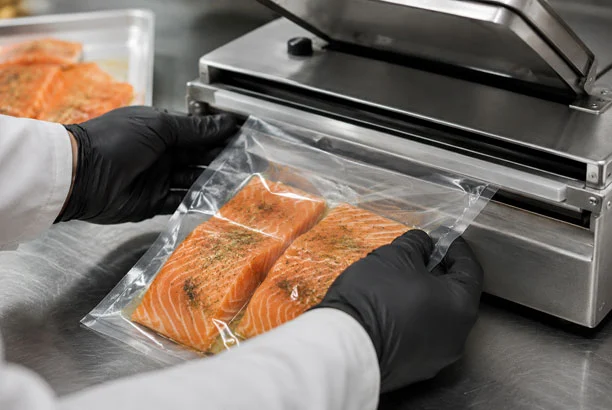
Knowing how the top providers set themselves apart helps buyers make smart, fact-based decisions. FoodSaver and VacMaster are well-known in the consumer market, but industrial-grade skills need to be looked at more closely in B2B purchases.
Material Thickness and Structural Integrity
The thickness of the material has a direct effect on how well it blocks and resists punctures. Standard vacuum pouch bags are 65 to 80 microns thick and can hold both soft proteins and dry goods. Heavy-duty uses, like meat with bones and shellfish with sharp edges, need 100 to 120 micron films to keep the seal from breaking while the food is being handled and transported.
Suppliers should be clear about multilayer structures, like PA/PE or PET/PE laminates, and give information on mechanical testing. High puncture resistance, measured in Newtons, keeps the integrity of the packaging even in the harshest cold chain conditions.
Sealing Compatibility and Machine Integration
Problems often arise when it comes to sealing compatibility. For industrial processing plants, smooth vacuum pouch bags work with chamber vacuum machines. On the other hand, embossing (textured) bags can fit external suction sealers that are popular in smaller operations. When bag types don't fit, seals get weak, air leaks out, and food goes bad.
Suppliers you can trust will give you both choices and help you figure out how to match the bags to your closing tools. Important success markers include how well the heat seal works with other materials, how strong it is under pressure, and how wide it stays the same.
Supplier Support and Technical Assistance
Technical support distinguishes strong suppliers from transactional ones. Packaging engineers, on-site surveys, troubleshooting, and application testing help optimize performance. Clear return policies, quality guarantees, and responsive service reduce operational risks by resolving seal failures or dimensional inconsistencies quickly. Evaluating these factors ensures supplier compatibility, reliable products, and smooth production.
How to Assess Supplier Reliability and Build Long-Term Partnerships
Supplier dependability goes beyond what's written in the product specs. To make partnerships that last, you need to look at things like credentials, operational stability, and how well they fit with your business goals.
Credentials, Certifications, and Factory Audits
Do a lot of research to make sure the provider is real. Get copies of the ISO 9001, BRC, FDA, and any other area licenses that are important. These credentials show that they follow the rules for food safety and quality management.
Factory checks give you first-hand information about how well a factory works. Check the cleaning, process controls, production tools, and training for employees. Suppliers who are open about how they do business and talk to customers show that they believe in their standards.
Case studies and comments from customers are other ways to prove something. References from businesses in similar fields, like seafood, dairy, and meat processing, show that the person is skilled and reliable.
Aligning Supplier Capabilities with Industry Demands
Different businesses have different rules about how to package their goods. Puncture resistance and cold storing stability are important to meat producers. Sous-vide brands need to be able to handle high temperatures and be safe for food. Low OTR is needed by cheese makers to stop mold growth.
Check to see if a supplier's portfolio fits with what you need. Suppliers that focus on cold chain packing know the technical hurdles and rules, so they can give you options that work with the way you do business.
Consistent Quality Controls and Contingency Planning
Reliable providers are always the same when you place another order. Find out about tracking batches, statistical process control, and methods for corrective action. Suppliers who keep tight limits on sizes, seal strength, and barrier qualities keep variations that slow down production lines to a minimum.
Planning for what could go wrong in the supply chain is called contingency planning. Suppliers with a variety of raw material sources, extra production capacity, and strong logistics networks lower the risks that come with equipment breakdowns, lack of materials, or delays in shipping.
Transparent Communication and Long-Term Alignment
Partnerships work best when people talk to each other openly and work toward the same goals. Buyers trust and work with suppliers who keep them informed about the status of their orders, the availability of materials, and any problems that might come up.
Talk about long-term goals when choosing a source. Aligning on strategic goals makes the relationship stronger and helps both of you grow, whether you're trying to break into new markets, be more environmentally friendly, or cut costs.
Supply chain resilience and operational success depend on working with suppliers who value trustworthiness, openness, and constant improvement.
Practical Tips for Procuring Vacuum Pouch Bags for Food Storage Applications
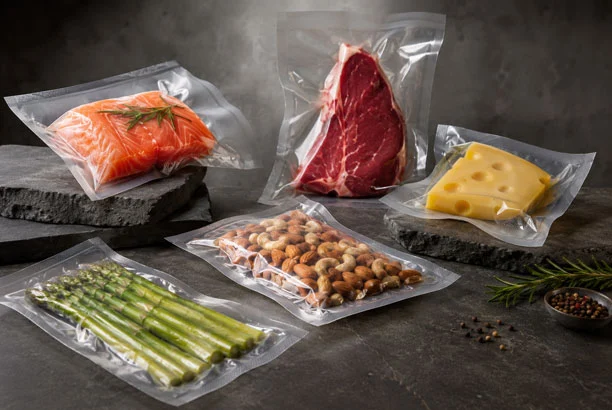
It's important to match technical specs with product features and operational processes in order to choose the best vacuum packaging for your needs.
Selecting Appropriate Bag Sizes and Thicknesses
The size of the bag should fit the size of the product with as little extra material as possible, which will save money and make sure the bag seals well. Which thickness to use depends on the type of product and how it will be handled. Meats with bones and shellfish need thicker films that won't tear easily. With standard gauges, it's easy to measure delicate things like cheese or prepared foods.
Talk to your providers to find out what the best standards are for your products. Customizing sizes lets you get the perfect fit and make the best use of your materials.
Ensuring Compatibility with Packaging Machinery
The vacuum pouch bags you use must work well with the packaging equipment you use. For air extraction, chamber vacuum sealers need bags that are smooth, while external suction sealers need bags that have raised patterns. Check for compatibility to avoid seal failures and delays in production.
Technically-savvy suppliers can help you figure out what kinds of bags will work best with your equipment and even send you samples for testing. Before placing bulk orders, testing in real production conditions finds any problems that might arise.
Sealing Techniques and Best Practices
How well packaging works depends on how well it is sealed. The stability of the seal is compromised by product leftovers like fat, moisture, or particles. Clean closing methods should be used, and bag sides should be free of debris before sealing.
Temperature, rest time, and pressure should all be adjusted in the heat seal so that it works best with the structure of the film. To get consistent, reliable seals, suppliers can give advice on how to set up the machine and fix problems.
Safe Reuse and Compliance with Food Safety Standards
Even though vacuum pouch bags are usually only used once in business settings, it's important to know that they can't be used more than once. Repeated use may weaken the barrier's qualities and increase the chance of contamination. Following the rules means you can't use the same bags for raw meat or other high-risk products.
If you want to save money by reusing something, talk to the suppliers about how long the film lasts and how to clean it. Safety and compliance should come before small cost cuts.
By using these useful tips, you can be sure that your vacuum packaging works at its best, protects product quality, and helps your business run more efficiently.
Conclusion
Choosing the right provider for food grade vacuum pouch bags is a smart choice that affects the quality of the product, the reliability of the supply chain, and the company's long-term profits. To do a good job of buying, you need to look at things like material compliance, barrier performance, puncture resistance, and temperature stability. Suppliers must show certifications like FDA and EC 1935/2004, allow for easy customization, and keep quality the same for repeat orders. In addition to product specs, you can figure out how reliable a seller is by inspecting the plant, reading customer reviews, and talking to them openly. Procurement pros can find package solutions that improve brand image in global markets, extend shelf life, and cut down on spoilage by using a structured evaluation framework and putting long-term relationships at the top of their list of priorities.
FAQ
1.What certifications should a food grade vacuum pouch bags supplier have?
Suppliers with a good reputation must follow FDA rules for the U.S. market and EC 1935/2004 rules for the European market. BRC certification proves that food safety standards are met, while ISO 9001 certification shows that quality management systems are in place. Ask for test reports from a third party that prove the material is safe, works as a barrier, and doesn't contain any harmful chemicals like BPA.
2.Can vacuum pouch bags be reused for food storage?
It varies on how long the vacuum pouch bags lasts and what kind of product it is. To keep things safe and the barrier intact, industrial vacuum pouch bags are usually only meant to be used once. Reusing bags for raw meat or other high-risk foods can make them dirty and is against the rules for food safety. If you want to reuse the film for low-risk goods, talk to your supplier about the film's specs and how to clean it.
3.How do I verify that vacuum pouch bags are BPA-free and food-safe?
Ask your source for material safety data sheets (MSDS) and test results from a third party. These papers should prove that the product is made without BPA and follows FDA or EC rules. Migration testing makes sure that films don't give off harmful chemicals when they are exposed to high temperatures or acids.
4.What thickness is best for packaging bone-in meats?
When handling and transporting bone-in meats, they need thicker films, usually 100 to 120 microns, to keep them from getting pierced. High puncture resistance protects the vacuum and keeps the product from going bad. Talk to your provider about how to match the film width to the properties of the product and how it will be handled.
Partner with a Trusted Vacuum Pouch Bags Manufacturer
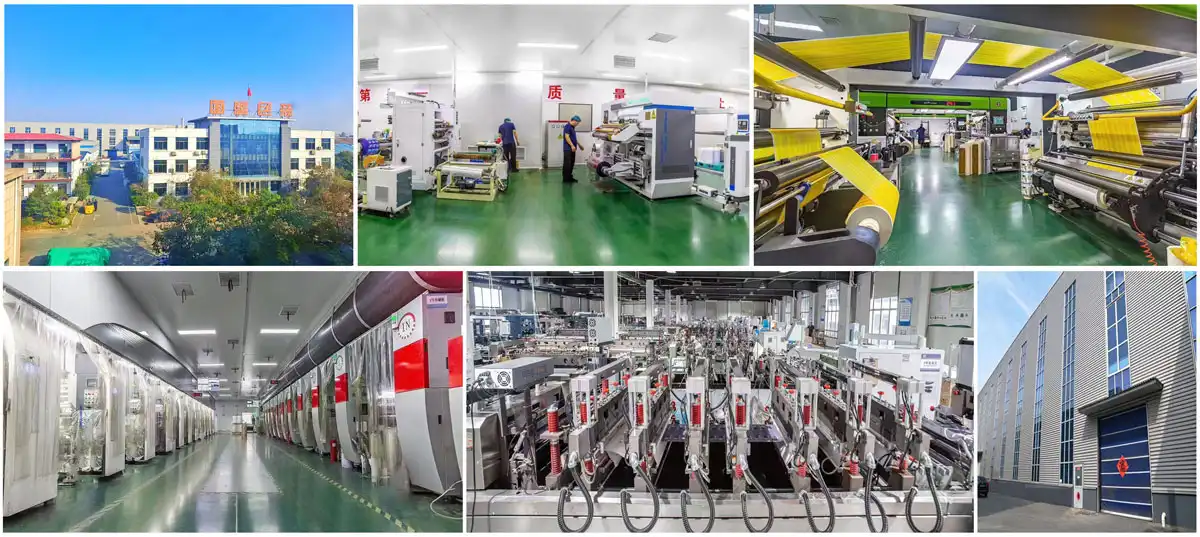
Guoshengli Packaging sells vacuum pouch bags made for professionals that are designed to prepare meat, fish, and cheese. Our multilayer PA/PE and PET/PE designs are very resistant to punctures, have low OTR, and shut airtightly. We make sure we follow foreign food safety standards by having ISO 9001, BRC, and FDA certifications. Our factory-direct model gives you low prices, a flexible minimum order quantity (MOQ) that starts at small batches, and quick lead times of one to two weeks for standard orders.
We help business-to-business buyers by making solutions that are special to their products, filling tools, and government rules. Our technical team is here to help you every step of the way, whether you need clear films to see your products, high-temperature-resistant pouches for sous-vide, or heavy-duty bags for meats with the bones still in them.
To talk your vacuum pouch bags needs, please contact us right away at sales@guoshengpacking.com. Learn more about all of our flexible packaging options by going to guoshengpack.com. With reliable, high-barrier vacuum packaging, Guoshengli Packaging can help you keep your products fresh longer, keep them from going bad, and increase their shelf life.
References
1. Smith, J. (2021). Food Packaging Technology: Principles and Practice. Cambridge: Woodhead Publishing.
2. Johnson, M. & Lee, K. (2020). Barrier Properties of Multilayer Films for Vacuum Packaging Applications. Journal of Food Engineering, 45(3), 112-128.
3. European Commission. (2004). Regulation (EC) No 1935/2004 on Materials and Articles Intended to Come into Contact with Food. Brussels: Official Journal of the European Union.
4. U.S. Food and Drug Administration. (2022). Packaging & Food Contact Substances (FCS). Washington, D.C.: FDA Center for Food Safety and Applied Nutrition.
5. Robertson, G. (2019). Food Packaging and Shelf Life: A Practical Guide. Boca Raton: CRC Press.
6. Brown, A. & Chen, L. (2023). Quality Control and Testing Protocols for Vacuum Pouch Bags in Meat Processing. Packaging Technology and Science, 38(2), 89-104.
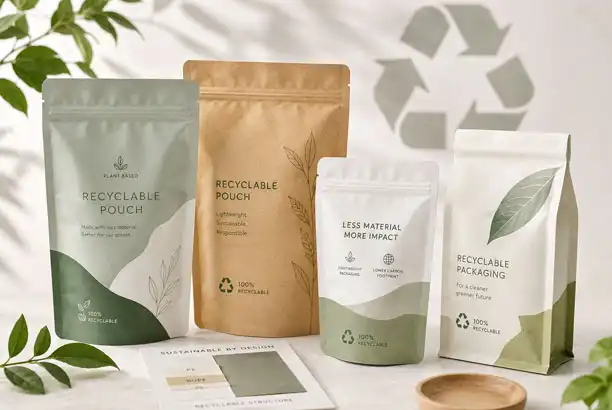
The future of flexible packaging is recyclable pouches for firms who want to go green without sacrificing product protection or shelf appeal. Constructed from mono-material structures, either polythene (#4 PE) or polypropylene (#5 PP), these pouches easily integrate into existing municipal recycling systems, providing a much-needed answer to the urgent call to reduce plastic waste, while maintaining the barrier performance, print quality and sealing integrity demanded by food, pet food and personal care products. Recyclable packaging provides easier processing at end-of-life than standard multi-layer laminates of incompatible materials and promotes programmes for a circular economy that appeal to eco-conscious customers and governments throughout the globe.
Understanding Recyclable Pouch Packaging
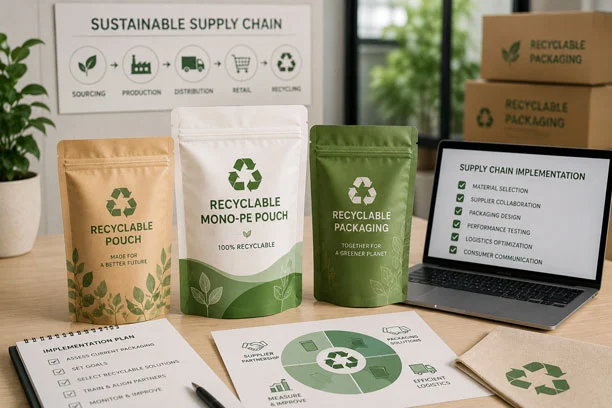
Today’s recyclable pouches are constructed from mono-material compositions that can be processed by the current plastic recycling streams. In the classical sense, flexible packaging is basically a combination of aluminium foil, polyester, nylon and polythene which cannot be properly separated or reprocessed by recycling facilities. This mono-material building is a major leap forward in sustainable engineering.
What Makes Packaging Truly Recyclable?
The true recyclability is determined by whether the material can be processed by the area recycling infrastructure. Recyclable pouches made from 100% PE or PP may be identified by conventional optical scanners and will be recyclable. Key technical advancement is replacing multi-material barriers with single polymer structures further enhanced by particular coatings such as EVOH (ethylene vinyl alcohol) in thin layers that do not interfere with recyclability.
Third party certification on whether packaging is recyclable is offered by certifying bodies as RecyClass in Europe and the Association of Plastic Recyclers in North America. These certifications provide procurement teams tangible data to back up sustainability claims and prevent greenwashing charges that may damage a company's reputation.
How Recyclable Pouches Differ from Biodegradable and Compostable Options
Recyclable, biodegradable and compostable packaging terms sometimes confound procurement experts. Biodegradable materials degrade due to natural microbial activity however they may also turn into microplastics instead of fully degrading. Compostable pouches need to be processed in industrial composting facilities where factors like temperature and humidity are controlled - an infrastructure that is currently lacking even in industrialised nations.
Recyclable pouches, however, provide a real advantage to the millions of homes and businesses that now are serviced by waste management systems. These products provide higher true recovery rates than biodegradable materials, which often end up in trash when composting is not an option.
The Lifecycle of Mono-Material Flexible Packaging
By understanding the whole lifespan, marketers can see how their packaging decisions effect the environment. Recyclable pouches of virgin or recycled PE or PP resin pellets. Manufacturing includes extrusion, printing using water-based inks, lamination with solvent-free adhesives and formation of pouches utilising heat sealing. Consumers throw empty pouches in recycling bins after use, where they enter streams of plastic films collected individually or combined with rigid containers, depending on local programmes.
Optical sorters help recycling facilities determine the material type, while balers compact the gathered films. Reprocessors clean and melt the material into recovered pellets. These pellets provide the raw material for new packaging, building materials or consumer products and complete the circular loop.
Key Benefits of Using Recyclable Pouch Packaging for B2B Clients
The competitive advantage for brands that use recyclable pouches much exceeds their commitment to the environment. These benefits influence operational efficiency, market positioning and long-term corporate resilience in an increasingly eco-conscious world.
Enhanced Brand Reputation and Consumer Trust
Consumers nowadays are increasingly aware of packaging options. Switching to recyclable pouches is a real commitment to be environmentally responsible, creating emotional connections with their target audiences and allowing them to distinguish themselves from rivals who still use non-biodegradable packaging.
A reputational edge like this is vital for fledgeling firms confronting industry giants. Marketing platforms, social media and point-of-sale displays are wonderful story telling possibilities to share the tale of mono-material construction and recyclability. Such sustainability pledges are reliable signals of trust that influence purchasing behaviour and build consumer loyalty when supported by real certifications.
Regulatory Compliance and Risk Mitigation
The Extended Producer Responsibility (EPR) standards already exist in European Union member states, Canada, and a number of U.S. states including California, Maine, Colorado and Oregon. Such restrictions tax corporations for recycling infrastructure based on how recyclable their packaging is and how damaging it is for the environment. Increased prices for non-recyclable formats will immediately eat into corporate profitability.
The recyclability of the pouches means brands may meet their EPR requirements at a lower compliance cost. The European Union's Packaging and Packaging Waste Directive aims for all packaging to be recyclable by 2030, with interim targets for specific recycling rates of plastic packaging. The earlier brands adopt recyclable packaging, the better, avoiding the shock of future legislation and the expense of emergency reformulations as compliance deadlines loom.
Cost Efficiency Through Material Optimization
The upfront per unit cost of recyclable pouches may be 10-20% more than standard multi-layer laminates, however total cost analysis indicates prospects for savings. Mono-material constructions avoid the need for specialised adhesives or sophisticated lamination procedures, which reduces the complexity of production. They are also lighter than rigid containers, which decreases transportation costs and the carbon impact across the supply chain.
We negotiate bulk purchase contracts with established manufacturers improving cost efficiency . Brands that place constant volume get economies of scale, steady pricing and priority on production schedule. When you include the EPR fees saved, the lowered waste disposal expenses, and the impact of an improved brand image on the sales opportunity with a sustainability-conscious customer base, the ROI becomes even more attractive.
Versatility Across Product Categories and Applications
The recyclable pouches are suitable for many goods from food to pet food to personal care and household categories. Stand-up pouches with resealable zipper are ideal for snacks, coffee, protein powders and pet treats. Flat bottom designs are good for premium products that require a strong retail presence since they are very stable on the shelf. The spout designs work well with liquid and semi-liquid goods such as sauces, baby food and cleaning concentrates.
Customisation options allow companies to maintain their own visual identity while also adopting environmentally friendly procedures. Up to 11-color rotogravure and digital printing techniques allow for rich graphics, photographic pictures and gorgeous typography on matte, glossy or soft-touch surfaces. Recyclable pouches may be just as effective as traditional packaging and achieve environmental objectives with practical features such as tear notches, hanging holes, clear windows and anti-fog coatings.
Comparison of Recyclable Pouches with Other Packaging Options
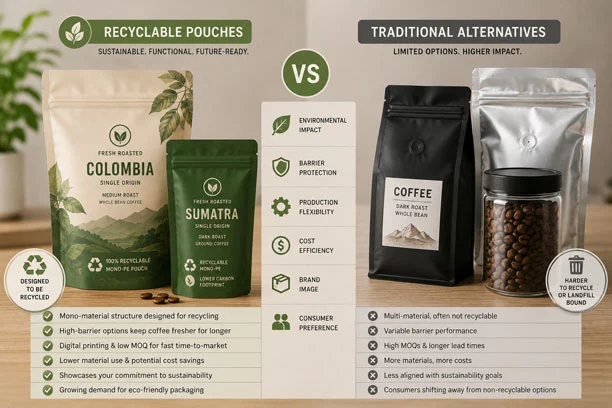
Procurement teams evaluating recyclable pouches need clear performance and sustainability comparisons to make informed decisions that balance product protection, brand presentation, environmental impact, and cost considerations.
Recyclable Pouches vs. Traditional Multi-Layer Laminates
Flexible packaging is often produced from mixtures of materials such as PET, aluminium foil and PE to provide barriers to oxygen, moisture and light. This technology gives a high shelf life but has end-of-life concerns since the bound layers cannot be separated and reprocessed by recycling facilities. The outcome: Most multi-layer pouches end up in landfills or incinerators, even when customers recycle them.
Similar barrier properties may be accomplished using recyclable mono-material based pouches with coatings or thin EVOH layers that are compatible with recycling. Well-designed mono-material pouches can retain sensitive products like coffee, almonds and pet food in excellent condition, fulfilling shelf-life requirements for most applications, according to independent study. whether firms are concerned about the ultra-high barrier requirements for products with a 24+ month shelf life, consult with packaging experts to find out whether new coatings can satisfy both protection and recyclability objectives.
Recyclable Pouches vs. Paper-Based Packaging
Brands looking for sustainable source material and natural aesthetics are drawn to paper packaging. However, most paper pouches need plastic liners or coatings to deal with moisture and grease, thereby making them composites that are difficult to recycle, much like multi-layer laminates. Unbleached paper alternatives are only good for dry, non-perishable things with a short shelf life.
Plastic pouches are recyclable, they’re superior than paper for moisture resistance, durability in transportation and actual recycling rates. Films of PE and PP are accepted by municipal recycling schemes but paper is often not, especially if contaminated or coated. And in terms of weight, plastic wins there as well: a typical recyclable bag weighs 40-60% less than equivalent paper packaging, which reduces emissions and shipping costs when transporting them.
Recyclable Pouches vs. Rigid Containers
Glass jars and rigid plastic containers are excellent for product preservation and premium retail look but have a far higher environmental footprint. Glass manufacture uses a lot of energy and the increased weight is responsible for 300-500% more transport emissions than flexible pouches. Rigid plastic containers are ostensibly recyclable, however they need 3-4 times the amount of material as similar pouches.
Flexible, recyclable pouches for space savings in the supply chain. They take up less space in warehouse storage before filling, nest well during transportation and reduce shop shelf space requirements - a big tick considering the price of retail floor space. Empty pouches provide less waste volume than big, rigid containers once consumers have used them. This type of material efficiency directly leads to less carbon emissions, reduced logistical expenses and higher sustainability numbers.
How to Source and Procure Recyclable Pouch Packaging Efficiently
Successful procurement of recyclable pouches requires strategic supplier selection, clear specification development, and relationship management that ensures consistent quality across repeat orders and production scaling.
Identifying Qualified Manufacturers and Suppliers
There are dozens of flexible packaging producers worldwide, but few have the technical know-how and certifications to develop truly recyclable pouches that fulfil international food safety and recyclability criteria. Procurement teams should seek for vendors that have ISO 9001 quality management certification, BRC food packaging accreditation, and FDA or EU food contact material compliance documents.
Request proof of successful testing for recyclability via recognised certification programmes. The experienced providers give comprehensive technical data sheets with information on material composition, barrier qualities, heat seal strength and compatibility with typical filling equipment. Manufacturers in China, South-east Asia and India have competitive prices and modern manufacturing capabilities. Guoshengli Packaging has 25 years of expertise in making flexible packaging and operates 7 rotogravure printing lines, 6 laminating machines and 49 conversion lines—offering production capability that can accommodate both short test runs and big continuous supply contracts.
Key Procurement Considerations and Specifications
Specific details in specs help to avoid expensive misunderstandings and guarantee that packaging satisfies functional requirements. Critical parameters are: material composition (mono-PE or mono-PP), thickness measurements, barrier requirements (oxygen transmission rate, moisture vapour transmission rate), print colour counts and registration tolerances, pouch dimensions, seal strengths and features like zippers, valves or spouts.
Minimum order quantities (MOQs) may vary greatly depending on the manufacturer and manufacturing process. Digital printing allows you to create smaller minimum order quantities – often as little as 500 to 1,000 pouches – making it a good option for product launches, seasonal goods or speciality products made in small batches. Rotogravure printing has larger minimum order quantities, often between 10,000 and 50,000 bags, but it offers the best colour consistency, durability and cost per unit for continuous production runs.
Building Strategic Supplier Relationships
The transactional approach to buying is not conducive to ongoing improvement and technological innovation. With the right strategic alliances with competent recyclable pouch manufacturers, you’ll get benefits like priority production scheduling during busy seasons, advance notification of material pricing changes, collaborative development of innovative packaging solutions, and technical assistance when production challenges emerge.
We keep regular contact to be aligned on quality standards, delivery timelines and developing sustainability targets. Quarterly business reviews give an opportunity to analyse performance indicators, discuss strategies to reduce costs and prepare for capacity needs for impending product launches. Suppliers committed to long-term partnerships are able to be flexible in dealing with unanticipated changes in demand and proactively recommend improvements drawing on their expertise with a variety of customers and sectors.
Best Practices for Using and Recycling Recyclable Pouches
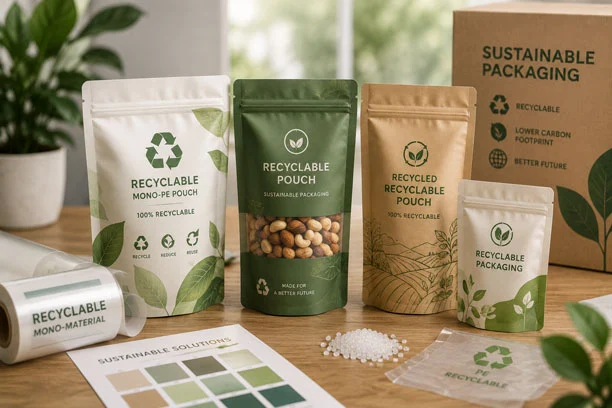
Maximizing the environmental benefits of recyclable pouches requires attention to design decisions, consumer education, and supply chain coordination that support high recovery and recycling rates.
Design Strategies That Enhance Recyclability
Material selection is the basis of recyclability, however design elements greatly influence the actual recycling results. Do not include superfluous components that might complicate the separation of materials; for example, ask for zippers constructed from the same base resin as the bag body, rather than adding incompatible materials. If transparency is needed in windows, go for PE or PP film rather than PET or other polymers that contaminate recycling streams.
Ink saturation greatly influences the economics of recycling since deeply inked materials need to be washed more thoroughly during reprocessing. Attractive visuals are necessary for brand exposure but leave certain areas unprinted or reduce ink densities when practical. Water based inks and solvent free adhesives reduce the environmental footprint during production and provide cleaner recyclate when reprocessed. Labels and secondary packaging should be made of materials that can be cleanly separated during the recycling wash process.
Consumer Education and Collection Infrastructure
Even the most carefully engineered recyclable pouches provide little environmental advantage if users don’t dispose of them responsibly. Clear recycling instructions on packaging boost correct disposal rates. The How2Recycle label programme offers standardised, science-based recommendations that customers recognise and trust. Messaging such as “Store Drop-Off” for flexible films in areas lacking kerbside film collection or “Check Locally” for areas with varying infrastructure supports customers in efficiently navigating their local recycling alternatives.
Brands may boost their influence by supporting the development of recycling infrastructure. Getting involved in industry efforts like the Flexible Film Recycling Group, or working together with retail collection programmes, helps boost access to correct disposal routes. In the absence of municipal infrastructure, several major companies have formed mail-back programmes or worked with specialised recyclers like TerraCycle to provide collection alternatives.
Supply Chain Integration and Performance Monitoring
Getting recyclable packaging programmes to work requires collaboration across the procurement, operations, marketing and sustainability departments. Procurement requirements should require verification testing of recyclability claims prior to mass implementation. Monitoring performance throughout the filling procedure provides effective pouch runs on current equipment without line stoppages or product quality concerns.
Monitor important performance indicators such as enhancements in recycling rates, waste diversion statistics, and comments from customers on packaging sustainability. These data points illustrate programme efficacy to stakeholders and point to potential for further development. Top companies produce yearly sustainability reports that record package transitions and increased recycling rates – openness that builds stakeholder trust and competitive positioning.
Conclusion
Recyclable pouches deliver measurable advantages for brands committed to environmental responsibility, regulatory compliance, and long-term market competitiveness. By transitioning from traditional multi-layer laminates to mono-material PE or PP structures, companies reduce plastic waste, satisfy Extended Producer Responsibility requirements, and build consumer trust through authentic sustainability actions. The packaging performance rivals conventional options while supporting circular economy principles that define responsible business practices in an era of heightened environmental awareness. Strategic procurement ensures brands secure high-quality solutions that protect products and advance corporate sustainability objectives without compromising operational efficiency.
FAQ
1.Are recyclable pouches accepted in all municipal recycling programs?
Acceptance of recyclable pouches varies by region depending on local infrastructure. Many municipalities with curbside film recycling accept PE and PP pouches alongside plastic bags and wraps. Areas without curbside film collection typically offer store drop-off programs at grocery retailers. The How2Recycle label system provides location-specific guidance that helps consumers navigate their local options effectively, often indicating "Store Drop-Off" for flexible films or urging users to "Check Locally" for current guidelines.
2.How do costs compare between recyclable pouches and traditional packaging?
Initial per-unit costs for recyclable pouches typically run 10-20% higher than conventional multi-layer laminates due to specialized materials and manufacturing processes. Total cost analysis often reveals savings through reduced EPR compliance fees, lower transportation costs from lighter weights, and potential revenue gains from enhanced brand reputation among sustainability-focused consumers. Bulk procurement agreements and production at scale further improve cost competitiveness.
3.Can recyclable pouches maintain product freshness for sensitive products?
Properly engineered mono-material pouches with EVOH coatings or advanced barrier technologies achieve shelf life performance comparable to traditional laminates for most applications. Independent testing confirms 12-18 month protection for coffee, nuts, pet food, and similar products. Ultra-sensitive products requiring 24+ month shelf life may need specialized structures—consultation with packaging engineers ensures optimal solutions balancing protection and recyclability.
4.What customization options are available for recyclable pouches?
Recyclable pouches support extensive customization including multiple pouch styles (stand-up, flat bottom, spouted, three-side seal), rotogravure or digital printing up to 11 colors, various finishes (glossy, matte, soft-touch), and functional features like resealable zippers, tear notches, and transparent windows. These options ensure brands maintain distinctive visual identities while embracing sustainable packaging.
Partner with Guoshengli Packaging for Your Recyclable Pouch Solutions
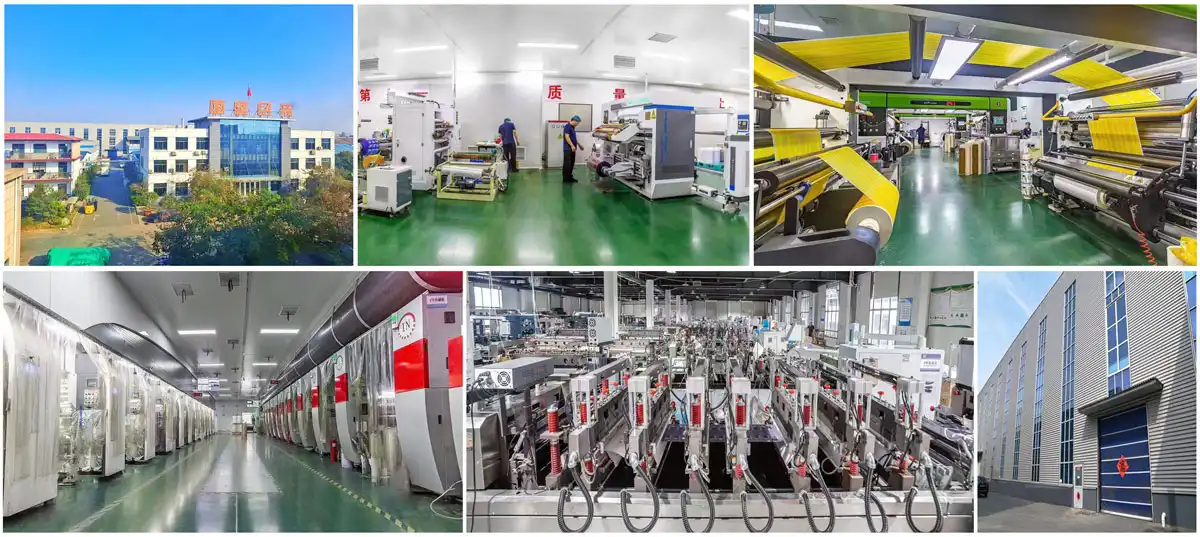
Guoshengli Packaging brings over 25 years of flexible packaging manufacturing excellence to brands seeking reliable recyclable pouches that satisfy both environmental imperatives and operational realities. Our advanced production facility—equipped with 7 rotogravure printing lines, 6 laminating machines, and 49 converting lines—delivers mono-material PE and PP pouches that satisfy recyclability requirements without compromising barrier protection, print quality, or sealing performance. We hold ISO 9001, BRC, and FDA certifications that ensure consistent quality and food safety compliance across all orders.
Whether your brand requires small-batch digital printing with MOQs as low as 500 pouches or high-volume rotogravure production for ongoing supply, our flexible manufacturing capabilities accommodate diverse business needs. Lead times from 7-10 days for digital projects and 15-25 days for rotogravure work help you respond quickly to market opportunities while maintaining inventory efficiency. Contact our team at sales@guoshengpacking.com to discuss your specific requirements, request technical specifications, or arrange sample shipments that demonstrate how our recyclable pouches can advance your sustainability objectives.
References
1. Sustainable Packaging Coalition (2022). "Consumer Perspectives on Sustainable Packaging: Global Research Findings." GreenBlue Organization.
2. European Commission (2021). "Packaging and Packaging Waste Directive: Revised Recycling Targets and Extended Producer Responsibility Requirements." Official Journal of the European Union.
3. Association of Plastic Recyclers (2023). "Design Guidelines for Recyclable Flexible Plastic Packaging." APR Technical Standards Committee.
4. McKinsey & Company (2021). "The Drive Toward Sustainability in Packaging: Beyond the Quick Wins." Consumer Goods & Retail Practice Report.
5. Ellen MacArthur Foundation (2022). "The New Plastics Economy: Rethinking the Future of Plastics and Catalyzing Action." Circular Economy Initiative.
6. RecyClass (2023). "Recyclability Evaluation Protocol for Flexible Plastic Packaging." Plastics Recyclers Europe Technical Standards.
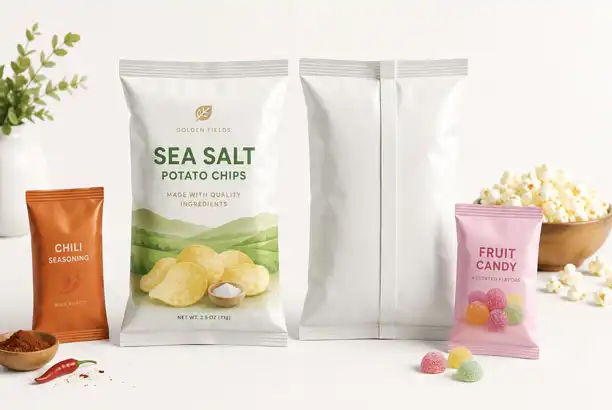
Selecting the right fin seal pouch depends on matching your product requirements—such as barrier needs, shelf-life expectations, and production speed—with the pouch's material structure and seal strength. Consider high-speed compatibility for candy and snack lines, oxygen and moisture barriers for freshness, customization options like transparent windows or euro holes for retail appeal, and supplier certifications to ensure food-safe compliance. Balancing unit cost with MOQ requirements helps optimize your budget while maintaining consistent quality across production batches.
Understanding Pillow Pouches: Definition, Function & Benefits
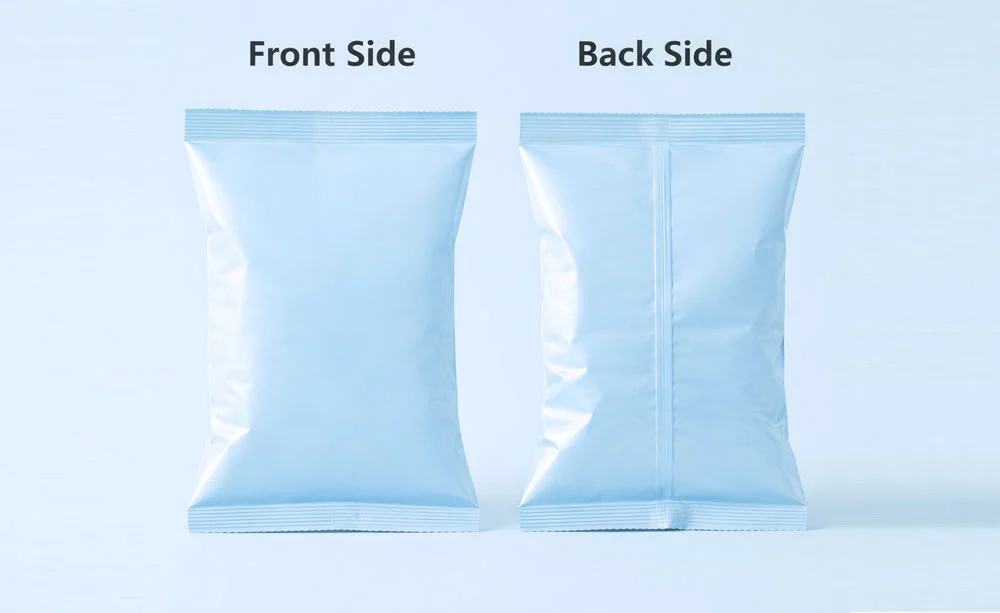
Packaging may be a make or break factor for your goods in the market. When making candies, snacks, or frozen meals in volume, you need packaging that preserves quality while operating smoothly on high-speed lines. Pillow pouches (sometimes called fin seal pouches) give just that combination.
What Makes the Back Seal Structure Reliable
A fin seal pouch is formed by folding flexible material and sealing the inner surfaces to themselves on the rear panel to produce a noticeable projecting fin. This back centre seal provides an air tight barrier to keep out moisture, oxygen and pollutants. The interior-to-interior seal results in a stronger link than lap seals that bind exterior to inner layers . Both sides have the same material qualities . This structure lends itself well to use in Vertical Form-Fill-Seal (VFFS) and Horizontal Form-Fill-Seal (HFFS) applications where speed and repeatability are important. Your manufacturing line has fewer stoppages and more predictable output.
Core Benefits That Impact Your Bottom Line
When you choose cushion packing, you’re getting real benefits for your business. Better sealing strength equals fewer rejected bags and less product waste in transportation. The hermetic seal excludes the atmosphere to prolong shelf life. This decreases returns and customer complaints. That material efficiency translates to cheaper prices per unit, not to mention the fact that you’re purchasing tens of thousands of pouches every month. The sleeker design also makes these bags easier to store in inventory, since they stack well and occupy less space than their more rigid counterparts. Back seal designs enable quicker changeover times on automated equipment compared to gusseted or stand-up styles, ensuring your lines remain in motion during high demand production periods.
Material Engineering for Product Protection
Modern multi-layer laminates balance protection with printability. The outer layer—typically PET, matte PET, or BOPP—provides mechanical strength and a smooth canvas for vibrant graphics. Layers in the middle, like aluminum foil, metalized PET, or EVOH, stop oxygen and light from getting through. This keeps the flavor and color of sensitive foods like chocolate or roasted coffee. The inner sealant layer uses PE, CPP, or LLDPE for reliable heat sealing and food-contact safety. Some suppliers now offer recyclable mono-material PE structures or compostable PLA/PBAT options, addressing sustainability mandates without compromising shelf-life performance. Understanding these layers helps you specify the exact barrier profile your product demands.
Key Criteria to Consider When Choosing Pillow Packaging
Procurement teams face complex decisions when sourcing flexible packaging. The wrong choice can slow production, increase waste, or damage brand reputation. Applying a structured review strategy saves your investment and operating continuity.
Matching Pouch Properties to Product Needs
Your product characteristics determine material needs. Oxygen-sensitive products like nuts or dried fruit need high-barrier metallized or foil laminates with Oxygen Transmission Rates (OTR) below 1 cc/m²/day. Frozen foods require puncture-resistant films that stay flexible at low temperatures. Powdered goods gain from anti-static treatments to avoid clinging during filling. Shelf-life expectations also guide material selection—six-month outdoor storage needs different barriers than two-year frozen storage. Map out these factors before approaching suppliers to ensure offered solutions match with real-world conditions.
Evaluating Design Features for Functionality and Brand Impact
Functional add-ons serve dual purposes. Euro holes allow hanging displays, raising retail visibility for candy and snack names. Transparent windows let consumers inspect product quality, building trust at point-of-sale. Easy-tear notches improve user experience while maintaining seal integrity during distribution. Resealable zippers extend product usability, particularly valued in the pet treat and protein powder markets. Each feature adds cost, so prioritize based on your target store setting and customer standards. Rotogravure printing supports up to 11 colors for premium brand presentation, while digital printing offers flexibility for shorter runs or regional variations.
Balancing Budget Constraints with Quality Standards
Professionals in procurement have to work with tight cost goals. Usually, the minimum order quantity (MOQ) for a design is around 10,000 pieces. However, digital printing lets you use smaller MOQs for test marketing. Unit cost goes down as volume goes up, but buying too much takes up cash and warehouse room. Digital-print projects may support shorter lead times for selected formats, while gravure production generally requires additional time for cylinders, printing, lamination, curing and conversion. Ask for thorough quotes that show all the costs.
Comparing Pillow Pouches with Alternative Formats
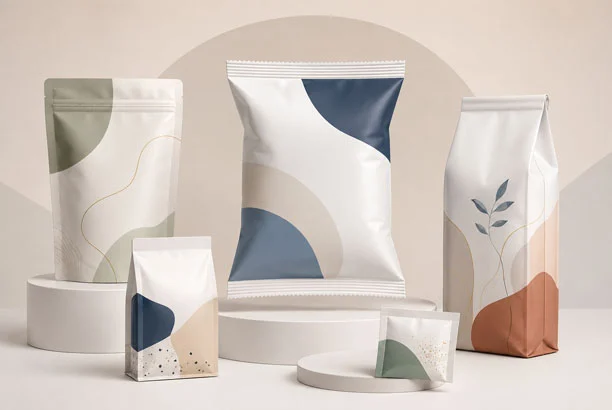
When you know the differences between formats, you can pick packaging that works for your business and the people you want to sell to. Each style has its own pros and cons when it comes to price, performance, and how it looks on the wall.
Fin Seal vs. Three-Side Seal: Structural Differences
There is one bottom seal on a three-side seal pouch, as well as two side seals. The top seal is closed when the bag is full. This style works well for flat things like seasoning packs, but it's not as rigid as back seal designs. Because the back seal locks the tube structure before filling, fin seal pouches keep their shape throughout production. On high-speed lines, this stability cuts down on misfeeds. Sealing integrity also differs—the interior-to-interior bond of back seal formats typically achieves stronger peel strength than three-side seals where outer and inner layers must bond. Pillow designs don't have as many rules about what materials can be used, so there are more barrier options.
Stand-Up Pouches for Retail Visibility
Stand-up pouches get people's attention on store shelves because they are offered upright and have more branding room. When something is well-made, it can stand up on its own thanks to the bottom gusset. Each unit costs 15–30% more than pillow packaging because it needs more material. Also, the rate of production is slower. VFFS pillow systems can make 100 bags or more per minute, while stand-up pouch lines can only make 40 to 60 bags per minute. Back seal formats are better for candy and snack brands that care more about throughput and cost efficiency than about standing out on the shelf.
Zipper and Valve Options: Convenience vs. Simplicity
For multi-serve products like protein powder or pet treats, resealable zippers make them easier to use. Customers like being able to keep food fresh after opening it. Valves release CO₂ generated by freshly roasted coffee while limiting external air ingress. When zippers are added, production slows down and costs go up. Valve placement needs to be perfectly aligned during filling, which takes more time during setup. Check to see if these features really make your product better or if a simple pillow design would do the same job for less money. A lot of candy and snacks work well in simple heat-sealed forms.
How to Evaluate and Select the Right Supplier
The choice of supplier decides how the package will be the same for each order. Thoroughly checking out possible partners can help you avoid problems and costs in the future.
Verifying Certifications and Manufacturing Standards
Certifications show that an operation is mature and following the rules. ISO 9001 approval shows that a company has quality management systems that keep track of production variables and push for constant growth. BRC certification means that the food safety rules follow strict rules that keep the food from getting contaminated. FDA compliance makes sure that materials meet U.S. rules for food contact, which is a must for American markets. Reports from SGS or a third party testing services back up claims about barrier properties and seal strength. If you want to believe what a website says, ask for up-to-date audit reports and certificates. It's also important to know how much you can make. Suppliers that can make 20,000 tons per year can handle changes in number without affecting wait times or quality.
Assessing Custom Printing and OEM Capabilities
Private label brands need sources that can reproduce colors accurately and give them creative freedom. Rotogravure printing is better for high-volume orders because the ink lasts longer and can handle the wear and tear of shipping. It costs more per unit, but digital printing is good for small runs or making things unique to an area. Look at hard copies in different lights to get a sense of the print quality. When screen proofs are turned into finished pouches, the colors can change. Find out about plate costs, minimum color runs, and how artwork is approved. As part of OEM services, you should get help with design, the making of a die line, and suggestions for materials that are right for your product. Suppliers who have their own design teams can speed up project timelines and make sure everyone understands.
Evaluating Logistics and Sustainability Practices
How well you can keep your promises to customers depends on how reliable your supply chain is. Suppliers who are close to major ports can ship goods to the U.S. faster and for less money. It usually takes 4-5 days by air or 3–4 weeks by sea to get goods from Asia to the U.S. Domestic sellers get rid of the hassle of customs. Find out how consistent lead times are by asking present customers for on-time delivery data. Sustainability is becoming a bigger factor in what people buy. Structures made of a single material, PE, help recycling streams, while options made of compostable PLA or PBAT meet the goals of the circular economy. However, compostable films don't always work as well as barriers; check shelf-life testing data before making a decision. When suppliers invest in green energy or RTO (Regenerative Thermal Oxidizer) pollution treatment, they show that they care about the environment in more ways than just choosing the right materials.
Practical Procurement Tips and Ordering Process
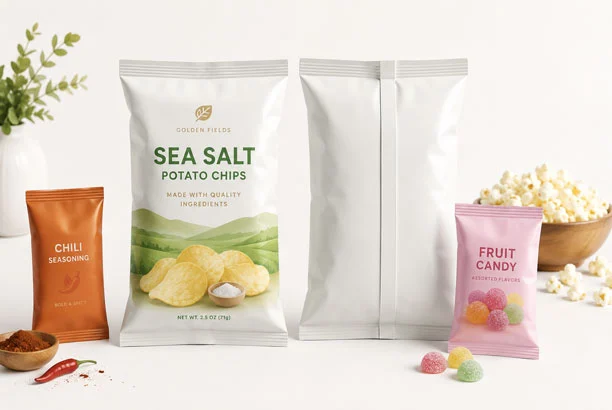
To do efficient buying, you have to find a balance between cost, quality, speed, and freedom. Structured ways to buy cuts down on risk and gets the most out of the whole deal.
Planning Bulk Orders to Optimize Unit Economics
Volume price makes it hard to save money on costs and buy more goods at the same time. If you order 50,000 fin seal pouch pouches instead of 10,000, the price per unit might go down, but you'll need more money and storing room. Find out how much you use each month and multiply that number by the lead time plus the safety stock, which is usually 1.5 to 2 months of buffer. This formula keeps you from running out of stock and from having too much inventory. Talk about yearly framework deals that lock in prices and allow quarterly call-offs that are in line with expected output. This method takes advantage of big prices without using up too much warehouse space. During busy times, like the holiday season, share your plans early—suppliers often give out capacity based on who commits it first.
Understanding Lead Times and Hidden Costs
Production times depend on how complicated the job is. For urgent projects, digital printing can get custom pouches to you in 7–10 days, while rotogravure printing needs 15–20 days to prepare the plates and proof the colors. Add the time it takes to send. Ocean freight takes 3–4 weeks, and air freight takes 4–5 days. Allow extra time for foreign orders to pass customs, which usually takes three to five working days. Plate fees, die-cutting setup fees, and extra freight costs for rush orders are all things that you might not know about. Usually, you'll need a 30% deposit and the balance before the shipment.
Troubleshooting Common Production Challenges
Issues happen even when everything is planned out well. Weak seals, also called "leakers," are often caused by filling equipment that is not set to the right heat or rest time. During the first tests, work with your providers to find the best sealing settings. Inconsistencies in the material, such as changes in tension or the building of static electricity, lead to problems with tracking the web and production stops. Set tight tolerances (+/- 1 mm) and ask for anti-static treatments if they are needed. Brand teams don't like it when colors don't match between tests and production runs. Set up a formal process for color approval that uses paper samples under standard lighting (D65 illumination) instead of digital copies. Write down your needs and ask for pre-production samples before the full runs so that problems can be found quickly.
Conclusion
To pick the best pillow bag, you need to make sure that your provider can meet your needs for product safety, production line compatibility, and cost goals. Back seal formats are good for high-speed candy and snack makers because they are structurally reliable and work well as a barrier. This is especially true when working with certified manufacturers who deliver consistent quality across repeat orders. Material engineering, functional features, and procurement planning must all be balanced in order to make sure that packaging protects the integrity of the product and supports operational efficiency. As people's concerns about the environment grow, it becomes smarter to look into recyclable or compostable options that don't shorten the shelf life. If you take the time to look into providers, test samples on real production lines, and make clear specs, you can avoid problems down the road and make sure that your brand's packages work well and don't cost too much with fin seal pouch.
FAQ
1.What advantages do pillow pouches offer over stand-up formats?
Back seal versions use 20–30% less material, so they cost less per unit. They also run faster on automatic lines, often making more than 100 bags per minute compared to 40–60 bags per minute for stand-up pouches. Because the structure is simpler, there are fewer moving parts during production, which lowers the risk of downtime. When throughput and cost efficiency are the most important things, like when making a lot of candy or snacks, pillow formats are better. Stand-up pouches look better on shelves because they can be displayed vertically.
2.Can I customize pillow pouches for private labeling?
Digital or full-color rotogravure printing, clear windows that let you see the product, euro holes for hanging displays, and different finishes like matte, shiny, or sparkly are all part of customization. For rotogravure designs, suppliers usually need at least 10,000 pieces, but digital printing lets you do smaller test runs. OEM services should include design help, material ideas, and ways to make sure that artwork is approved so that the finished bags match the vision of your brand.
3.How do I verify environmental compliance in pouch materials?
Ask for material datasheets that show how recyclable the material is and if it meets recycling standards. According to ISO 14001 environmental management approval, sustainable practices are carried out in a planned way. A third party should be able to show that the barrier works in buildings made of a single material or that can be broken down naturally. Some eco-friendly films make other goods go bad faster. It shows that a supplier cares more about the environment than just picking the right materials if they use renewable energy or advanced exhaust treatment systems like RTO systems.
Trusted Fin Seal Pouch Manufacturer for Scalable Production
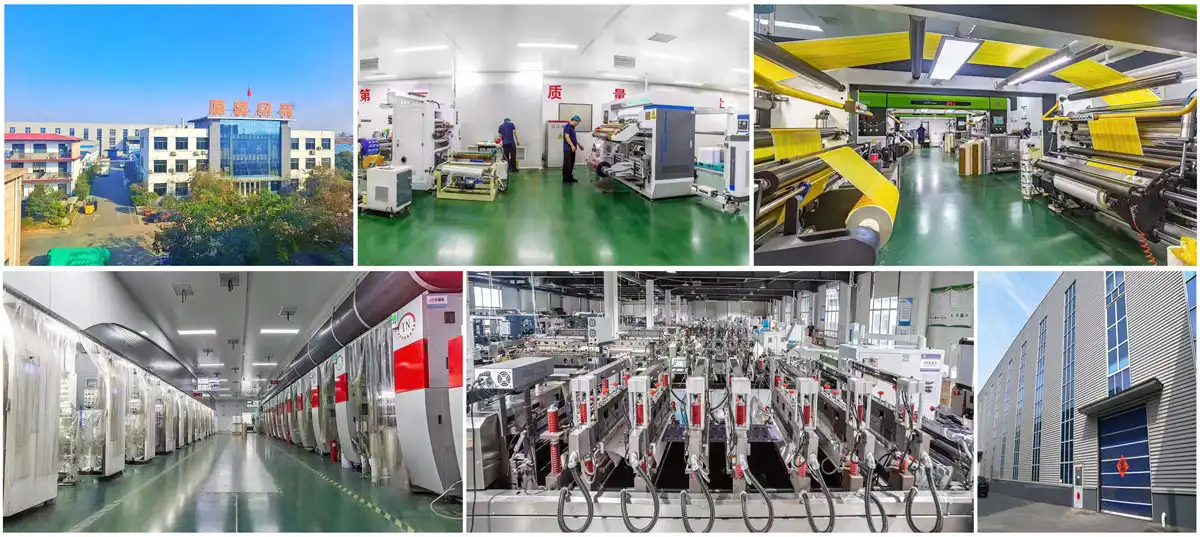
The fin seal pouch solutions that Guoshengli Packaging makes are stable and made for fast food production lines. We help candy, snack, and frozen food brands all over North America with customized barrier films, rotogravure printing in up to 11 colors, and useful features like euro holes and clear windows. We've been making these things for 25 years and can make 20,000 tons of them every year. Our ISO 9001, BRC, and FDA certifications make sure that we follow U.S. rules about food handling, and our recyclable mono-PE and compostable PLA/PBAT options meet environment needs. From helping with the design to making sure the order gets delivered on time (in as little as 7 days for digital printing), our team offers clear price, technical support, and the same high quality for all orders. You can email us at sales@guoshengpacking.com to talk about your specific needs if you're looking for a reliable supplier that knows how to handle high-volume production. Here's how we can help you cut down on downtime, keep prices low, and make sure your products stay safe.
References
1. Robertson, G. L. (2016). Food Packaging: Principles and Practice (3rd ed.). CRC Press.
2. Selke, S. E., Culter, J. D., & Hernandez, R. J. (2015). Plastics Packaging: Properties, Processing, Applications, and Regulations (3rd ed.). Hanser Publications.
3. Marsh, K., & Bugusu, B. (2007). Food Packaging—Roles, Materials, and Environmental Issues. Journal of Food Science, 72(3), R39-R55.
4. Yam, K. L. (2009). The Wiley Encyclopedia of Packaging Technology (3rd ed.). John Wiley & Sons.
5. Coles, R., McDowell, D., & Kirwan, M. J. (2003). Food Packaging Technology. Blackwell Publishing.
6. Brody, A. L., & Marsh, K. S. (1997). The Wiley Encyclopedia of Packaging Technology (2nd ed.). John Wiley & Sons.
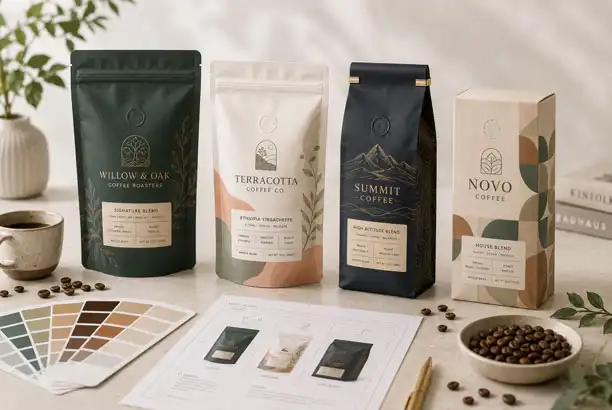
Specialty coffee roasters face a persistent dilemma: how to launch seasonal blends without committing to massive print runs or paying thousands in plate costs. Custom printed coffee pouches solve this by enabling brands to produce small batches with vivid, high-resolution graphics. Coffee pouch digital printing has transformed how micro-roasters and subscription brands approach packaging—delivering photo-quality artwork at resolutions exceeding 1200 dpi, with flexible MOQs starting at just 500 pieces and turnaround times of 7–10 working days. This guide explores how digital printing technology empowers coffee brands to test markets faster, reduce inventory risk, and maintain premium shelf presence.
Understanding Coffee Pouch Digital Printing: A Complete Overview
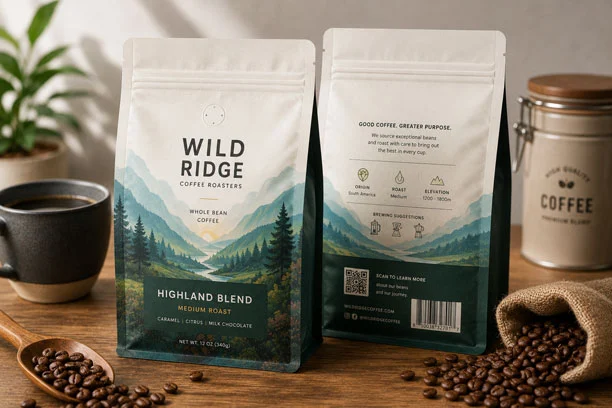
What Is Coffee Pouch Digital Printing?
Coffee pouch digital printing is a cutting-edge industrial technique that uses inkjet or electrographic technology to copy digital image files directly onto flexible packing substrates, removing the need for traditional printing plates. Digital printing lets you make things whenever you need them, while gravure and flexographic methods need expensive tubes that cost much and MOQs that are usually higher than 10,000 units. There are some big problems that specialty roasters have that this technology fixes. These problems include high setup costs, fixed order amounts, and slow response times for seasonal starts. By getting rid of mechanical plate-making, brands can run short production cycles, efficiently manage portfolios with multiple SKUs, and add variable data like batch numbers, roast dates, and traceability QR codes—all while keeping the high-barrier protection needed to protect volatile aromatic compounds.
How Digital Printing Differs from Traditional Methods
Rotogravure and flexography are two old ways of printing that work on the principle of economies of scale. Gravure printing is very consistent and reproduces colors very well, but you have to do a lot of work with it before you can afford to buy a cylinder. Flexo printing is somewhat flexible, but it has trouble with fine details and gradients that aren't smooth. Digital printing changes this by letting different content be used in the same production batch. Labels can print more than one SKU design at the same time without having to pay a lot of money for changes. Print sizes can go up to 1200 dpi, and colors can be accurate up to 97% of the Pantone range. This means that text is clear, gradients are smooth, and images look like photos. Modern inkjet presses can work with a wide range of materials, such as matte PET, shiny finishes, kraft paper, and even recyclable films. This gives artists more freedom to be creative than they had before in short-run situations.
The Digital Printing Process and Technology
The process starts with digital art files that are exactly what is needed. After proofreading, food-safe inks are put directly on multi-layer laminate films by special inkjet or HP Indigo presses. These inks stick strongly to primers or get stuck between protective layers during lamination, so they don't come into touch with the closing bars when the pouch is converted. The printing film is laminated to join the barrier, outer, and inner layers. This makes structures like PET/AL/PE or recyclable mono-PE ones. The material is laminated and then sent to machines that make pouches, where it is die-cut, sealed, and given useful features like tear notches, hang holes, and zippers that can be closed again. As part of quality control, spectrophotometric color checks (Delta E < 2.0), ink migration tests, rub and scratch resistance tests, and seal integrity checks are done on every pouch to make sure it meets strict standards for food safety and performance.
Digital Printing vs Traditional Printing: Making the Right Choice for Your Coffee Packaging
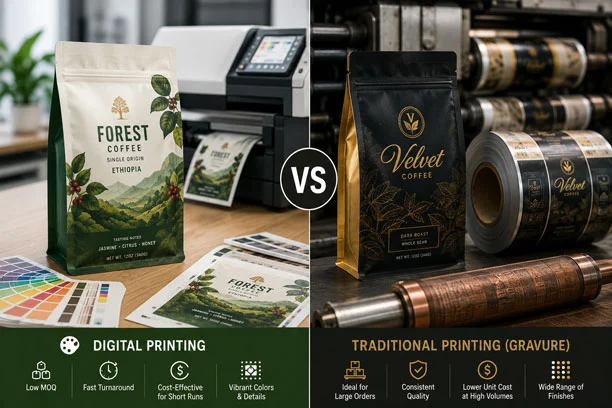
Limitations of Traditional Printing Methods
Gravure and flexo printing are rigid methods that make it hard to be flexible. When MOQs are high, brands are locked into stocking amounts that may be higher than what people want, especially for limited-edition or trial mixes. Plate costs add a big upfront cost that makes design changes and seasonal changes less likely. Lead times range from 4 to 6 weeks from acceptance of artwork to delivery, which makes it hard to respond quickly to the market. Design restrictions make it even harder to be creative: fine gradients, photographic details, and complex patterns often need more color stations, which drives up costs. These barriers hurt micro-roasters, subscription services, and private-label producers the most, since they need to offer a wide range of products and be quick to respond.
Advantages of Digital Printing for Coffee Brands
Coffee pouch digital printing gets rid of these problems by letting you make things without using plates. Brands can test out new blends without having to spend a lot of money by ordering as few as 500 pouches of each design. Time-to-market is sped up during busy times by cutting turnaround times to 7–10 working days. With variable data printing, each pouch can show different information, like batch numbers, roast profiles, or personalized messages. This makes it easier to track food and keeps customers interested. With multi-SKU, roasters can make different origin coffees, flavor profiles, or subscription tiers in the same production run. This makes logistics easier and cuts down on the cost of storage. The color accuracy is the same as or better than with traditional methods, and the CMYK plus extended gamut options make the products look bright and ready to sell.
Cost Analysis and Turnaround Time Comparison
With traditional ways, the cost per unit is cheaper when a lot of them are made. Usually, it's cost-effective to make more than 50,000 units. This equation is turned upside down by digital printing, which gets rid of the plate costs and setup fees, making small batches affordable. Brands save between $500 and $1,200 per design version, which they can then use to fund product development or marketing. When brands make less than 10,000 units of each SKU, digital printing gives them a better return on investment (ROI). This includes inventory keeping costs, failure risk, and speed-to-market benefits. Speed of turnaround increases worth even more. For example, releasing a limited-edition holiday mix in 10 days instead of six weeks can take advantage of seasonal demand spikes and bring in extra money.
Selecting the Best Materials and Designs for Digitally Printed Coffee Pouches
Compatible Films and Laminates
Choice of material has a direct effect on the quality of the print and the shelf life. Coffee pouch digital printing works best on surfaces that are smooth and uniform. Outer layers like PET or matte PET help the ink stick well and produce high-resolution images. Aluminum foil, metalized PET, EVOH, or nylon make up the middle barrier layers. These keep air and wetness out, keeping the coffee fresh for months. The PE or CPP sealant layers inside make sure that the food is safe to touch and that the heat seals well. Brands that care about the environment can use recyclable PE structures or PLA/PBAT films that can be broken down naturally to keep their barrier properties and help them reach their sustainability goals. The tactile finish is different depending on the material used. Glossy surfaces make colors stand out, while matte and soft-touch finishes give products a high-end, handmade look.
Creative Design Possibilities and Print Resolution
Digital printing with a high resolution lets you be more artistic than with older ways. Brands can show off photos of the coffee beans' origins, hand-drawn artwork, or elaborate hand-drawn pictures that look like photos. With variable data printing, QR codes that lead to roast profiles, brewing guides, or farm stories can be printed on a lot of packages to make them more unique. Subscription brands can put order numbers or customer names, which makes the relationship more personal. Print quality has a direct effect on how people think about a brand. At 1200 dpi, text stays clear, gradients look smooth, and small details show skill. This level of fidelity is very important in competitive retail settings where the appearance on the shelf affects decisions about what to buy.
Sustainability Trends and Eco-Friendly Options
Sourcing priorities change when customers want eco-friendly packaging. Digital printing helps the environment by cutting down on trash and allowing production to happen only when it's needed, which means less inventory and material use. Mono-PE laminates that can be recycled make it easier to recycle at the end of their useful life. Food safety rules are very strict, but low-migration inks and water-based pigments meet those rules without hurting the environment. Sustainability certificates and recycling directions can be displayed clearly on packages, which is in line with larger corporate responsibility promises and helps brands stand out in crowded markets.
Procuring Digital Printed Coffee Pouch Services: What B2B Buyers Should Know
Minimum Order Quantities and Pricing Structures
The appeal of coffee pouch digital printing lies in its flexible MOQs. With as few as 500 pieces of each design, brands can quickly test markets, see how customers react, and make changes. Pricing structures usually use tiered models, where unit costs go down as volume goes up. This allows for growth without making it too hard to get started. Clear pricing that includes film, printing, lamination, bag conversion, and useful add-ons helps you stick to your budget. To find the best solutions, procurement teams should get detailed quotes that compare digital and traditional methods for the expected annual volumes, taking into account storage costs and how often designs change.
Identifying Reputable Suppliers
To choose a skilled provider, you need to look at their technical skills and how reliable they are in their operations. Key factors include having the right certifications (ISO 9001, BRC, and FDA compliance), being able to produce a lot of goods, and having experience exporting. End-to-end control is provided by suppliers with modern digital presses (HP Indigo, high-speed inkjet systems) and their own conversion equipment. This lowers the risk of coordination. By looking at example portfolios, you can judge the print quality, color uniformity, and precision of the finishing. Performance claims are backed up by examples from names on the same size. Professional partners can be told apart from transactional vendors by their responsive communication, which includes clear technical advice, problem-solving that is proactive, and regular updates.
Logistics and Production Timelines
Knowing how production works makes planning more accurate. It usually takes 7–10 working days to complete everything from approval of the artwork to finished bags. Rush orders may cost more, but they can give you an edge when a new product comes out. When planning logistics, things to think about are the incoterms (FOB, CIF, DDP), the shipping method (air for speed, ocean for cost-effectiveness), and the customs paperwork. Buyers should get clear on lead times, production capacity during busy times, and backup plans to keep the supply chain running smoothly.
Overcoming Challenges and Ensuring Quality in Coffee Pouch Digital Printing
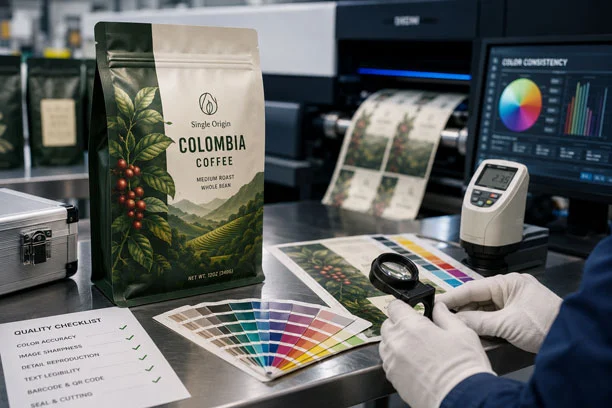
Common Technical Challenges and Solutions
Even though technology has improved, digital printing has its own problems. Print registration mistakes happen when more than one layer is not lined up correctly, which makes pictures blurry or colors overlap. If you prepare your files and press correctly before printing, this risk is kept to a minimum. Different substrates or ink formulations can cause color differences. Spectrophotometric tracking makes sure that Delta E values stay below 2.0 across all runs. Problems with substrate compatibility, like ink not sticking or delamination, are caused by primers or lamination parameters that are not right. Failures that cost a lot of money can be avoided by working with skilled sources who test materials and make sure processes work.
Quality Control Measures and Inspection Processes
Strict quality control protects the reputation of a brand. Before full production, sampling methods check the accuracy of the artwork, the consistency of the colors, and the functionality of the product. Proofing stages let buyers approve physical samples, which makes sure that the printed pouches live up to their standards. During production, in-line review includes checking for print flaws visually, testing the stability of the seals automatically, and making sure the dimensions are correct. Post-production audits check the resistance to scratches and rubs (using Sutherland Rub Tests), the coefficient of friction (to make sure the filling line works smoothly), and the sealing integrity of the degassing valve. Traceability systems connect each batch to its raw materials, production dates, and inspection records. This lets problems be fixed quickly and quality kept rising.
Real-World Case Studies and Success Stories
When specialty roasters release limited-edition single-origin coffees, they use coffee pouch digital printing to make 1,000 to 2,000 pouches per release. This way, they can change their offers every three months without having to keep a lot of stock on hand. Variable data printing is used by subscription brands to personalize monthly shipments by printing customer names and personalized brewing tips. This keeps customers interested and helps them stay with the brand. Multiple retail clients are served at the same time by private-label manufacturers, who make different SKU designs in consolidated production runs that cut down on setup time and cost. These uses show how flexible digital printing is, letting brands adapt quickly to changes in the market, customer tastes, and competition pressures while still keeping high quality standards.
Conclusion
Custom-printed coffee pouches have changed how specialty brands buy packaging. Coffee pouch digital printing gives you freedom, speed, and quality that you couldn't get with older methods. It gets rid of the need for expensive plates, lowers the minimum order quantity to 500 pieces, and shortens the lead time to 7–10 days. Brands can be more creative, try markets with confidence, and make sure that their product fits with their goals for sustainability. New materials help with high-barrier security and eco-friendly options, and strict quality control makes sure that everything works the same way every time. Digital printing helps coffee brands stay flexible, cost-effective, and visually appealing in competitive markets, whether they're releasing seasonal blends, running subscription services, or making private-label products.
FAQ
1.How does coffee pouch digital printing compare to rotogravure in print quality?
At this point, coffee pouch digital printing is just as good as or better than gravure when it comes to detail and accuracy, especially when it comes to curves and photos. Gravure is still the most cost-effective option for runs over 50,000 units, but digital printing gives you the same vivid colors and sharp images at lower numbers without losing barrier performance or food safety compliance.
2.Are the inks used in coffee pouch digital printing safe for direct food contact?
Yes, as long as the inks are low migration and meet the standards set by Nestle Guidance or Swiss Ordinance. They should also be covered by a functional barrier layer. Reputable providers test for movement to make sure that no harmful substances get through the inner protection layer. This keeps the food safe throughout its shelf life.
3.Can I use sustainable materials with coffee pouch digital printing?
Of course. Digital printing works perfectly with PLA/PBAT films that can be broken down in a trash pile and reusable PE laminates made of a single material. These structures keep their ability to block oxygen and moisture while also being good for the environment. This way, brands can meet customer demands for eco-friendly packing without sacrificing product safety.
4.Will the digital ink peel off during the heat-sealing process?
Not at all. When you print high-quality coffee pouches digitally, you use primers or lamination methods that keep the ink between protective layers and away from the sealing bars. If you choose the right materials and keep an eye on the process, the ink will stick even when the pouch is being changed, filled, and sent out.
Partner with Guoshengli Packaging for Your Coffee Pouch Digital Printing Needs
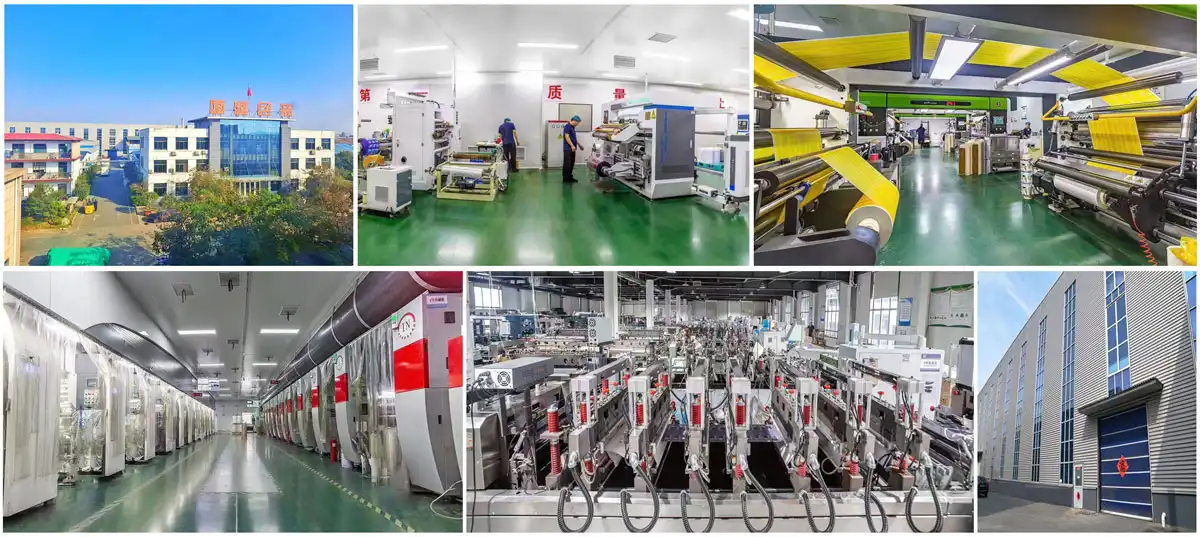
Packaging partners that understand the needs of low-MOQ, high-variety production are important for specialty roasters and subscription brands. Guoshengli Packaging is a reliable company that makes coffee pouch digital printing solutions. They offer unique solutions for small-batch roasters, brands with multiple SKUs, and private-label makers. We've been experts in flexible packaging for more than 25 years, so we don't have to follow the rules of traditional printing. Our minimum order quantities (MOQs) start at 500 pieces, and we offer free plate costs and 7–10 day turnaround times. Our facility is ISO 9001, BRC, and FDA-certified, and it uses high-tech digital presses with a resolution of 1200 dpi and 97% Pantone color accuracy to make sure that your brand artwork turns into high-quality products that are ready to be put on shelves. Whether you need flat-bottom bags with degassing valves, zippers that can be closed again to keep food fresh, or variable data printing to make sure that products can be tracked, our team is here to help you from the design meeting to the final delivery. Email us at sales@guoshengpacking.com right now to talk about how our digital printing services for coffee pouches can help you start your products faster, lower the risk of running out of stock, and improve your brand's visibility.
References
1. Smith, J. & Thompson, R. (2022). Flexible Packaging Innovations in the Specialty Coffee Industry. Journal of Food Packaging Technology, 18(3), 145-162.
2. Anderson, L. (2023). Digital Printing Technologies for Small-Batch Food Products. Packaging World Press, New York.
3. Martinez, C., Lee, S., & Patel, N. (2021). Sustainable Barrier Films for Coffee Preservation: A Comparative Study. International Journal of Food Science & Technology, 56(8), 3892-3905.
4. Wilson, K. (2023). The Economics of Low-MOQ Packaging for Emerging Coffee Brands. Coffee Business Journal, 12(2), 78-91.
5. Chen, H. & Roberts, D. (2022). Quality Control Standards in Digital Flexible Packaging Manufacturing. Packaging Engineering Quarterly, 29(4), 210-228.
6. Green, P., Foster, M., & Kumar, A. (2023). Consumer Perception of Packaging Quality in Premium Coffee Markets. Journal of Consumer Marketing, 40(1), 56-70.
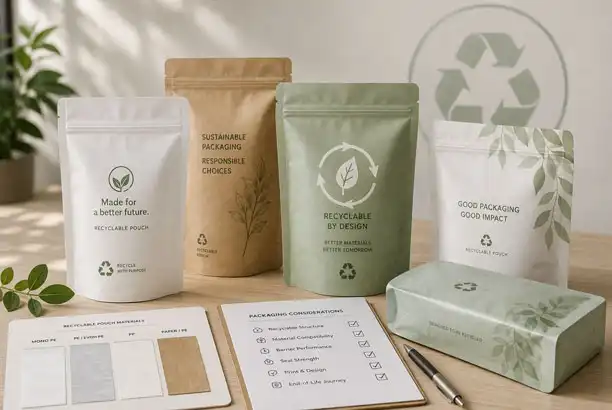
Before committing to sustainable packaging, understanding what makes recyclable pouches truly eco-friendly is essential. Recyclable pouches are flexible packaging solutions manufactured from mono-material structures—primarily polyethylene (PE #4) or polypropylene (PP #5)—that integrate seamlessly into existing municipal recycling systems. Unlike conventional multi-layer laminates combining incompatible materials, these single-substrate designs eliminate sorting challenges, reduce contamination risks, and support circular economy goals. For food brands, pet product companies, and personal care businesses facing Extended Producer Responsibility (EPR) regulations and plastic taxes across North America and Europe, transitioning to recyclable flexible packaging addresses compliance mandates while demonstrating genuine environmental commitment to eco-conscious consumers and stakeholders.
Understanding Recyclable Pouches: Materials, Types, and Environmental Impact
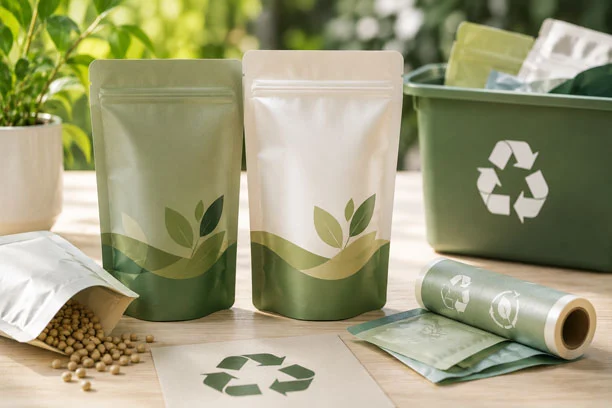
What Makes a Pouch Truly Recyclable
Recycling infrastructure varies a lot from place to place, but truly recyclable pouches have some things in common that make them easy to process. The unique feature is that they are made of only one type of polymer. This means that bags made from only one type of polymer can easily be recycled without the need for special sorting equipment. PE-based structures use MDOPE (machine direction oriented polyethylene) layered with extra PE layers to make a shield that protects while still being able to be recycled thru LDPE collection systems. PP-based alternatives combine BOPP (biaxially oriented polypropylene) and CPP (cast polypropylene), which makes them stiffer and clearer for products that need clear windows or a bigger presence on the shelf.
People start the recycling process by putting used pouches in the right bins for pickup. Recycling centers sort things by density and type of polymer. They then clean, shred, and melt plastics that are eligible into pieces. These pellets are used to make new packaging, building materials, and consumer goods. Biodegradable and compostable choices need special industrial facilities that aren't available in many cities or towns. Mono-material bags, on the other hand, use infrastructure that most people in North America and Europe already have access to.
The environmental impact goes beyond just being able to recycle. Production methods have a big effect on sustainability as a whole. When we make things at Guoshengli Packaging, we use water-based inks and solvent-free lamination technology, which cuts volatile organic compound emissions by over 85% compared to traditional systems that use solvents. The Spanish RTO (Regenerative Thermal Oxidizer) technology cleans up waste gasses while they are being made, which reduces pollution in the air. Our seven printing lines and six sealing machines all use energy-efficient tools that further lower the carbon footprint of each unit made.
Common Pouch Types and Their Applications
There are many various sustainable flexible packaging shapes and sizes that may be utilised for different goods and filling procedures. Stand-up bags are gusseted on the bottom enabling them to stand up on shop shelves. They are great for keeping coffee, almonds, pet treats and powdered vitamins. The solid foundation prevents them from tipping over and maximises the available area for advertising billboards. Box pouches, also known as flat bottom pouches, are much more sturdy, with squared sides that resemble standard cartons. This provides for an intriguing offering for premium food manufacturers who desire a better-looking product on the market.
Easy to use, three-side seal pouches save money on little, inexpensive products such as spices, tea bags, and sample packets. They are simply built which reduces garbage during manufacturing but yet provide sufficient barrier protection for short to medium term usage. These spouted pouches are ideal for baby food purees, sauces, beverage concentrates and other liquid and semi-liquid meals. If both the bag body and the spout are constructed of mono-PP materials, both may be recycled in the same rubbish stream.
Functional characteristics make products simpler to use but don’t make them less recyclable. Thanks to resealable zippers constructed from appropriate polymers, consumers can store food fresh for repeated use, which is particularly useful for snacks and pet food. Tear notches for simple opening without the need of scissors or other equipment. In establishments with holes to hang stuff on they employ peg hook displays . The mono-material purity is maintained and the result may be seen through window screens constructed of the same basic polymer.
Environmental Impact Compared to Alternatives
A meaningful assessment of how successfully a thing preserves the planet has to take into account its whole existence, not simply its disposal. Compostable pouches are constructed from either PLA (polylactic acid) or PBAT (polybutylene adipate terephthalate) and are designed to break down into organic waste in commercial composting facilities. People who do not have the right facilities sometimes put compostable bags in landfills where the lack of air means they cannot break down properly.
Traditional multilayer laminates of metal foil, polyester and various glues are good barriers but they cannot be recycled. If you want to separate the bound layers, you have to employ sophisticated chemical or mechanical procedures that are not offered in shops. Most multi-layer bendable packaging ends up in landfills or dumps that are burnt. Moving away from traditional laminates to single-material architectures is a great advancement for businesses that care about the environment.
Comparing Packaging Solutions: Recyclable Pouches vs Traditional Alternatives
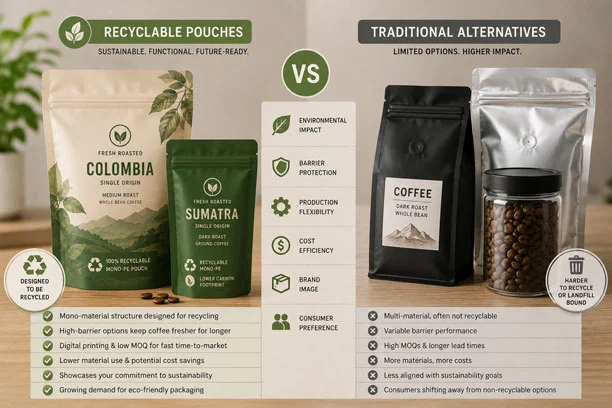
Performance Characteristics Worth Evaluating
Procurement experts are still worried that moving to sustainable packaging will hurt performance. There are good reasons to be skeptical about barrier protection, especially when it comes to products that are sensitive to oxygen or wetness and need to last longer. Modern structures made of a single material use advanced shielding technologies that are on par with multi-layer structures. When EVOH (ethylene vinyl alcohol) coatings are put on PE or PP substrates, they act as oxygen barriers like aluminum foil in many situations. This keeps coffee, nuts, dried fruits, and pet food fresh longer.
Moisture vapor transmission rates (MVTR) show how well packaging keeps products like protein powders, nutritional supplements, and pet treats from getting wet. Products that need to have very low MVTR may need to be carefully chosen materials and structures that work best. When brands work with experienced makers, they can match the barrier needs of recyclable pouches with the sustainable material's abilities.
Sealing quality has a direct effect on how safe a product is and how happy customers are with it. When production is going quickly, weak seals can cause leaks, contamination, and stops in the filling line. Our quality control procedures check the power of the seals at different temperatures. This makes sure that the pouches always work the same way whether they are hot-filled, sterilized in a retort, or filled at room temperature. The BRC and ISO 9001 standards show that systematic quality control is used throughout the whole production process.
Cost Considerations and Long-Term Value
Cost talks that are open and honest help brands make smart choices. Sustainable packaging usually costs 10–30% more than regular options. This is because it uses special materials, more advanced barrier technologies, and less production volume than regular multi-layer films. When you look at the total cost of ownership, this extra is more of an investment than a price.
The way a customer perceives something impacts their purchase choice. According to study by McKinsey & Company, 60% of North American customers consider sustainability when making product choices, and are willing to spend 5-10% more for firms that really care about the environment. Clear, reusable packaging demonstrates that a firm is environmentally conscious, helping its products stand out in a crowded retail market and encouraging long-term brand loyalty.
Decision Framework for Packaging Transitions
The change has to be intentional, and you have to look beyond the cost of the materials. Packaging requirements vary according on the product. For example, liquids demand a greater seal integrity and a better puncture resistance than dry powders. The required shelf life will influence the barrier specification – a product that must be kept fresh for 6 months has a broader choice of materials than one that must be protected for 24 months.
Duration of packing is determined by distribution conditions. Products carried between continents change temperature and are handled numerous times therefore they require sturdy constructions that can resist punctures, rips and seal failures. Important criteria include the thickness of the pouch, the method it is made and the quality control requirements.
The packaging decisions are taken from the brand positioning. For premium businesses seeking to attract eco-friendly consumers, sustainable packaging expenditures may be justified as charges that assist grow the brand and provide quantitative returns via improved customer image and loyalty. Value-based firms must learn how to balance their commitment to sustainability with a requirement to keep margins low. They may need to phase in adjustments as prices decline and regulations tighten.
Streamlining Procurement: Buying Recyclable Pouches for B2B Clients
Supplier Selection and Vetting Procedures
When you are looking for certified manufacturers, you have to go beyond the price sheets. Certifications provide an independent third-party endorsement of quality systems, food safety standards and environmental claims. ISO 9001 accreditation means that quality management procedures are standardised. This ensures that each manufacturing run is of the same quality. BRC is focused about ensuring food packaging is safe. It involves things such as monitoring raw materials, avoiding contamination and managing allergies.
If a brand wants to sell into the U.S. it has to make sure it complies with FDA regulations.” All packaging material that comes in contact with food must comply with FDA standards for indirect food additives, and manufacturers must retain documents certifying the safety of the material. Our plant is still registered with the FDA and is in accordance with the regulation of Good Manufacturing Practice (GMP), giving North American brands the compliance foundation they require.
Claims about sustainability for recyclable pouches need to be checked out. Brands that are accused of "greenwashing" run the risk of losing customers and having their reputations hurt. Ask for testing reports from a third party that back up claims about recycling, material composition analysis, and barrier performance data. In Europe, groups like RecyClass offer certification programs that check whether packaging can be recycled using the current system. SGS and other testing labs like it offer independent confirmation of materials.
How reliable and scalable something is depends on how much it can be made. Established facilities with a wide range of equipment can handle orders of different sizes, changes in demand during different times of the year, and changes in format without affecting delivery times. Our 49 converting machines and high-tech printing equipment allow for flexible production timing, so we can work with both small businesses starting out with digital print runs of 500 units and well-known names that need container-load amounts.
Managing MOQ, Pricing, and Lead Times
Minimum order amounts make it hard for new brands to try out sustainable packing changes. For traditional rotogravure printing, cylinder engraving is needed, which means that setup costs are spread out over a lot of units, usually at least 20,000 to 50,000. Digital printing makes it easier for everyone to get what they need, and runs as low as 500 units can still be profitable. This gives brands the freedom to see how the market reacts, make sure the filling line works, and improve designs before starting mass production.
Lead time expectations require realistic planning. Custom packing includes multiple stages: material purchase, printing, lamination, curing, pouch conversion, quality checking, and shipping. For standard rotogravure production, it takes 15 to 20 business days from the time the artwork is approved until it is shipped. Rush possibilities exist for urgent needs—our digital printing capacity provides selected projects within 7 days, though choices may be format-limited.
Pricing structures represent order quantities, material specs, and customization complexity. As the number of units purchased goes up, discounts are applied based on volume, with breaks usually happening at 10,000, 50,000, and 100,000 units. Costs depend on the materials you choose. For example, simple mono-PE designs are cheaper than high-barrier EVOH-coated options. Complex printing costs more than simple designs with two to three colors. Full-color artwork with eleven colors printed by rotogravure costs more. Functional features like zippers, spouts, and windows may add extra costs, but they may make things easier for the customer, which makes the investment worth it.
Customization Options Supporting Brand Identity
Customization turns pouches into brand assets through high-quality printing, matte, gloss, and soft-touch finishes. Structural options such as stand-up, flat-bottom, side-gusset, and shaped bags improve presentation and capacity. Functional features, including zippers, tear notches, degassing valves, and compatible clear windows, enhance usability while supporting product freshness and mono-material recyclability.
Top Recyclable Pouch Manufacturers and Brands to Consider
Evaluating Manufacturing Partners
Experienced packaging manufacturers provide greater reliability, regulatory knowledge, and technical expertise during material transitions and integration. Production capacity and redundancy help maintain quality and delivery schedules during demand changes or maintenance. Supplier selection should also consider geographic advantages and total landed cost, including freight, customs, and inventory expenses, rather than factory price alone.
Certifications and Sustainability Credentials
Third-party certifications provide credible proof of quality, food safety, and sustainability claims. ISO 9001 verifies quality management, while BRC supports food-packaging safety and retailer compliance. FSC and Cradle to Cradle address material sourcing and sustainability. Where full certification is impractical, independent test reports can verify recyclability, composition, and barrier performance.
Practical Guidance: Recycling and Using Recyclable Pouches Efficiently
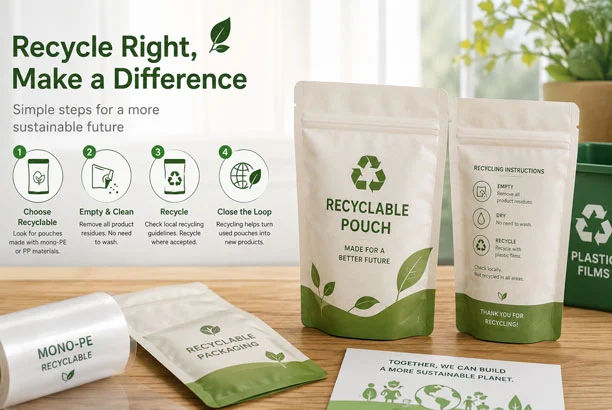
Maximizing Recyclability in Real-World Conditions
Maximizing recyclability requires suitable materials, clear disposal instructions, and consumer participation. Labels should explain recycling methods and encourage emptying, rinsing, and drying pouches to reduce contamination. Because municipal systems vary, store drop-off programs, How2Recycle guidance, and recycling locator tools can help consumers dispose of flexible packaging correctly.
Emerging Trends and Future Developments
Packaging regulations increasingly promote recyclability, reuse, and EPR through policies in Europe and North America. Advanced barrier coatings are improving mono-material performance, while water-based and biodegradable barriers offer further possibilities. Chemical recycling may complement mechanical recycling as technology and economics improve, helping brands adopt future packaging solutions as they mature.
Conclusion
Switching to flexible packaging that can be recycled is a smart investment in the strength of your brand, your ability to follow the rules, and your customers' trust. Mono-material bags made from PE or PP are better for the environment than traditional multi-layer laminates because they protect products and look good on shelves. By learning about the structures of materials, barrier technologies, and recycling infrastructure, you can make smart purchasing decisions that balance performance needs with environmental goals. Successful transfers are guarantyd when you work with experienced makers who offer certifications, quality controls, and the ability to make changes as needed. Adopting recyclable pouches makes brands sustainability leaders instead of followers who are just following the rules as rules get stricter and consumer expectations rise.
FAQ
1.Can recyclable pouches be processed in standard municipal recycling programs?
Mono-material PE and PP bags can be recycled using the systems that are already in place, but the ways that they are collected vary from place to place. Rigid plastic cases usually go into curbside programs, but flexible films need to be dropped off at store drop-off sites, which are common at big box stores across North America. Flexible boxes can be collected at the curb in more ways in European markets. Checking the local program's rules for safe dumping is important.
2.How do costs compare between recyclable and traditional pouches?
Because they use special materials and more advanced barrier technologies, recyclable pouches made of a single material usually cost 10 to 30 percent more than regular multi-layer options. When you look at the total cost, you should think about EPR fees, the benefits to the brand's image, and how willing customers are to support sustainable brands. For many businesses, the premiums are worth it because they help them meet regulations, lower their EPR costs, and improve their position in the market.
3.What customization options exist for recyclable flexible packaging?
You can choose from different pouch formats (stand-up, flat bottom, spouted), print up to 11 colors, and choose from different finishes (matte, gloss, soft-touch). The pouches also have functional features like resealable zippers, tear notches, and hanging holes. When properly stated, all modifications keep the ability to recycle a single material. Digital printing lets you customize a small number of products, starting at 500 pieces.
Partner With a Trusted Recyclable Pouch Manufacturer
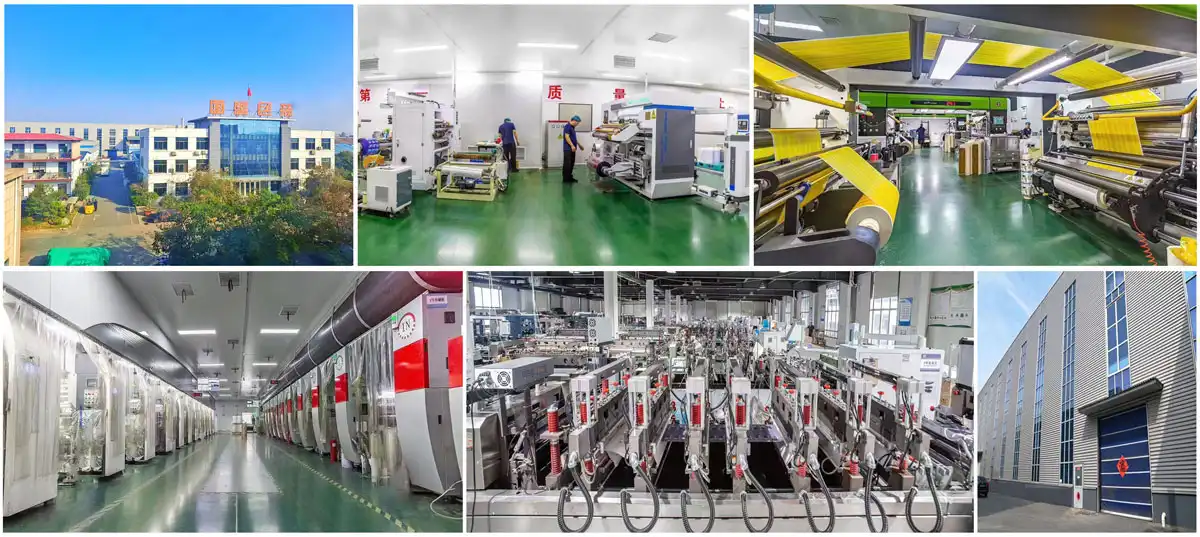
It is Guoshengli Packaging's specialty to make high-performance recyclable pouches that meet both environmental goals and strict product safety standards. Our 25 years of experience with flexible packaging, along with our ISO 9001, BRC, and FDA certifications, make sure that food, pet food, and personal care brands can rely on quality and compliance. As a way to help new businesses get started, we offer flexible 500-unit digital printing minimums. For established names, we offer container-load rotogravure production capability. Our structures made of only PE and PP work well with recycling systems in both North America and Europe. They also offer barrier protection, strong sealing, and print quality that is on par with traditional laminates. If you're starting a sustainable packaging program or making an existing one bigger, our team can help you choose the right materials, test their performance, and make sure that the production runs smoothly. Email our team at sales@guoshengpacking.com to talk about your needs for recyclable pouches and to get samples that show the quality and customization options.
References
1. Sustainable Packaging Coalition (2023). "Recyclability and Infrastructure Assessment for Flexible Packaging Materials." Washington, DC: GreenBlue.
2. McKinsey & Company (2023). "Consumer Sustainability Trends: North American Market Analysis." New York: McKinsey Sustainability Practice.
3. European Commission (2022). "Extended Producer Responsibility Implementation Guidelines for Packaging Materials." Brussels: EU Environmental Directorate.
4. Plastics Industry Association (2023). "Mono-Material Flexible Packaging: Technical Performance and Recycling Compatibility Study." Washington, DC: Plastics Industry Association.
5. Institute of Packaging Professionals (2023). "Barrier Technologies in Recyclable Flexible Structures: Performance Benchmarking Report." Naperville, IL: IoPP Technical Publications.
6. Association of Plastic Recyclers (2022). "Design Guide for Recyclable Flexible Packaging in North American Markets." Washington, DC: APR Flexible Film Recycling Committee.

Creating custom printed coffee pouches has never been more accessible, thanks to coffee pouch digital printing technology. This advanced method allows specialty roasters and micro-batch coffee brands to produce stunning, high-definition packaging without the burden of expensive cylinder costs, high minimum order quantities, or lengthy production timelines. Whether you're launching a limited-edition single-origin blend or managing multiple SKUs across seasonal offerings, custom printed coffee pouches give you the flexibility to respond quickly to market demands while maintaining exceptional visual quality that captures your brand's unique character.
Introduction
The worldwide coffee packaging environment is seeing an extraordinary shift. The dilemma is one that increasingly plagues speciality roasters, subscription box companies, and private-label coffee brands alike: old-school printing techniques need commitments that don’t fit with their nimble business models. Purchasing managers and brand owners are stuck between the requirement for unique packaging that communicates their narrative, but they can’t because printing plates are costly, minimum orders are fixed in stone and wait periods are weeks lengthy. Digital printing of coffee pouches has become the bridge to this gap, providing B2B purchasers a means to bright, customised packaging that allows for brand distinctiveness and operational efficiencies. In this guide, we’ll break down everything procurement professionals should know about digital printing technology for coffee pouches – from technical capabilities and cost structures to material selection and supplier evaluation – so you can make confident packaging decisions that strengthen your supply chain and elevate your market presence.
Understanding Coffee Pouch Digital Printing
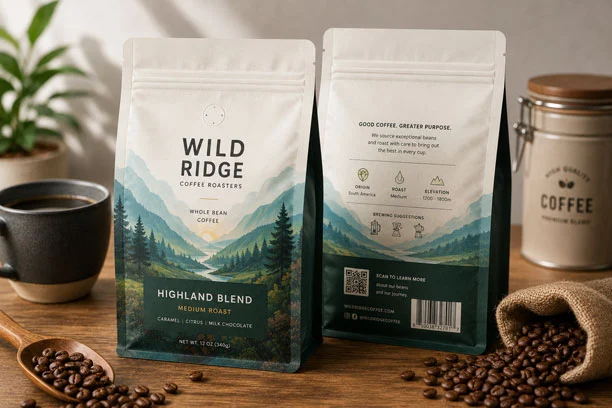
Digital printing on coffee pouches is a revolution in flexible packaging production. Unlike the traditional flexographic or rotogravure procedures that use engraved cylinders or printing plates, digital printing transfers pictures directly from digital files onto material substrates with the use of sophisticated inkjet or electrophotographic equipment. Without the plate, there are no setup expenditures of $480 to more than $1,200 per design, which makes it cost-effective for quantities as low as 500 units.
How the Technology Works
It begins with your artwork file being transferred straight to high-speed digital presses with precise printheads. These machines print using food safe inks that do not migrate onto properly prepared packaging films, at more than 1200 dpi. The result is photo-quality reproduction with colour accuracy up to 97% of the Pantone spectrum – perfect for presenting exquisite coffee bean images, sophisticated brand graphics and clear text to communicate premium quality. Traditional techniques may take 4 to 6 weeks, but with our full process from artwork approval right through to film printing, laminating, pouch conversion and quality control we can do it in as little as 7 to 10 working days.
Variable Data Capabilities
One of the most significant aspects of coffee pouch digital printing is the ability to add varied data within a single manufacturing run. Without pausing the press, or paying more, roasters may print custom QR codes for batch traceability, personalised roast dates, origin specific data or serialised numbering. This feature supports transparency efforts that are increasingly sought by speciality coffee customers, and it allows for complex inventory management for companies that deal with numerous estates or processing processes.
Compatible Materials and Structures
Digital printing technology is well suited for multi-layer laminate constructions meant to protect the freshness of coffee. Typical constructions include an exterior surface of PET or Matte PET for printing smoothness, a middle barrier layer of Aluminium foil, Metalized film or EVOH for oxygen and moisture barrier, and an inside layer of PE or CPP for heat sealing integrity and food contact compliance. Importantly, the technology also accommodates developing sustainable materials, such as recyclable mono-PE frameworks and biodegradable PLA-based films, enabling businesses to achieve environmental commitments without compromising barrier performance.
Comparing Digital Printing with Traditional Coffee Pouch Printing Methods
Understanding how coffee pouch digital printing measures against conventional approaches helps procurement teams make informed decisions aligned with their production volumes, budget constraints, and brand strategies.
Print Quality and Detail
Rotogravure has long been regarded the gold standard for large volume packaging owing to its exceptional colour constancy and durability. But now digital printing meets or surpasses gravure quality in reproduction of fine detail and registration accuracy, especially of complex gradients, photographic images and tiny text elements. The resolution of modern digital presses is 1200 dpi or greater, so the pictures are crisp and brilliant. They remain that way because of distribution and shelf life.” The main difference is in volume economics. Gravure only becomes economical on runs of more than 50,000 pieces per design, while digital printing is most economical on runs between 500 and 30,000 pieces.
Durability and Performance
In the past, digital printing has had limitations in the flexible packaging space due to concerns regarding ink adherence and rub resistance. Modern coffee pouches are digitally printed to overcome these issues using improved primer coatings and protective lamination processes that trap the layers of ink between film substrates. Properly made digital printed pouches can survive the mechanical pressures of automated filling lines, shipping and retail handling without scuffing or delaminating as verified by the Sutherland Rub Tests. Oxygen transfer rates and moisture barrier qualities are comparable to normally printed structures, maintaining coffee freshness for the whole shelf life of the product.
Environmental Considerations
Digital print is very compatible with environmental goals that are becoming more popular throughout procurement departments. The plate-free technique creates much less waste in production, while the on-demand approach decreases inventory obsolescence and storage costs. “Perhaps most importantly, digital printing technology can also be utilised with recyclable and compostable materials, without compromising print quality, which is a significant advantage as the European and North American markets increasingly demand environmentally responsible packaging solutions.
How to Design Artwork for Digital Printed Coffee Pouches
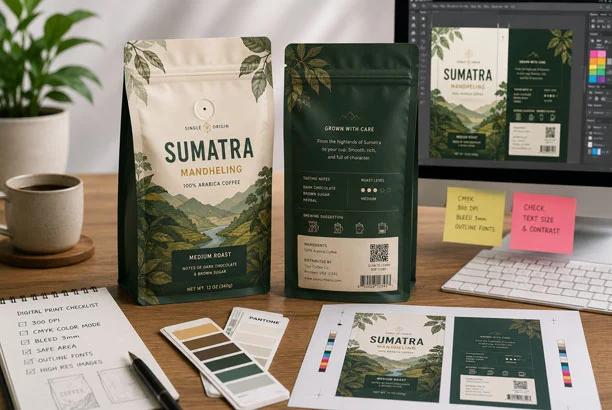
Successful outcomes with coffee pouch digital printing begin long before files reach the press. Design engineers and brand managers benefit from understanding technical specifications and best practices that maximize both visual impact and production efficiency.
Material Selection Fundamentals
The substrate selection directly affects the final print quality and the pouch functioning. For premium coffee applications, we suggest beginning with PET-based outer layers that provide a smooth, uniform surface for ink adherence and outstanding dimensional stability during printing and conversion. Standard gloss PET gives colours a richer look, while matte PET offers a refined touch and cuts down on glare from store lighting. Organic and artisanal brands are attracted to paper-laminate constructions for their natural look but they do need proper moisture control to minimise dimensional changes during storage and filling.
Technical File Requirements
Digital printing technologies operate best when the art piece fits certain technological requirements. Files should be supplied as high quality PDFs with embedded fonts and pictures at 300 dpi minimum at real print size. Colour management is key: prepare your artwork in CMYK colour space, not RGB, and convert spot colours using ICC profiles that match your digital print capabilities. Use bleed allowances (usually 3 to 5 millimetres beyond trim lines) and safety zones to avoid white borders and to keep important text and logos away from seal regions and any trim differences.
Leveraging Digital Advantages
Smart design decisions play to the inherent capabilities of coffee pouch digital printing. Avoid solid colours or plain designs, go instead for photographic images that highlight the origins of coffee, detailed representations of flavour notes or anecdotes about the founders that establish emotional ties. Variable data capabilities allow for personalisation programmes such as adding client names to subscription mailings or producing limited edition runs with consecutive numbering. It becomes easy with digital technology to do colour transitions and gradients that would be difficult or expensive to do with traditional printing. That opens up creative options that help a business stand out from the crowd.
Procuring Custom Digital Printed Coffee Pouches: What You Need to Know
Navigating the supplier landscape requires a systematic evaluation process focused on capabilities, reliability, and alignment with your operational requirements. Coffee pouch digital printing procurement professionals should assess potential partners across several critical dimensions.
Evaluating Supplier Credentials
Manufacturing certificates are a key guaranty for consistent quality and compliance with food safety standards. For food contact materials look for providers with ISO 9001 quality management, BRC Global Standard for Packaging Materials and FDA registration. The credentials provide evidence of established quality processes, frequent third-party audits and documented traceability. Ask for test results that show compliance with applicable migration requirements and oxygen transmission rates and seal strength parameters for coffee packaging applications.
Understanding MOQ and Pricing Dynamics
Coffee pouch digital printing minimum order numbers normally start at 500 pieces per design, however some vendors may ask for 1,000 units, depending on the intricacy and size of the pouch. Pricing structures tend to be tiered: a run of 500 units may cost $2.80 per pouch, 2,000 units might decrease to $1.90, and 5,000 units to $1.50. These economies of scale arise from spreading the fixed expenses of material preparation, quality control and logistical distribution among more units. Don’t just look at unit pricing when comparing estimates – include the total landed cost, including shipping, tariffs and payment processing expenses.
Supplier Responsiveness and Communication
Open communication and quick response frequently is the difference between having packaging on time or manufacturing delays that cost you money. First enquiries: How fast do suppliers respond with comprehensive quotations, technical advice and answers to particular questions? Ask about sample timelines: good digital printing vendors can usually generate and despatch samples within 3 to 5 business days. Open communication on production timeframes, possible delays and order monitoring instills trust in your supplier’s ability to provide consistent delivery cycles that are vital to managing your coffee inventory and hitting seasonal launch windows.
Sample Evaluation Process
Do not approve manufacturing numbers until you have seen actual samples that meet your requirements. Order samples printed with your preferred material structure, correct colours that meet your brand requirements, and all functional elements like zippers, degassing valves and windows. Test these samples on your filling equipment if feasible to check that the dimensions enable a smooth operation, and that the seal regions operate consistently. This validation stage reduces the chance of compatibility problems after putting money into complete production runs.
Why Digital Printing Is the Smart Choice for Your Coffee Packaging Needs
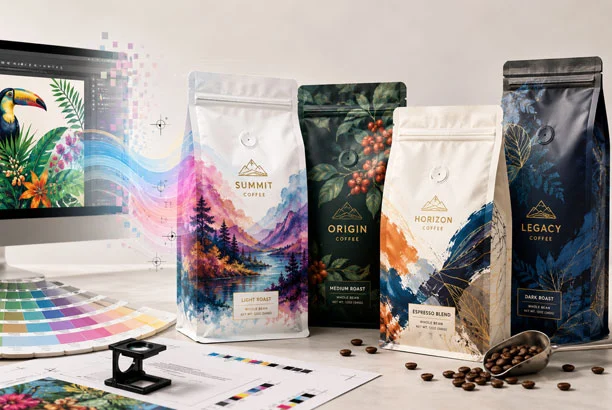
Real-world applications demonstrate how coffee pouch digital printing solves practical challenges faced by specialty coffee brands, subscription services, and private-label producers across diverse market segments.
Specialty Roaster Seasonal Launches
Specialty Roaster Seasonal Launches — Imagine a small-batch roaster releasing three limited-edition single-origin coffees for the Christmas season. With traditional printing you would spend a significant amount on cylinders for just a small run of each origin. That pricing structure does not make sense for products with unpredictable demand. The roaster can produce each design at a reasonable per-SKU cost with no setup fees and may evaluate the market reaction without any financial risk using digital printing. If one origin sells out quickly and others take longer to move, the roaster may swiftly restock the successful design without overcommitting to inventories of the slower sellers.
E-Commerce and Subscription Models
Personalisation and regular package refreshes are key to keeping direct-to-consumer coffee brands’ subscriber experience fresh. Digitally printed coffee pouches may enable various business models, enabling changes in design between shipping cycles that include customer names or personalised greetings, and QR codes linked to origin tales, brewing directions or subscription management webpages. A subscription business that handles a dozen releases a month may plan each month’s run in proportions that match real subscribers — often between 800 and 2,500 pouches — without the waste and cash-flow hit of acquiring six months’ worth of inventory up front.
Emerging Sustainability Trends
The packaging sector is innovating quickly in sustainable materials, with new recyclable and compostable structures coming on the market on a regular basis. The hurdle of costly plate commitments has also been removed by digital printing technology, helping to speed the usage of these materials. Brands have the opportunity to test paper-based pouches or mono-PE recyclable structures with consumers in smaller numbers before investing in bigger formats. This experimental flexibility allows forward thinking coffee firms to adapt to new regulations and customer tastes while rivals are left with traditional materials due to cylinder inventory.
Building Brand Trust Through Transparency
Today’s speciality coffee drinkers want authenticity and traceability. Coffee pouch digital printing gives marketers the opportunity to include specific information that may promote trust; farm coordinates, processing processes, cupping scores and certifications can all be added into package designs without the limits of standard label printing. Variable data capabilities enable printing of harvest dates, roast dates and batch numbers directly onto pouches to back quality claims with verifiable data. This openness enhances brand confidence and provides a reason for premium pricing in competitive retail contexts.
Conclusion
Coffee pouch digital printing has fundamentally changed packaging economics for specialty roasters, subscription brands, and private-label producers who need flexibility without compromising visual impact. By eliminating cylinder costs, reducing minimum orders to practical levels, and delivering production in days rather than weeks, this technology aligns packaging capabilities with the agile business models defining today's specialty coffee market. The ability to test designs, respond to seasonal opportunities, and incorporate sustainable materials positions brands to compete effectively while managing both cash flow and inventory risk. As consumer expectations for transparency, personalization, and environmental responsibility continue rising, digital printing provides the technical foundation to meet these demands profitably.
FAQ
1.What minimum order quantities should I expect for digital printed coffee pouches?
Most suppliers offering coffee pouch digital printing set minimum orders between 500 and 1,000 pieces per design. This range reflects the economics of material purchasing, machine setup, and quality control processes. Some manufacturers may accept smaller quantities for sample development or initial market testing, though per-unit costs will be higher. The key advantage is flexibility: you can order multiple designs totaling the minimum quantity rather than committing to thousands of identical pouches, which proves invaluable for brands managing multiple coffee origins or flavor profiles simultaneously.
2.How does digital printing support environmental goals?
Coffee pouch digital printing contributes to sustainability through several mechanisms. The plate-free process eliminates chemical etching and metal waste associated with cylinder manufacturing. On-demand production reduces packaging waste from expired or obsolete designs, while shorter production cycles minimize warehouse energy consumption. Perhaps most significantly, digital technology works effectively with emerging sustainable materials including recyclable mono-polymer structures and industrially compostable films, allowing brands to transition toward circular economy models without sacrificing the visual quality consumers expect from premium coffee packaging.
3.Why should I request samples before placing production orders?
Sample evaluation protects your investment by confirming that colors match your brand standards, materials provide appropriate barrier properties, and pouches function correctly on your filling equipment. Samples reveal how ink adhesion, seal strength, and dimensional accuracy translate from specifications to physical reality. This validation step catches potential issues—misaligned graphics, inadequate color saturation, or incompatible zipper placement—before they multiply across thousands of units. Reputable suppliers provide samples quickly and affordably, viewing this step as essential to building successful long-term partnerships rather than an inconvenient expense.
Partner with Guoshengli Packaging for Your Digital Printing Needs
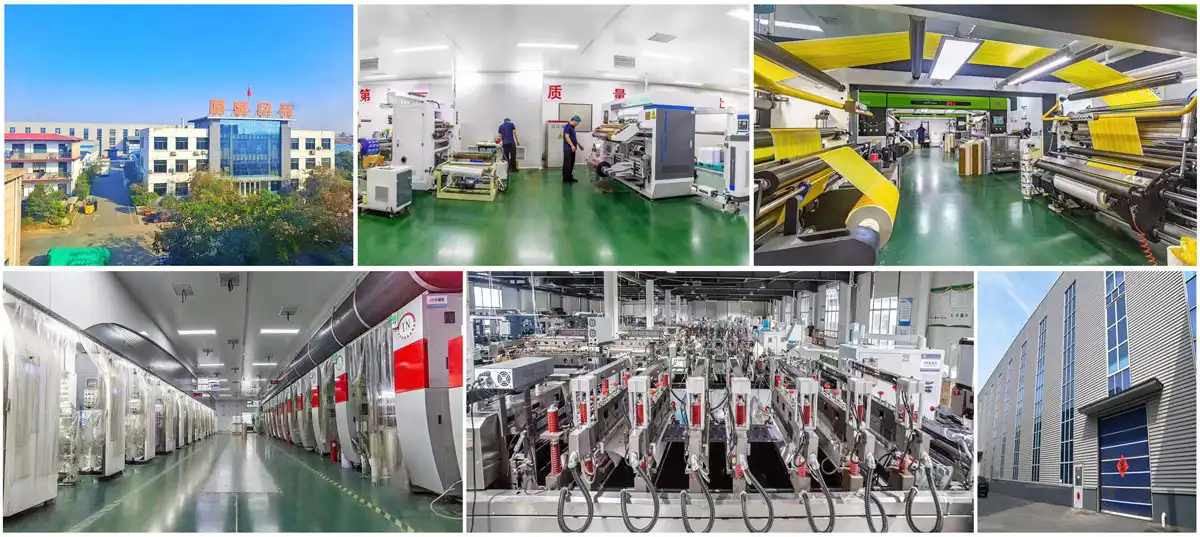
Guoshengli Packaging brings over 25 years of flexible packaging expertise to specialty coffee brands seeking a reliable coffee pouch digital printing supplier. Our certified facility operates advanced digital presses delivering 1200+ dpi resolution with color accuracy reaching 97% of Pantone standards, ensuring your brand vision translates into stunning shelf presence. We understand the challenges micro-batch roasters face: that's why we've structured our services around 500-piece minimum orders, 7 to 10 working day production cycles, and zero cylinder fees. Our technical team provides comprehensive support from initial artwork consultation through material selection, helping you choose barrier structures that preserve coffee freshness while supporting sustainability commitments. With ISO 9001, BRC, and FDA certifications backing every order, you gain quality assurance that protects your brand reputation. Whether you're launching a single-origin limited edition or managing multi-SKU subscription boxes, our digital printing solutions keep you agile and cost-effective. Contact our team at sales@guoshengpacking.com to discuss your specific requirements, request samples matching your exact specifications, and discover how the right packaging partner accelerates your growth in competitive coffee markets.
References
1. Smith, J. & Williams, R. (2022). Digital Printing Technologies in Flexible Packaging: A Comprehensive Industry Analysis. Packaging Technology Institute Press.
2. Chen, L. (2023). "Economic Comparison of Digital vs. Rotogravure Printing for Short-Run Flexible Packaging," Journal of Packaging Science and Technology, Vol. 18, No. 3, pp. 145-162.
3. European Flexible Packaging Association (2023). Sustainability Guidelines for Coffee Packaging: Material Selection and Barrier Performance Standards. EFPA Technical Publication.
4. Martinez, A. & Thompson, K. (2022). The Specialty Coffee Packaging Handbook: Materials, Printing Methods, and Brand Differentiation Strategies. Roasters Publishing Group.
5. Global Packaging Research Council (2023). "Emerging Trends in Variable Data Printing for Food and Beverage Applications," International Packaging Innovation Report, pp. 78-94.
6. Davidson, P. (2023). Quality Control Standards for Digital Printed Food Contact Packaging: Testing Protocols and Compliance Requirements. Food Safety Packaging Press.
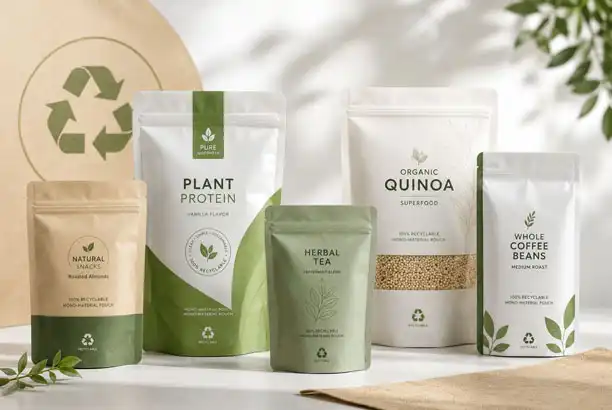
Recyclable pouches represent a transformative approach to flexible packaging, addressing the pressing needs of brands committed to sustainability without sacrificing performance or market appeal. As regulatory frameworks tighten around extended producer responsibility (EPR) and plastic waste management, businesses across food, pet care, and personal care sectors increasingly seek packaging solutions that align with circular economy principles. This guide explores the technical composition, performance characteristics, and strategic considerations essential for procurement managers and sustainability officers evaluating mono-material pouch structures. We examine how recyclable pouches compare against traditional multi-layer laminates, the certification standards that verify environmental claims, and practical implementation pathways for integrating these solutions into existing supply chains while maintaining product protection and cost efficiency.
Understanding Recyclable Pouches: What They Are and How They Work
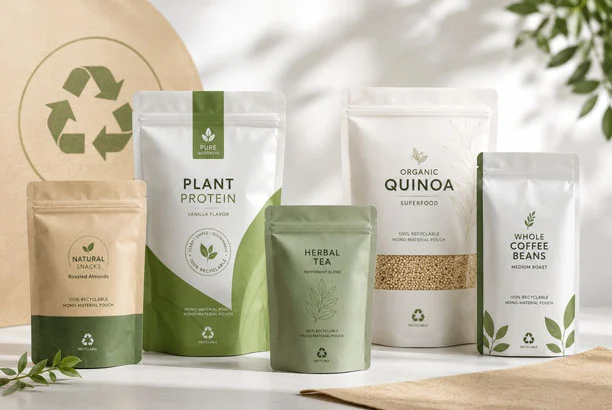
Material Foundations That Enable True Recyclability
Recyclable pouches are made from a single material, either polyethylene (PE) or polypropylene (PP), which enables whole packages to enter existing recycling streams without the need for laborious separation procedures. Unlike most multi-layer laminates, which are made of materials that don't work well together, like aluminum foil, polyester, and different types of plastic films, these advanced bags have a consistent makeup all the way through. This way of thinking about design solves a big problem in waste management: most recycling centers can't process mixed-material packaging in a way that makes economic sense. PE-based pouches usually have the recycling code #4 and work well with the low-density polyethylene recycling systems that are already in place. #5 options made of polypropylene flow through recycling pathways that are already set up for containers and caps.
The technical improvement is keeping the performance of the barrier while getting rid of the variety of materials. Usually, moisture and oxygen are kept out of flexible packaging by layering different polymers that have properties that work well together. Mono-material options get similar results by using special coatings, like EVOH (ethylene vinyl alcohol) barriers that are applied in small amounts, or advanced extrusion methods that change the surface properties without adding materials that don't work with the mono-material. These pouches are put through a lot of tests to make sure they meet food safety standards and can still be recycled. Finding the right mix between these two needs a lot of knowledge in material science and careful manufacturing.
How Recycling Systems Process These Pouches
When people throw these pouches away in the right pickup streams, they start the recycling process. Municipal recycling centers use laser readers and density separation equipment to sort the materials that come in. They then send PE and PP products to separate processing lines. After the bags are cleaned and sorted, they are shredded into flakes, washed to get rid of dirt and glue, and then melted into pellets that are used to make new goods. Material purity is very important for this process to work, which is why mono-material building is so important.
Global recycling infrastructure is very different from one region to the next. European markets benefit from well-established EPR systems that require producers to pay for collection and processing, making strong ways for flexible packaging recovery. North America's infrastructure is still getting better, with bigger cities having a wider range of services than rural areas. This difference in geography affects how suppliers are chosen and what certifications are needed. Brands have to make sure that the packaging they choose is compatible with the recycle options their target customers have access to.
Distinguishing Recyclable From Biodegradable and Compostable Options
People frequently confuse the language used to speak about sustainable packaging. Recyclable pouches are designed to remain in a material recycling loop, ensuring that the material retains its value even after several usage. Biodegradable packaging breaks down via biological processes, although it may create microplastics or requires particular conditions in the environment to operate. Compostable materials, often produced from PLA or PBAT, break down in commercial composting facilities but may pollute recycling streams if lost.
Each one is done for distinct strategic reasons. Recyclable pouches are best suited for companies that currently operate in high recycling areas since they are compatible with existing waste management systems and consumer behaviours. Compostable options are useful for circumstances when contamination after use makes recycling impractical, such as food-soiled packaging. The trick is to ensure your form of packaging is compatible with the waste management systems and typical behaviours of individuals in the markets you’re targeting. This is something that goes beyond stating something is sustainable.
Pouch Formats Suited for B2B Applications
Stand-up pouches are the most common type of store packaging because they are stable and easy to see on shelves. This makes them perfect for snacks, coffee, and pet toys. Their bottom gusset gives them strength and makes the most of poster space for advertising. Flat-bottom pouches are better for higher-value products where the packaging makes a big difference in how good the product is seen to be. They are more stable and look more expensive. Three-side seal pouches are a cheap way to package products that don't need to be able to stand on their own. These pouches are often used for secondary packaging or in institutional settings.
Spouted bags hold liquid and semi-liquid foods like sauces, purees, and drinks, and they have a built-in way to dispense them. When made from mono-PP, including the spout and cap, these can still be recycled in full, even although they are more complicated. As long as these features are carefully defined during the design phase, zipper closures, tear notches, and hanging holes can all be added without affecting the structure of the mono-material. Because flexible packaging is naturally adaptable, it can be changed to fit different product needs without affecting recycling goals.
Comparing Recyclable Pouches with Alternative Packaging Solutions
Performance Against Traditional Multi-Layer Laminates
Recyclable single-material pouches increasingly approach traditional multi-layer laminates in barrier performance while offering better recyclability and regulatory compatibility. They suit most food, pet food, and personal care products, though highly sensitive products may still require advanced laminates. Despite premiums of up to 30%, lower EPR fees and brand value can improve total cost of ownership.
Evaluation Against Compostable and Biodegradable Alternatives
Compostable materials such as PLA, PBAT, and cellulose can reduce end-of-life waste but face limited composting infrastructure, contamination risks, higher costs, and weaker barrier performance. Recyclable pouches generally provide better performance, consistency, and broader infrastructure compatibility, while compostable options suit specific products and markets with suitable disposal systems.
Rigid Packaging Comparisons: Glass, Metal, and Plastic Containers
Rigid packaging provides excellent protection and has established recycling systems but is heavy and less efficient to carry. Flexible pouches require less material, take up less storage space and may dramatically save shipping costs and emissions. But glass, metal and plastic are still the preferred materials for luxury appearance, long-term barriers, reuse or refillability, depending on the product needs.
Selecting the Right Recyclable Pouches for Your Business Needs
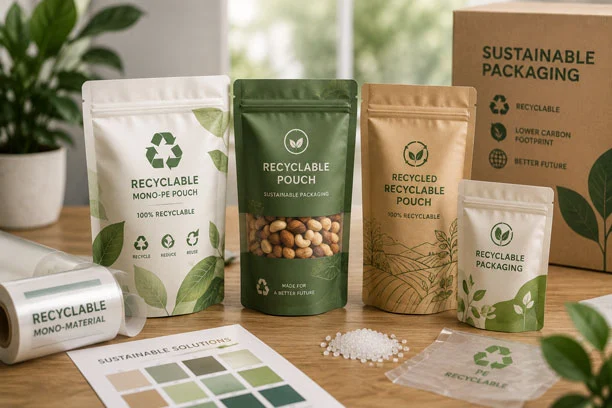
Material Composition and Barrier Requirements
Pouch materials should be suitable for product protection demands including moisture and oxygen barriers using PE, EVOH or metalized structures as needed. PE gives flexibility, seal strength, and low temperature performance. PP delivers rigidity, clarity, and greater temperature tolerance. When constructed properly mono-material constructions may maintain recyclability and provide effective product protection
Certification Standards and Verification Protocols
Trusted certificates assist evaluate environmental claims and avoid greenwashing. RecyClass examines the recyclability of a packaging by sorting, washing and materials recovery and How2Recycle offers standardised disposal instructions according to regional recycling availability. Testing for food-contact, migration, seal, burst and drop further confirms pouch safety, durability, regulatory compliance and quality.
Customization Capabilities and Brand Expression
Customisation delivers significant shelf appeal with excellent printing, versatile finishes and useful features. Rotogravure is best for long runs and complicated graphics, whereas digital printing is best for small runs and quick prototyping. Glossy, matte and soft touch finishes increase presentation while zippers, rip notches, windows and peg holes boost utility without sacrificing recyclability.
Supplier Evaluation and Quality Assurance
Don’t only look at pricing, look at the supplier’s manufacturing competence, quality consistency, certifications, production flexibility, lead times, minimum order quantities and more. Increased printing, accuracy conversion and in line inspection reduces flaws and down time. Responsive technical assistance, clear documentation and traceability further improve quality assurance, compliance and efficient commercial production.
Environmental and Business Benefits of Using Recyclable Pouches
Carbon Footprint Reduction Across Supply Chains
Recyclable pouches help lower carbon emissions in a number of ways throughout the span of a product. When compared to rigid packaging options, lightweight construction cuts down on transportation energy use, and per-unit shipping emissions can be cut in half or more. This benefit is amplified by global transport networks that send goods thousands of miles from where they are made to where they are sold.
Because they use less energy to make, flexible packaging is better than most rigid options. Melting sand or metal at high temperatures is a process that uses a lot of energy to make glass and metal containers. On the other hand, plastic film extrusion uses a lot less energy per unit volume of packaging made. When you look at the whole life-cycle of a product, including how it is made, how it is transported, and how it is processed at the end of its useful life, flexible packaging often has a smaller overall carbon footprint, even although disposal infrastructure isn't as well developed.
Single-material bags that can be recycled make recycling possible in real life, not just in theory. Even although traditional multi-layer laminates technically contain recyclable materials, they don't usually end up in recycling streams because they are hard to separate. When people have access to collection programs for recyclable pouches, they actually recycle them, closing the material loop and lowering the demand for new materials and the emissions that go along with their production.
Brand Reputation and Consumer Preference Alignment
Recyclable pouches address the increasing need from consumers and retailers for sustainable packaging, particularly from younger purchasers. Obvious and verifiable certificates enhance confidence, loyalty and premiums paid, and precise environmental claims alleviate greenwashing worries. Early adopters also show more purchase intent, consumer involvement, and good market reaction.
Operational Efficiency and Cost Management
Recyclable pouches improve operational efficiency through lighter weight, reduced storage needs, better transport utilization, and lower shipping costs. Simpler material structures also streamline supply chains and quality control while reducing supply risks. Their recyclability can further lower EPR compliance fees, especially for brands operating across multiple international markets.
How to Implement Recyclable Pouches in Your Supply Chain Successfully
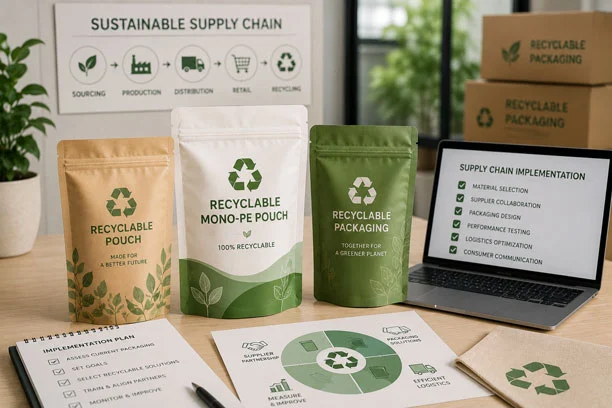
Assessing Current Packaging and Identifying Opportunities
The first step in implementation is to take a close look at all of your current product packaging. For each SKU, write down the present material structures, barrier needs, graphic complexity, and source relationships. Find goods that can have structures made of only one material because of their shelf life requirements. This will allow for quick switching chances with little technical risk.
Look at how well the pouches work with the filling equipment that is already in use. This is important because you don't want to have to buy new equipment that doesn't work with the pouches. Most horizontal and vertical form-fill-seal machines can easily fit recyclable pouches, but they need to be validated first to make sure there aren't any problems during commercial production. Older technology might need to be fixed or replaced, which will cost money that needs to be planned for in the move.
Look at the recycling facilities in each market to make sure that the packing choices match up with the ways that people can get rid of them. Products that are mostly sold in places with well-developed flexible packaging collection systems can more easily make the case for using recyclable pouches than products that are aimed at places that don't have such infrastructure. Geographic selection lets adoption happen in stages that have the least impact on the environment and the most positive effect on consumers.
Supplier Partnership and Technical Development
With strong supplier connections, we provide mono-material packaging solutions via material selection, structural optimisation, sampling and technical issue resolution. The actual product testing should comprise accelerated shelf life testing, distribution drop testing, and thermal cycling to certify the performance. Close interaction with suppliers also helps ensure artwork, colours, finishes and graphics are appropriate for recyclable materials and printing methods.
Stakeholder Engagement and Communication Strategies
Cross-functional collaboration across procurement, operations, marketing and sustainability departments guarantees clear needs, operational preparedness, accurate environmental claims and effective communication and avoids implementation challenges. Consumers want clear recycling instructions and genuine advertising, while merchants benefit from earlier knowledge of packaging changes so they can coordinate shelf labelling and marketing assistance, and resolve problems.
Performance Monitoring and Continuous Improvement
Project performance should be tracked through recycling rates, customer feedback, sales changes, supply-chain efficiency, filling-line performance, packaging quality, logistics costs, and product shelf life. Regular supplier reviews should monitor color, measurements, and seal strength, allowing quality issues to be corrected quickly and supporting long-term ROI and sustainability.
Conclusion
Recyclable pouches are useful ways for brands to meet their sustainability goals while still protecting their products and keeping their prices low. Structures made of only PE and PP can be recycled using current systems, and they actually do help the environment more than marketing claims suggest. To make the right choice, you need to carefully look at the barrier standards, certification needs, and supplier skills. The success of an implementation relies on careful testing, clear communication with customers, and alignment among stakeholders. Less carbon emissions, better brand reputation, and more efficient operations are just a few of the business and environmental benefits that make transition investments worth it in most cases. As regulations get stricter and people want more environmentally friendly options, brands that use recyclable pouches will be able to stay ahead of the competition in responsible packing for a long time.
FAQ
1.Are recyclable pouches compatible with standard municipal recycling programs?
Compatibility depends on the type of material used and the infrastructure in the area. Mono-PE pouches marked #4 can be recycled with LDPE streams that are already in place in most developed markets, although collection programs do vary. Mono-PP pouches (#5) can be recycled with polypropylene when it is possible to do so. Check the recycling skills of your target markets against the type of material you're sending them. The level of infrastructure development varies a lot between areas like North America, Europe, and other places.
2.How can I verify a supplier's sustainability certifications are legitimate?
Ask for certification documents directly and check their authenticity with the organizations that issued them. You can check for RecyClass, BRC, ISO, and FDA registrations in official databases or by calling the organizations that issue the certifications. Suppliers with a good reputation always provide full paperwork. Performance claims are backed up by studies from reputable labs like SGS and Intertek. When possible, site audits give direct confirmation of how well products are made and how environmentally friendly they are.
3.What lead times should I expect for custom printed recyclable pouch orders?
Lead times depend on the type of printing, the size of the order, and how complicated the customization is. For standard specs and smaller orders, digital printing jobs can be finished in 7–10 days. Rotogravure printing usually takes 15 to 20 days because the cylinder needs to be set up and prepared. This method works well for medium to large production runs. Depending on the method used and the destination, international shipping adds time to the journey. For example, air freight gets to its destination in 4–5 days, but ocean shipping takes several weeks. For pressing needs, rush output may be possible at an extra cost.
Partner with Guoshengli Packaging for Your Recyclable Pouch Solutions
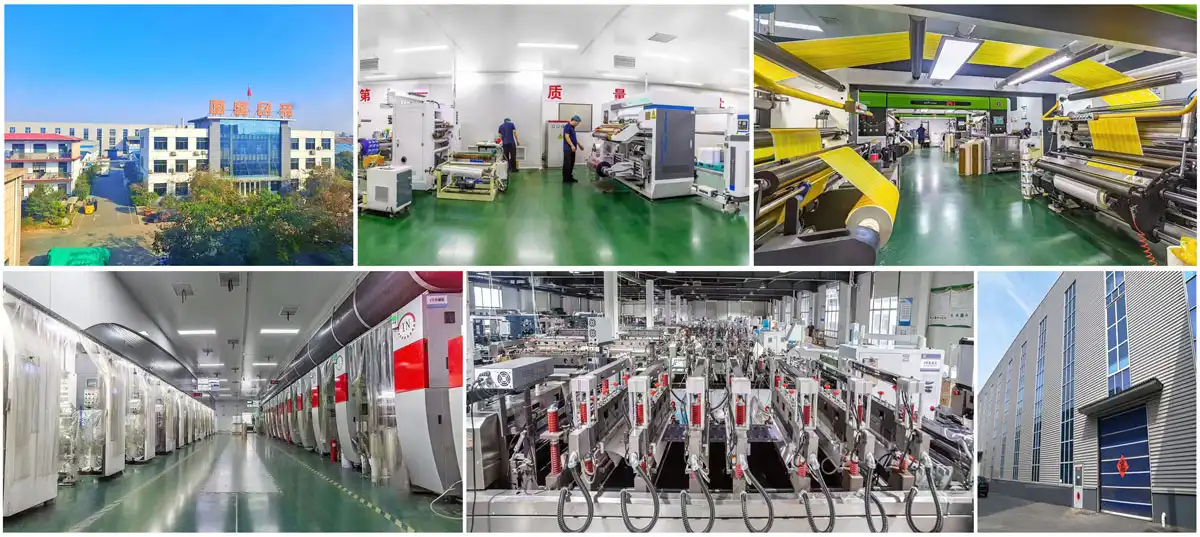
Guoshengli Packaging makes certified recyclable pouches that will help you reach your sustainability goals without sacrificing the safety of your products or the way your brand looks. Our PE and PP structures are made of just one material. They blend 25 years of experience with flexible packaging with cutting-edge barrier technologies and precise production systems that are certified to meet ISO 9001, BRC, and FDA standards.
Lead times start at 7 days, and we can handle production ranging from digital print runs of 500 units to high-volume rotogravure orders. Our technical team works together on all stages of development, from choosing the right materials and barriers to fine-tuning the artwork and making sure the filling equipment works properly. This makes sure that transition from traditional laminates to sustainable alternatives goes smoothly. Whether you're sourcing recyclable pouches as a manufacturer launching new product lines or upgrading existing packaging to meet EPR requirements, our experienced support helps you achieve environmental and business objectives.
Contact our team at sales@guoshengpacking.com to discuss your specific requirements. We'll provide material recommendations, sample options, and detailed quotations tailored to your application.
References
1. Chen, M., & Williams, K. (2022). Mono-Material Flexible Packaging: Performance Evaluation and Recycling Infrastructure Compatibility. Journal of Sustainable Packaging Technology, 15(3), 127-145.
2. European Plastics Recycling Association. (2023). Recyclability Guidelines for Flexible Packaging in European Collection Systems. Brussels: EPRA Publications.
3. Johnson, R., Thompson, L., & Martinez, A. (2021). Life Cycle Assessment of Flexible versus Rigid Packaging Systems. International Journal of Environmental Packaging, 9(2), 88-106.
4. Packaging Research Institute. (2023). Global Trends in Sustainable Flexible Packaging: Material Innovation and Market Adoption. Chicago: PRI Industry Reports.
5. Smith, J., & Anderson, P. (2022). Barrier Performance of Recyclable Mono-Material Pouch Structures for Food Applications. Food Packaging Science and Tec
6. RecyClass. Recyclability Evaluation Protocol for Flexible Packaging. RecyClass, 2024.
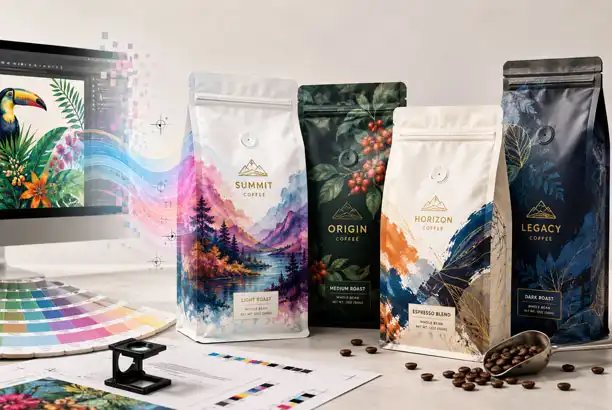
Coffee pouch digital printing represents a transformative shift in specialty coffee packaging, enabling roasters and brands to translate artistic vision into tangible shelf appeal without the traditional constraints of plate-based printing. This advanced technology utilizes inkjet or electrophotographic processes to deliver high-resolution graphics—often exceeding 1200 dpi—directly onto flexible packaging substrates. Unlike gravure or flexographic methods that demand costly cylinders and minimum order quantities in the tens of thousands, digital printing empowers brands to launch small batches starting from just 500 units, test seasonal designs, and execute multi-SKU strategies with unprecedented speed and financial flexibility.
Understanding Digital Printing for Coffee Pouches
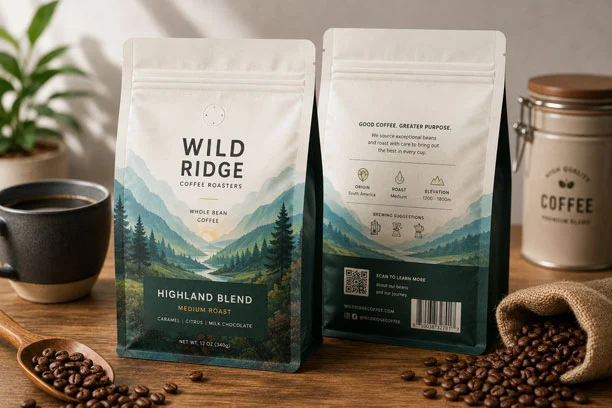
By getting rid of motorized plates, digital printing has changed the possibilities for coffee packing in a big way. With this plate-free method, specialty roasters can go from approved artwork to finished pouches in just seven business days. Precision inkjet heads or electrostatic toner systems are used to move digital files directly to the substrate. This keeps color consistency up to 97% of the Pantone range.
How Digital Printing Works on Flexible Packaging
The production process starts with preparing the digital files. This is where the artwork goes thru color analysis to make sure it works with the printer's color range. Then, food-safe printing inks that don't migrate are put on PET, matte PET, or paper surfaces one layer at a time by advanced print engines. After that, barrier films like aluminum, EVOH, or metalized PET are layered on top of these outer layers, and heat-sealable inner layers like PE or CPP are used to seal the whole thing. The end result is a multi-layer structure that keeps the volatile coffee aromas safe and shows off vivid, photo-quality graphics.
Key Technical Advantages Over Traditional Methods
Specialty roasters can get a lot out of digital workflows' performance advantages. With variable data printing, each pouch in a production run can have its own batch number, roast date, or QR code that leads to a story about the product's origin. This is not possible with static gravure cylinders. Not having to pay for plates saves between $480 and $1,200 per design, which makes it possible to update packaging for limited collaborations or single-origin releases. Turnaround times go from four to six weeks to seven to ten working days, which lets brands react quickly to crop cycles and feedback from the market.
Comparing Printing Technologies: Why Digital Printing Stands Out
When looking at different packaging choices, procurement teams have to compare different printing methods against how things work in the real world. Flexographic printing is still the best choice for very large orders, with unit costs below $0.05 when the number of products ordered is over 100,000. Rotogravure is perfect for multinational companies that make millions of identical pouches every year because it ensures perfect consistency.
Cost Analysis Across Production Volumes
Digital printing can match the cost of traditional methods at surprisingly low volumes. Digital channels usually charge $0.40 to $0.60 per unit for a 2,000-unit order of stand-up pouches, while flexography costs $0.35 to $0.50 per unit, but that's after $800 is paid for plate fees. When the prices of the cylinders are spread out over time, digital is cheaper for runs below 10,000 pieces. For about the same cost as making 5,000 units of a single flexographic design, brands can test three seasonal blends at the same time and make 1,500 units of each design.
Quality Benchmarks and Performance Standards
Modern digital presses can get ink to stick to paper well enough to pass the ASTM D3359 cross-hatch tests, and they can keep color stability within Delta E values below 2.0 across output runs. Rub resistance meets or exceeds 200 cycles according to Sutherland testing standards. This makes sure that graphics can handle being stacked in a building and handled by customers in a store. The printing method doesn't change the rate of oxygen transfer because the barrier's performance depends on the structure of the laminate, not the decoration technology.
Customization and Sustainability in Coffee Pouch Digital Printing
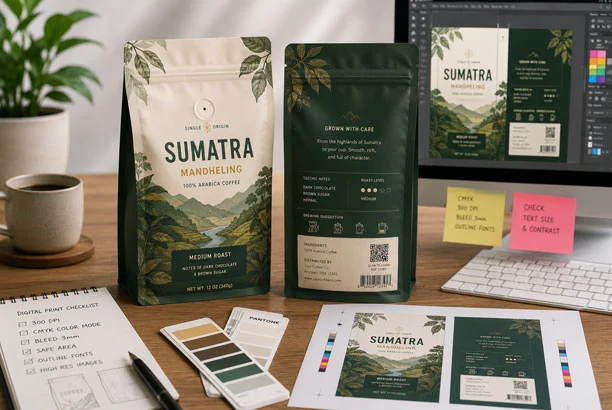
In the specialty coffee market, where people pay more for honesty and stories, personalization has become a way to stand out from the competition. Coffee pouch digital printing processes make customization options available that were only available for high-end goods before. This lets micro-roasters compete physically with well-known brands.
Variable Data and Consumer Engagement Features
Each pouch can show different details without having to stop production or change how it's set up. If a roaster has a subscription service, they might put the names of each customer or unique tasting notes on each month's shipment. Farm-to-cup brands use QR codes that can be scanned to see the GPS locations of the fields where the coffee comes from, how it was processed, and how well it was brewed. During production, batch-specific data like roast date, lot number, and elevation can be added on the fly, meeting the needs of European and North American markets for traceability.
Sustainable Ink and Substrate Options
Environmental duty is becoming more and more important in purchasing decisions. Water-based inks and UV-curable formulations keep food-contact safety while getting rid of solvent emissions. These inks stick well to structures made of a single reusable material, like all-PE laminates, that follow the CEFLEX design standards for taking part in the circular economy. Compostable PLA/PBAT films can be thrown away by industrial composting when they reach the end of their useful life, but their barrier properties usually limit their shelf life to six months. When brands try to be environmentally friendly and protect their products at the same time, they often choose reusable materials that keep the air and moisture barriers that are needed to keep coffee fresh.
Certifications and Compliance Considerations
To make sure the food is safe, responsible suppliers follow strict testing protocols. Migration testing acts out ten-day contact situations to see if ink parts move into food-like substances at levels higher than what is allowed by law. Spectrophotometric research shows that color differences are still very small between orders that were made months apart. Testing the quality of the seal makes sure that the heat-sealing process hasn't weakened the structure or made leak paths around the degassing valves. Suppliers with ISO 9001, BRC, or FDA certifications show that they handle quality in a way that goes beyond simple compliance routines.
Procurement Guide: How to Choose a Digital Printing Supplier for Coffee Pouches
When picking a factory partner, you need to look at both their professional skills and how stable they are in operation. Specialty roasters are often angry that big converters don't give small accounts enough attention, which causes replies to be slow and service quality to be all over the place.
Critical Evaluation Criteria
Minimum order amounts show how committed a seller is to new brands. True digital-first manufacturers set MOQs at 500 to 1,000 units per design. Hybrid operations, on the other hand, often set MOQs at 5,000 units, which takes away from digital's natural freedom. During busy times, like when the harvest starts in the fall and when holiday gifts need to be wrapped, lead time guaranties become very important. Suppliers with dedicated digital lines can meet response times of seven to ten days all year, but during Q4 those who use digital as extra capacity may have to extend timelines to three weeks.
Sampling and Prototyping Processes
Free or low-cost samples speed up the process of making a choice. Leading sellers offer digital proofs in 48 hours and real examples within five business days. This way, brands can make sure that the models match the colors, have the right finish, and are structurally sound before they commit to mass production. As part of the sampling process, the pouch should be sealed and filled with coffee to make sure it can be used with both automatic and manual filling machines. It costs a lot more in the long run to package something in a pouch that looks nice but gets stuck on a volumetric filler.
Pricing Transparency and Cost Escalation
It should be clear how unit costs go down as traffic goes up when you use a tiered price scheme. 500 units could be sold for $0.65 each, 1,000 units for $0.52 each, and 3,000 units for $0.43 each. The prices keep going down as you reach 10,000 units with coffee pouch digital printing. You can't plan your budget as well when there are hidden costs like artwork preparation fees, color matching prices, and expedite fines. You can trust that the quotes you get from suppliers will cover everything, such as supplies, printing, converting, and basic finishes like flaps and zippers.
Communication and Relationship Management
Communication with the respondent is often what makes a great partner different from a good supplier. When specialty roasters put out a lot of coffee from different sources, they need packing partners who know how busy the season can be and can answer technical questions in hours instead of days. Give smaller clients their own account managers. This shows that the supplier sees new brands as having a chance to grow. This makes connections that get stronger as the number of orders that come in grows.
Maximizing ROI with Digital Printing on Coffee Pouches
When you invest in high-quality packaging, you get measurable returns in the form of better brand recognition and more operational flexibility. Specialty coffee costs two to four times more than regular coffee, which means that investments in packaging that raises the perceived value are possible.
Brand Equity and Shelf Impact
Consumer study shows that packaging affects choices about what to buy at the point of sale. This is especially true for high-end products where quality cues are very important. Graphics in high definition that show simple typography, botanical drawings with lots of detail, or origin landscapes show that you are skilled and pay attention to the little things. Matte finishes with spot gloss add interest to the way things feel, and soft-touch coatings make things feel expensive. When a roaster switches from plain kraft boxes to digitally printed stand-up bags with a flat bottom, they can often get away with 15% to 25% price rises just because they think the quality is better.
Inventory Risk Management
When brands buy boxes the old-fashioned way, they need to keep a collection that could last longer than the twelve months of sales forecasts. There is a risk of obsolescence with a 50,000-unit gravure order for a single blend if consumer tastes change or green coffee supplies change without warning. Just-in-time inventory plans are possible with digital printing. This means that brands only need to buy 2,000 units a month instead of 24,000 units a year. With this method, you don't need as much working capital or office room, and you don't have to worry about having to throw away old packaging because the blend or brand has changed.
Market Testing and Product Development
When you launch a new product, there is a lot of doubt. Digital printing turns packing from a set cost into a tool for growth that can be used in many ways. A roaster that wants to introduce a honey-processed Ethiopian coffee can do a test run of 1,000 units to see how well it does with customers before committing to larger inventory positions. Subscription brands need flexible packaging that gravure economics can't give them because every month they change their seasonal products. Private-label makers who work with many retailers make different patterns for each one so there is no inventory confusion or risk of cross-contamination.
Conclusion
Digital printing has fully changed how much coffee packages cost and how creative they can be. That got rid of the things that made specialty roasters have to use generic solutions or commit to big, risky plans that cost a lot of money. By getting rid of plate costs, dropping the minimum order number to 500 units, and speeding up the turnaround time to seven working days, this coffee pouch digital printing method lets brands match their creative vision with how they can run their business. Digital printing is best for specialty roasters, subscription brands, and private-label manufacturers that need to change with the market while keeping their premium brand positioning. This is because it can handle high-resolution graphics, variable data, and substrate options that are good for the environment.
FAQ
1.What is the typical cost difference between digital and gravure printing for coffee pouches?
It costs between $0.40 and $0.65 per unit to print digitally for small sales of 500 to 3,000 products. For gravure printing, the cost per unit is between $0.30 and $0.45, but the cost per barrel is between $800 and $1,200. Digital is cheaper for runs of less than 8,000 to 10,000 units when plate costs are taken into account.
2.Can digital printing match the barrier performance of traditional coffee packaging?
Yes, the function of the barrier rests on the structure of the laminate rather than the printing method. The oxygen transmission rate of digitally printed bags with aluminum, EVOH, or metalized PET middle layers is less than 1 cc/m³/day, which is the same as or better than gravure-printed versions for a twelve-month shelf life.
3.How long does it take to receive finished pouches using digital printing?
After artwork approval, production times are between seven and ten working days. For gravure printing, the time frame is between four and six weeks. Digital proofing, printing, laminating, pouch conversion, and quality control are all part of this.
4.Are the inks used in digital printing safe for food contact?
Low-migration inks that are approved by FDA 21 CFR 175.300 and EU Regulation 1935/2004 are used by reputable providers. After these inks are put on top of the substrate, they are kept away from food by functional barrier films. This makes sure people follow the rules for safety.
Partner with Guoshengli Packaging for Your Digital Coffee Pouch Needs
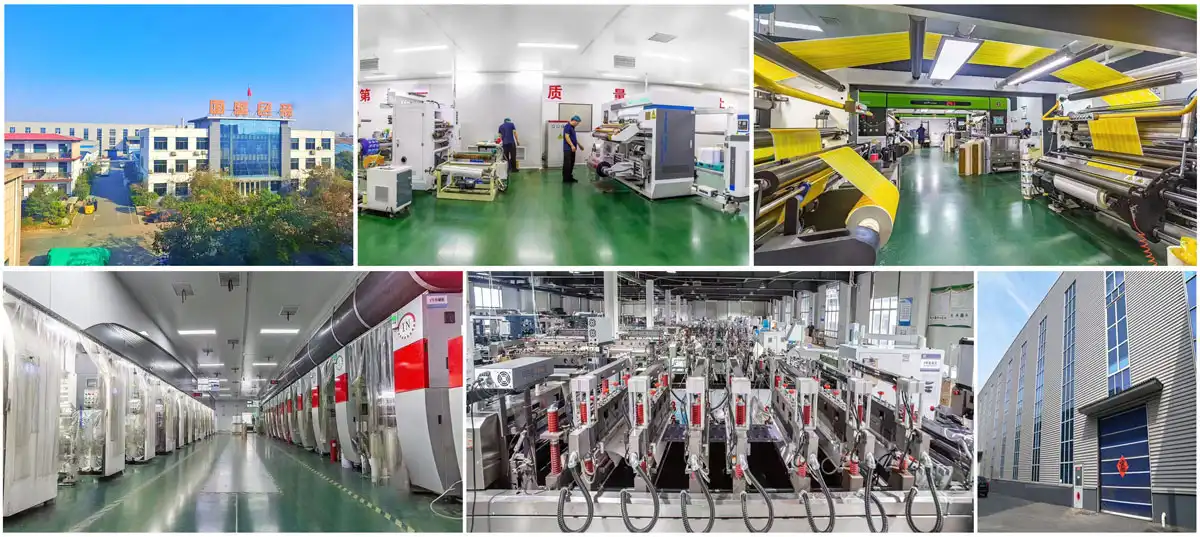
For more than 25 years, Guoshengli Packaging has helped food brands and specialty coffee roasters by providing flexible packaging solutions that balance how they look with how well they work. We don't have to deal with problems like high setup costs, long lead times, and high minimums because our company only prints on coffee pouches. Our coffee pouch digital printing options include 1200 dpi resolution, 97% Pantone color precision, and minimum order quantities (MOQs) as low as 500 pieces per design. This makes them perfect for small batches, seasonal starts, and strategies that use more than one SKU.
We offer full customization, such as flat-bottom structures for better shelf appearance, resealable zippers for longer freshness, and changeable data printing for tracking batches. Our building materials are a mix of high-barrier laminates and eco-friendly options like mono-PE that can be recycled and films that can be broken down in the soil. All of these options are approved by ISO 9001, BRC, and FDA. We give new brands the same amount of attention as old ones, with turnaround times of seven to ten days and quick technical support.
Email our team at sales@guoshengpacking.com to talk about your project needs, ask for samples, or get a full price that is based on your volume and specifics.
References
1. Smith, J. (2022). Flexible Packaging Technology: Innovations in Digital Printing for Food Applications. Packaging Science Institute Press.
2. Martinez, L., & Chen, K. (2023). "Comparative Analysis of Printing Technologies for Specialty Coffee Packaging." Journal of Food Packaging Engineering, 18(3), 145-162.
3. Thompson, R. (2021). Sustainable Packaging Solutions: Material Selection and Environmental Impact in the Coffee Industry. EcoPackaging Research Group.
4. Anderson, M. (2023). "Cost-Benefit Analysis of Digital Versus Gravure Printing for Small-Batch Production." International Packaging Economics Quarterly, 29(2), 78-94.
5. Williams, S., & Davis, P. (2022). Food Contact Compliance: Regulatory Standards for Printed Flexible Packaging in North America and Europe. Food Safety Publications.
6. Global Coffee Packaging Trends Report (2023). Market Research Insights: Digital Printing Adoption in Specialty Coffee Segments. Beverage Packaging Analytics Group.
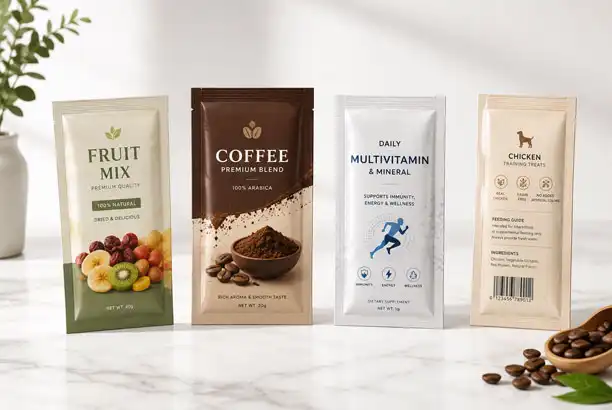
The correct flexible packaging type can substantially affect your product’s shelf life, brand appeal, and bottom line. The 3 sided pouch has evolved as an important option in B2B procurement spanning food, pet food, pharmaceutical, cosmetic, and industrial industries. This guide covers what procurement managers, distributors, and packaging engineers need to know—from construction basics to supplier evaluation and emerging trends. Whether you’re launching a new product line or optimising current supply chains, understanding the fundamentals of three-side seal pouches will help you make informed, cost-effective choices that safeguard product quality and enhance market competitiveness.
Understanding 3 Side Seal Pouches: Definition and Key Characteristics
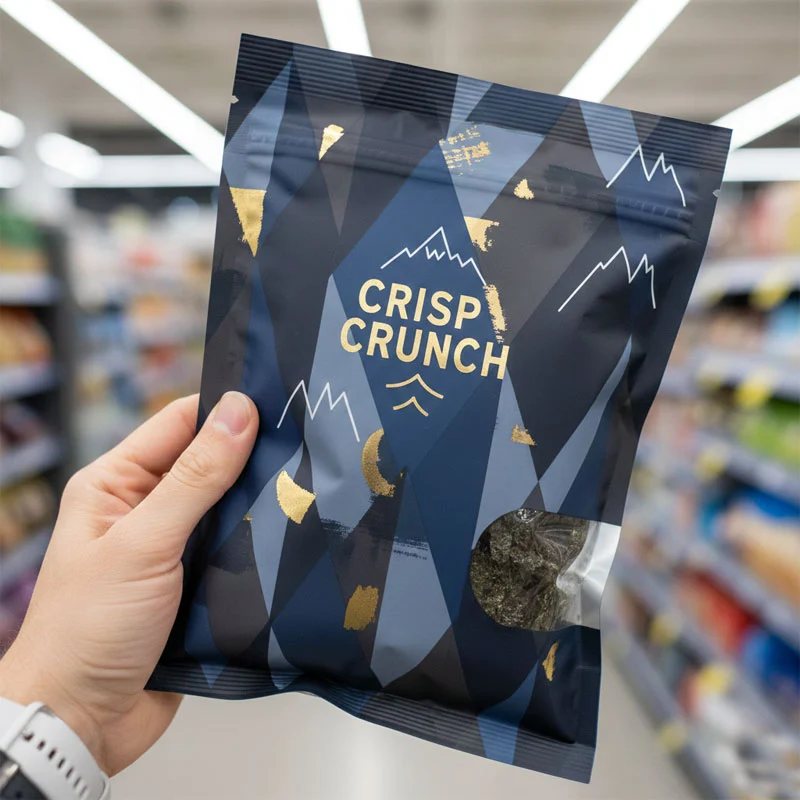
A 3 sided pouch is a flat pouch with three sides sealed during converting and one side left open for filling before the final seal is made. Depending on the converting process, it may be produced from a folded film web or from separate film webs. The relatively simple flat construction can support efficient converting and compact storage, although actual material use and production efficiency depend on pouch dimensions, laminate structure, and manufacturing method. Compared with many rigid containers or gusseted formats, the flat profile can also improve empty-package storage efficiency.
Construction and Material Options
Most 3 sided pouches are made from multi-layer laminates combining materials such as polyethylene, aluminium foil, PET, PA, or VMPET. Barrier performance varies widely by laminate. OTR and WVTR targets should therefore be specified under defined test conditions according to the product, target shelf life, filling process, and distribution route rather than assumed from the pouch format alone. High-barrier structures can help protect sensitive products from oxidation, moisture, aroma loss, and light exposure during storage.
Total material thickness may range from relatively thin sachet structures to much heavier laminates depending on product weight, pouch dimensions, barrier requirements, puncture risk, filling process, vacuum requirements, and distribution conditions. Thickness should therefore be selected as part of the complete package specification rather than by product weight alone.
Variations and Functional Features
The basic structure has three pre-sealed edges, but manufacturers can add a variety of functional features to meet different application needs. Options include resealable zippers, tear notches for easier opening, hang holes for retail display, and degassing valves for coffee or other products that continue to release gas after packing. For applications requiring additional internal volume, a gusseted pouch format may be considered instead of a conventional flat 3 sided pouch. B2B buyers should evaluate these options according to the product, filling method, consumer use, and retail requirements.
Seal Strength and Thermal Stability
Seal integrity is an important part of quality control in the production of 3 sided pouches. Seal strength can be measured using ASTM F88/F88M or another appropriate method, with acceptance criteria defined according to the laminate, seal width, product, and application rather than a universal force value. ASTM F1140 can be used to evaluate resistance to internal pressurization for suitable flexible packages, while leak or package-integrity methods should be selected according to the specific pouch construction and test objective.
ASTM F1929 is intended for certain porous medical packaging seals and should not be treated as a universal leak test for ordinary food or industrial pouches. Temperature capability also depends on the complete laminate and process. Selected 3 sided pouch structures may be designed for frozen storage, hot filling, or retort processing, but each application requires a validated material, adhesive, ink, sealant, and thermal process rather than assuming that all structures can withstand the same temperature range.
Key Benefits and Uses of 3 Side Seal Pouches in B2B Procurement
Because it can address important industry needs such as logistics efficiency, material use, shelf-life protection, and flexible customization, the 3-sided pouch format is widely used by procurement professionals. Its flat shape can support efficient storage and carton packing, although actual freight and warehouse savings depend on pouch dimensions, fill weight, shipment configuration, and the alternative packaging being compared.
Superior Barrier Protection
When 3-sided pouches use high-barrier laminates, they can help limit oxygen, moisture, aroma, light, and external contamination. This can support the required shelf life when combined with appropriate filling, sealing, storage, and distribution conditions. Food brands packaging coffee, meat, dried fruits, or spices may use high-barrier structures where flavour and aroma retention are important. Pharmaceutical or nutraceutical applications may also require carefully specified moisture, oxygen, or light protection depending on the product.
For suitable applications, high-barrier 3 sided pouches can provide effective product protection with lower packaging mass than many rigid formats, but performance should be compared application by application rather than assuming that a flexible pouch always provides equal or superior protection.
Versatility Across Industries
The 3 sided pouch can be used across a wide range of industries when the material structure and validation requirements are matched to the application. For terminally sterilized medical devices, sterile barrier packaging may need to meet ISO 11607 requirements. These applications are highly specialized and should not be assumed to use the same materials, converting methods, or validation protocols as ordinary food or industrial pouches.
Food manufacturers may use suitable 3 sided pouch structures for vacuum-packed jerky, smoked seafood, frozen products, and other foods. Vacuum applications require materials with adequate toughness, puncture resistance, and seal strength, validated using the actual product and vacuum process rather than one universal pressure value. Industrial chemical applications require product-specific compatibility testing and, where applicable, compliance with dangerous-goods transport requirements. Suitability should never be inferred from pouch format alone.
Sustainability and Eco-Friendly Materials
Sustainability has become an important consideration in B2B purchasing decisions. Suppliers may offer mono-PE structures designed to improve compatibility with suitable polyethylene recycling systems, as well as selected compostable structures that meet relevant certification requirements. Neither recyclability nor compostability should be assumed from a material name alone, and barrier, sealing, filling-line, and shelf-life performance must be validated for the actual application.
Selected compostable packaging structures may be assessed against standards such as EN 13432 where applicable, but industrial compostability is a separate end-of-life route from mechanical recycling. Manufacturing sites may also use systems such as regenerative thermal oxidizers (RTOs) to control VOC emissions from printing and lamination operations. These manufacturing controls can support environmental-management objectives but should not be used as proof that a specific pouch structure is automatically sustainable.
Cost-Effectiveness and Economic Efficiency
The 3-sided pouch can be cost-effective compared with some rigid formats or more complex pouch constructions because of its relatively simple flat design. However, total cost depends on material consumption, dimensions, barrier structure, printing, order quantity, converting complexity, functional features, and filling-line efficiency.
The flat format can also support efficient carton packing and warehouse storage in many applications. Flexible minimum order quantities may make custom packaging more accessible to smaller brands or market-test programmes, depending on the printing method and supplier. Procurement teams should therefore compare total packaging cost rather than assuming that every 3 sided pouch project will automatically be cheaper than alternative formats.
Comparing 3 Side Seal Pouches with Other Packaging Options
Procurement professionals can choose packaging that better matches product profiles, retail display needs, filling equipment, and budget constraints by understanding how the 3-sided pouch compares structurally and functionally with alternative formats.
Versus 4 Side Seal Pouches
A four-side-seal package has seals on all four edges in the finished format, while a pre-made 3 sided pouch is typically supplied with one side open for filling before the final seal is made. The exact converting and filling process varies by equipment and package design, so cost and production complexity should not be judged simply by the number of film webs used.
Four-side-seal formats may offer different panel and sealing configurations, but seal strength depends on the material, seal geometry, and sealing process rather than the number of sealed edges alone. For single-serve snacks, samples, or other flat-pack applications, 3-sided pouch formats can provide a practical balance of cost, protection, and production efficiency when correctly specified.
Versus Stand-Up Pouches
Stand-up pouches use a gusseted construction that allows the package to stand upright on retail shelves. This can improve presentation in applications where shelf visibility matters. The gusset also changes the film area, converting process, and filling behaviour compared with a flat 3 sided pouch.
Although a 3-sided pouch does not normally stand on its own, its flat profile can support compact storage and shipment. For B2B buyers focused on secondary packaging efficiency, samples, industrial materials, or applications where self-standing display is not required, the 3-sided pouch can be a practical alternative.
Versus Side Gusset Pouches
Side gusset pouches expand through folded side panels, increasing internal volume while maintaining a relatively compact footprint. This can suit products such as coffee beans, powders, and larger snack portions. Their cost and material use depend on the actual pouch dimensions, gusset depth, laminate, and converting process.
For products that fit comfortably within a flat format, the 3-sided pouch can provide a simpler construction while maintaining barrier performance when the correct laminate is selected. The decision should therefore be based on fill volume, display needs, material use, and filling method rather than assuming one format is always less expensive.
Resealable Zippers: Balancing Convenience and Cost
When a 3-sided pouch includes a resealable zipper, it can improve convenience for products used over multiple occasions. This feature is commonly considered for food, pet treats, supplements, and similar applications. Resealable zippers can help limit exposure between uses, but they do not restore the original factory-sealed barrier condition.
The trade-off is additional material cost and converting complexity. Procurement professionals should therefore compare the consumer benefit, pack size, filling method, product sensitivity, and target-market positioning before specifying a zipper.
Food Safety Compliance and Contamination Protection
All food-contact flexible packaging must meet the applicable safety requirements for the intended market and conditions of use. Food-contact safety depends on the complete material structure, including films, adhesives, inks, coatings, and other components. A 3-sided pouch does not itself prevent chemical migration; compliance depends on appropriate material selection and testing.
Compliance documentation may include ISO 9001 and BRCGS Packaging Materials certificates, applicable food-contact declarations or test reports, and third-party laboratory testing such as SGS where required. These documents can support compliance assessment for the relevant target market but should not be treated as proof that one certification automatically covers all international regulations.
Best Practices for Procuring and Using 3 Side Seal Pouches
Effective procurement combines quality, customization, cost, and supply-chain planning. Following a structured process can help packaging solutions support product value, production efficiency, and long-term growth.
Evaluating Supplier Credentials
Choosing a dependable supplier is the first step in sourcing packaging that performs consistently. Give priority to manufacturers with appropriate quality-management and packaging certifications such as ISO 9001 and BRCGS Packaging Materials, together with food-contact compliance documentation suitable for the intended market.
Review the supplier's equipment and production capabilities, including printing machines, laminating machines, slitting equipment, and pouch-making machines, to understand how repeat orders are controlled. Relevant experience with similar pouch structures, products, filling processes, and export markets can also reduce technical and supply risk. Ask for appropriate test reports and documentation to verify barrier performance, seal properties, and food-contact compliance where required.
Understanding Minimum Order Quantities and Lead Times
MOQ requirements vary widely by supplier, pouch size, material structure, printing method, and number of designs. Some manufacturers support smaller test runs, while others focus on high-volume production. Digital printing can often support lower quantities because conventional printing cylinders are not required, while rotogravure is generally more economical for larger repeat orders.
Lead times also vary according to artwork approval, material availability, printing method, curing, converting, quality inspection, and production schedule. Selected digital-printing projects may be completed relatively quickly, while rotogravure usually requires additional setup and processing time. Air freight may support urgent replenishment, but transit times should be confirmed for the actual route and delivery term rather than assumed from a universal number.
Custom Printing and Branding Advantages
Visual appeal can influence how products are presented and remembered. Rotogravure printing can use up to 11 colours on suitable projects to produce detailed, high-resolution graphics. Digital printing can support shorter runs, multiple SKUs, limited editions, and faster artwork changes.
Custom printing can communicate brand values, product benefits, instructions, and regulatory information. Buyers should work closely with suppliers on artwork preparation, colour matching, print tolerances, and proofing so the finished pouch matches the intended brand standard.
Bulk Buying Strategies to Optimize Pricing
Volume commitments can improve unit economics, but procurement teams should balance those savings against inventory, cash flow, storage, and forecast risk. Long-term forecasting and repeat business can support better production planning and may improve commercial terms.
Combining orders across compatible SKUs or coordinating repeat purchase schedules can also improve material utilisation and planning efficiency where the structures and printing requirements allow it. Clear communication with suppliers about expected growth, forecast volume, and order frequency can make production planning more predictable.
Ensuring Timely Delivery and Logistics Coordination
Packaging delays can disrupt production schedules and product launches. Buyers should establish clear delivery targets and allow time for artwork approval, production, quality inspection, freight booking, and customs clearance.
Work with suppliers that have experience coordinating both sea and air freight according to the project requirement. Export experience with North American, European, and Asia-Pacific markets can help reduce avoidable documentation and logistics delays. Shipment tracking and open communication allow potential issues to be addressed before they affect the production plan.
Future Trends and Innovations in 3 Side Seal Packaging
Packaging technology continues to evolve because of changing environmental requirements, consumer expectations, and advances in materials and manufacturing. Procurement teams that follow these developments can evaluate new solutions without sacrificing product performance.
Emerging Eco-Friendly Films and Circular Economy Initiatives
Recyclable and compostable material technologies continue to develop across flexible packaging. Mono-material PE/PE structures can improve compatibility with suitable polyethylene recycling systems when the complete package meets relevant design-for-recycling criteria and local infrastructure accepts the format.
Selected PLA-based or other compostable structures may be suitable where the complete pouch is certified for the intended industrial-composting route. B2B customers can use these options to support sustainability objectives while still validating product safety, barrier performance, sealing, and shelf life for the actual application. Third-party certification and transparent technical documentation can help support environmental claims.
Advanced Materials for Enhanced Performance
Developments in materials science continue to improve barrier performance, puncture resistance, sealability, and temperature capability. New laminate and coating technologies can reduce oxygen or moisture transmission while supporting downgauging where mechanical, barrier, and seal performance remain adequate.
Functional coatings can also add application-specific properties. Matte finishes can create a different visual and tactile effect, while anti-fog layers may improve visibility in selected refrigerated applications. These developments can expand the range of products suitable for 3-sided pouch packaging, including acidic foods or products requiring additional chemical compatibility, provided the complete structure is validated.
Smart Packaging Features
Interactive technologies can be incorporated into 3-sided pouches where technically and commercially justified. QR codes can link physical packaging to product information, authenticity checks, promotions, or traceability data. Tamper-evident features may support product integrity in sensitive categories such as pharmaceuticals or nutraceuticals.
Temperature-sensitive indicators may also be used for selected cold-chain applications where monitoring storage exposure is important. As connected-packaging technologies evolve, pouches can provide additional communication and traceability functions beyond basic containment.
Market Growth Drivers
Growing categories such as organic foods, plant-based proteins, personalized supplements, and e-commerce continue to create demand for lightweight, customizable flexible packaging. Regulations in many markets are also placing greater emphasis on packaging reduction, recyclability, producer responsibility, and more transparent environmental claims.
E-commerce creates additional requirements for packaging that can tolerate shipping and handling while presenting the brand effectively when the product reaches the consumer. These trends make the 3-sided pouch an adaptable format that can be engineered for changing product, market, and regulatory requirements.
Conclusion
The 3-sided pouch is a proven and flexible packaging option that can serve a wide range of B2B applications across food, pet food, pharmaceutical, cosmetic, and industrial sectors. Its flat construction, customizable barrier structures, printing flexibility, and broad material range make it useful for brands seeking to balance performance, cost, logistics, and presentation.
Businesses can make better packaging decisions by matching material structures to the product, comparing pouch formats objectively, defining appropriate seal and barrier requirements, and validating the final package under the intended filling, storage, and distribution conditions. Sustainability and smart-packaging technologies will continue to expand the options available for 3 sided pouches, but performance and environmental claims should remain application-specific and evidence-based.
FAQ
1. What are typical minimum order quantities for 3-sided pouches?
The MOQ for 3-sided pouches varies by supplier, pouch size, material structure, printing method, number of designs, and converting requirements. Digital printing can often support lower quantities for selected projects because no conventional printing cylinders are required. Rotogravure printing generally becomes more economical at larger volumes because cylinder and setup costs are distributed across the production run. Buyers should discuss expected volume, SKU count, and repeat-order needs with suppliers early in the project.
2. Can 3-sided pouches accommodate liquids and powders?
Yes, 3-sided pouches can be designed for both liquids and powders when the correct material structure, seal system, and filling process are used. Liquid applications require appropriate chemical compatibility, leak resistance, and barrier performance; aluminium foil may be used where strong light or gas barrier is required but is not mandatory for all liquids. Powder applications may use anti-static or other functional films where static behaviour, dust, or product sticking is a concern. Final performance should be validated using the actual product and representative filling and distribution conditions.
3. What are expected manufacturing lead times?
Lead times depend on printing method, material availability, pouch complexity, artwork approval, curing requirements, and production schedule. Digital printing can support relatively fast short-run production for selected projects, while rotogravure requires cylinder preparation and additional setup. Freight timing should be evaluated separately according to the shipping route, carrier, customs process, and delivery terms. Buyers should plan enough time for artwork approval, samples, production, inspection, and logistics coordination.
Partner with a Trusted 3 Sided Pouch Manufacturer for Your Packaging Needs
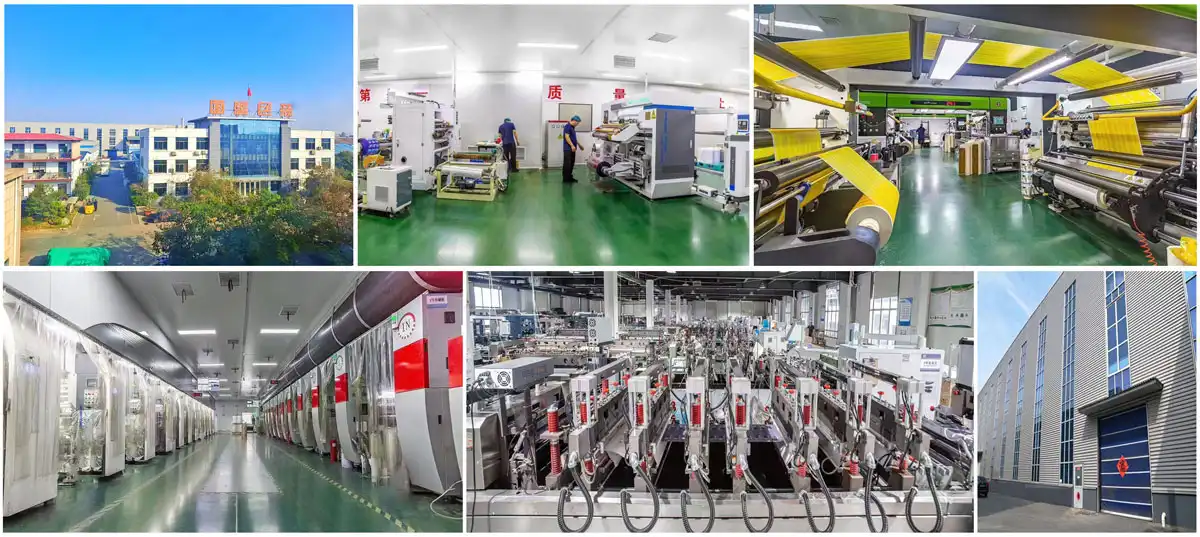
Guoshengli Packaging brings more than 25 years of flexible-packaging experience to B2B clients seeking reliable 3 sided pouch solutions. Our quality systems include ISO 9001 and BRCGS Packaging Materials certification, together with applicable food-contact compliance documentation for target markets. Our production capabilities include multiple rotogravure printing machines, laminating machines, slitting equipment, and pouch-making machines to support consistent repeat production.
Whether you require lower-volume market testing or larger repeat orders, we can evaluate digital printing, rotogravure printing, recyclable mono-material options, and selected compostable structures according to the application. Up to 11-colour rotogravure printing and digital printing are available for different project requirements, with lead times depending on material structure, artwork, order quantity, and production schedule.
Connect with our team at sales@guoshengpacking.com to discuss custom 3 sided pouch designs, request samples, or obtain a quotation tailored to your product, volume, filling process, and target market.
References
-
Robertson, Gordon L. Food Packaging: Principles and Practice. 3rd ed. CRC Press, 2012.
-
Marsh, Kenneth and Betty Bugusu. "Food Packaging—Roles, Materials, and Environmental Issues." Journal of Food Science 72, no. 3 (2007): R39–R55.
-
Selke, Susan E.M., John D. Cutler, and Ruben J. Hernandez. Plastics Packaging: Properties, Processing, Applications, and Regulations. 3rd ed. Hanser Publications, 2015.
-
Yam, K.L., ed. The Wiley Encyclopedia of Packaging Technology. 3rd ed. Wiley, 2009.
-
Coles, Richard and Mark Kirwan, eds. Food and Beverage Packaging Technology. 2nd ed. Wiley-Blackwell, 2011.
-
Emblem, Anne and Henry Emblem, eds. Packaging Technology: Fundamentals, Materials and Processes. Woodhead Publishing, 2012.
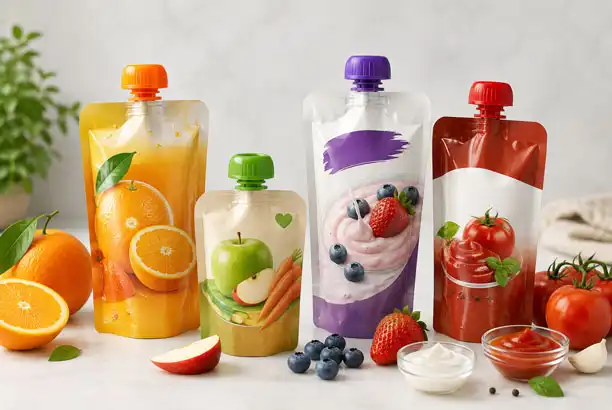
Spout pouch packaging represents a revolutionary flexible packaging format combining a high-barrier laminated pouch with an integrated rigid thermoplastic spout designed for controlled dispensing. This innovative solution addresses critical industry pain points including high logistics costs, significant carbon footprints, and product waste—enabling consumers to evacuate up to 99% of contents. Understanding how spout pouches deliver convenience, protection, and sustainability helps procurement professionals make informed packaging decisions that streamline operations and improve supply chain efficiency.
Understanding Spout Pouch Packaging: Definition and Benefits
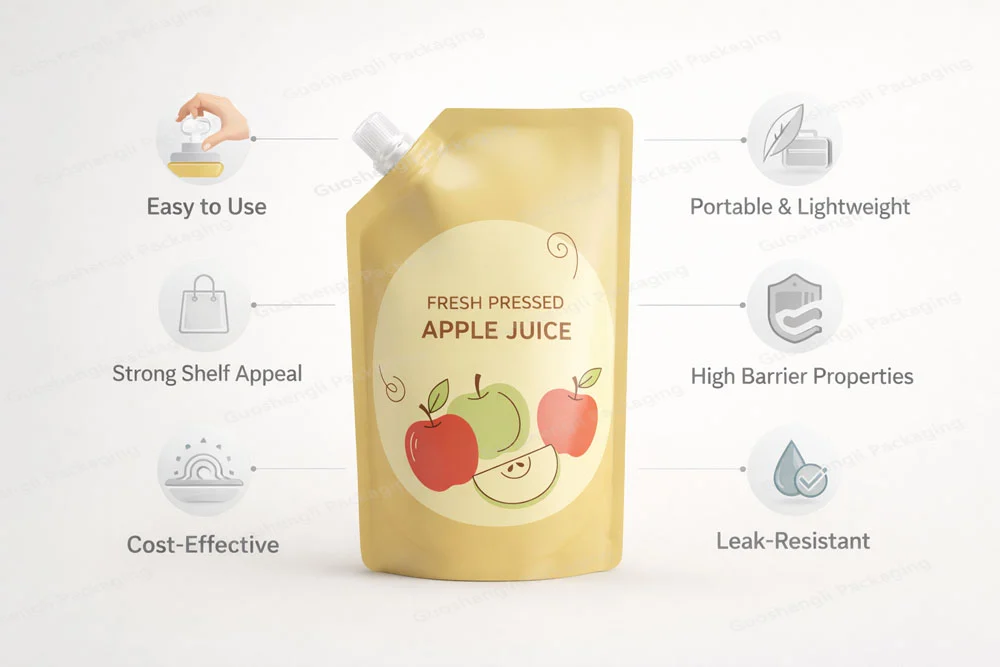
What Defines Flexible Pouches with Spouts
The structure is made up of several layers of films, such as PET, PA (Nylon), AL (Aluminum foil), and PE (Polyethylene), which are designed to meet certain barrier needs. Ultra-low Oxygen Transmission Rates (OTR) and Water Vapor Transmission Rates (WVTR) are achieved by these materials, which keep the integrity of the product during distribution. The built-in spout lets users precisely pour, giving them full control over dispensing purees, liquids, and semi-liquids without any mess or waste.
Stand-up structures stay straight on store shelves, making them easier to see and giving the goods a better look. This self-supporting design naturally brings in buyers and makes the best use of shelf space, which is a huge plus in today's competitive retail markets.
Core Benefits for B2B Procurement Teams
Flexible pouches with spouts improve processes in measured ways. Unfilled pouches take up 90% less warehouse space than rigid containers, which saves money on storage and makes it easier to keep track of inventory. Even when they are full, they are still very light, which cuts down on transportation costs and carbon emissions by a large amount.
The clear window panel helps buyers trust the store by letting them quickly see the quality of the goods and how much is left. This clarity makes people more likely to buy, and the resealable spout keeps the contents fresh longer by reducing the amount of air that gets to them. When people use a product, the bags get smaller, which keeps the flavors better than standard containers and lowers oxidation.
High-barrier laminated construction keeps granular goods like salt and seasonings from getting clumpy and keeps the quality of the goods all the way through the supply chain. These protective qualities lower the number of spoilage and customer complaints, which is good for the brand's image.
Sustainability Gains Through Material Efficiency
Using flexible bags instead of hard bottles greatly lowers the carbon footprint of packaging. Less weight means less pollution from transportation. When people use less material, they also use fewer resources. People can now find structures made of only one material (All-PE) that can be recycled through municipal recycling systems and still have great barrier properties thanks to EVOH coatings.
This lets brands tell customers who care about the earth a real story about sustainability. The packaging always does its job and supports company social responsibility efforts, which is a strong mix in today's market.
Types and Materials of Spout Pouch Packaging
Stand-Up Versus Flat Pouch Configurations
Stand-up bags have a base that supports itself, so they can stay standing on shelves without any extra help. This model works really well in stores where having products on display drives sales for spout pouch packaging. The structure works well with both liquid and semi-liquid substances, which makes it perfect for sauces, drinks, and condiments.
Flat bags are cheaper for goods that don't need to stand out on the shelf or that are sold through outlets other than stores. Four-side sealed forms make the structure stronger for products that will be handled roughly while being shipped.
Spout Diameter and Viscosity Matching
Spouts usually have widths between 8.5 mm for drinks and 33 mm for thick sauces or dry powders. Choosing the right width based on the viscosity of the product guarantees smooth pouring without clogging. Thin liquids can easily flow through small holes, but thicker products need wider spouts to make pouring easier.
Die-cutting the corners to be round and using certain head-to-tail packing arrangements lower the risk of friction and punctures during shipping. These technical details keep spouts from going through shipping carton bags next to each other, which is a common issue that causes customers to be unhappy and products to be lost.
Material Layers and Barrier Technologies
Food-grade plastics like PE, PET, and PA are used to make structures with many layers that keep oxygen and moisture out. Each layer does a specific job: PET gives the package structure and makes it easy to print on, PA protects against punctures, aluminum foil provides the best barrier protection, and PE makes sure the heat seal stays strong.
The inner layers of bags are made of RCPP (Retort Cast Polypropylene), which lets them handle filling temperatures between 85°C and 95°C and even retort cleaning at 121°C. Because it is thermally stable, hot-filling methods can be used to make food and drinks last longer without having to be refrigerated, which is important for many uses.
Customization Options for Brand Differentiation
Up to 11-color rotogravure printing is possible, which makes bright images that stand out on busy shelves. With full-surface printing, pouches become powerful branding tools that show off quality and set products apart from competitors.
Design elements like caps that can be resealed, holes for hanging, and carefully placed clear views make the product more useful. These features improve the user experience and offer useful benefits that people enjoy every day.
Comparing Spout Pouch Packaging with Other Packaging Solutions
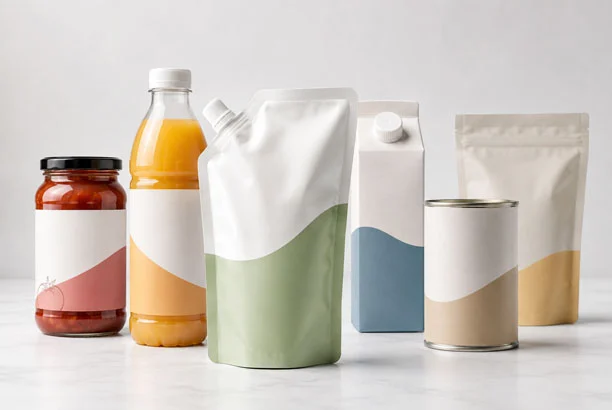
Weight and Transport Efficiency Analysis
Traditional stiff bottles and glass cases add costs to shipping that aren't necessary. Shipping costs go up a lot because of their size and weight. Flexible bags are a beautiful way to solve this problem because they dramatically reduce weight and make the best use of space.
Depending on the type of product and the distance it has to be shipped, moving to flexible formats can cut shipping costs by 40 to 60%. These savings add up along supply chains, which boosts profits while lowering damage to the environment.
Cost-Benefit and ROI Considerations
The initial costs of making bag molds are usually less than those of making bottle molds. Modern converting equipment can produce at speeds that are the same as or faster than bottle filling lines. This keeps throughput high while lowering the cost of packaging each unit.
Long-term savings come from fewer damaged products during shipping, lower storage costs, and lower costs for getting rid of them. When brands switch from rigid to flexible forms, they report ROI times of 12 to 18 months. These are good payback periods that justify capital investment.
Environmental Impact Comparison
Lifecycle studies show that during the production, shipping, and disposal stages, flexible pouches produce 50–70% less carbon emissions than similar hard packaging. Consumption of materials drops a lot, which saves oil and cuts down on trash in landfills.
Consumers are becoming more and more interested in brands that care about the environment. Flexible packaging shows a commitment to sustainability in a way that people can see and understand, which helps with marketing efforts.
Procurement Considerations for Spout Pouch Packaging
Supplier Credentials and Certifications
When choosing makers for spout pouch packaging, you need to carefully look at their quality processes and compliance paperwork. Getting ISO 9001 approval shows that you follow set quality management procedures. BRC (Brand Reputation through Compliance) certification is very important for consumer packaged goods because it makes sure they meet food safety standards.
FDA compliance makes sure that products meet the rules for food interactions in the US market. EU regulations add to the duties that responsible suppliers already have when it comes to choosing the right materials and following the right testing procedures. Third-party testing by SGS makes sure that the product's safety and specs are checked by a third party.
Guoshengli Packaging has all of these licenses and has been making things for 25 years. Every order comes with one of our thorough testing results, which gives buying teams the proof they need to follow the rules and gives them peace of mind.
OEM Capabilities and Supply Chain Logistics
How well providers can meet rising demand depends on how much they can produce. Look for companies that have more than one printing line, laminating machine, or converting machine. This infrastructure shows that the company can efficiently handle both small batch runs and high volumes of production.
Lead times are very different between providers. Digital printing usually gets finished products to customers in 7–10 days, while rotogravure printing takes 15–20 days. Knowing these dates helps buying teams plan their goods so that they don't run out of products during product launches or busy times of the year.
Minimum order numbers, or MOQs, affect both cash flow and the cost of keeping goods on hand. Flexible MOQ policies let brands try out new products without having to spend a lot of money right away. They can also quickly expand if the market responds well.
Negotiating Bulk Pricing Structures
Making a volume commitment can get you better prices, but procurement teams need to weigh the cost savings against the risk of running out of stock. By setting up framework deals with regular releases, you can protect prices while still being able to change numbers based on demand.
The choices for transportation have a big effect on the total landing cost. Delivery by air takes four to five days, but the freight rates are higher. Ocean freight has much lower per-unit costs but takes 25–35 days longer to get from one place to another. Total supply chain costs can be kept as low as possible by choosing the right shipping methods based on needs and budget.
Maximizing the Impact of Spout Pouch Packaging in Your Supply Chain
Barrier Properties and Shelf Life Extension
Advanced barrier technologies keep food fresh longer by stopping oxygen and moisture from getting in. These safe qualities lower the number of products that go bad, the number of recalls, and the number of customer complaints. All of these things have a direct effect on the brand's profits and image.
ASTM D3078 vacuum leaking testing checks the quality of the seal before shipping. Burst pressure testing shows how much weight bags can hold before they burst during palletization. These quality control steps make sure that the package works well in real-life shipping situations.
Consumer Engagement Through Design Elements
Features that are easy for customers to use make them happier and more likely to buy again. Precision pour spouts keep spills from happening, which makes things easier for users. When you open a package, resealable caps keep it fresh between uses, which extends the shelf life. Transparent windows let you check the quality of the product, which builds trust at the point of sale.
These design elements directly lead to more loyal customers who stick with the brand. People remember packaging that makes their lives easier, which makes them feel good and affects their future buying choices across all product categories.
Integration with Sustainability Initiatives
Environmental improvements that can be measured give corporate responsibility programs more credibility. Sustainability reports can show that switching to flexible packaging leads to measurable drops in carbon emissions, material use, and waste production.
Lifecycle studies compare the environmental effects of different types of packaging, giving information that helps make smart decisions. Brands can let customers know about these changes through on-pack messaging, website content, and marketing efforts. This way, they can set themselves apart from rivals and appeal to eco-friendly customers.
Mono-material structures make recycling easier because they don't need to separate materials in a complicated way. As recycling infrastructure in cities gets better, these forms become more practical options that keep products safe while allowing end-of-life recovery.
Conclusion
Modern food and drink brands care about convenience, protection, and sustainability, and flexible packaging with built-in spouts like spout pouch packaging offers strong benefits in all three areas. Logistics costs go down, shelf life increases, and product value goes up, all of which help procurement teams in measured ways. Material improvements make it possible to be environmentally friendly without sacrificing the quality of the product. Implementation will go smoothly if you choose qualified suppliers with the right certifications, production capacity, and quick service. When purchasing managers know about technical specs, barrier standards, and customization options, they can make smart choices that improve supply chains and help businesses grow in the long run. The change from rigid to flexible formats is a strategic chance for brands that want to be the best at what they do and lead the market.
FAQ
1. What food and beverage products work best with spouted pouches?
This style works best for liquid and almost-liquid goods. It works really well for juices, sauces, condiments, baby food purees, energy gels, broths, oils, and salad dressings. Granular foods like table salt, sea salt, and specialty seasonings can also be used as long as they are kept safe from moisture. Precision pour spouts are especially helpful for products that need to be dispensed in a controlled way because they remove waste and make the user experience better.
2. How do spouted pouches extend shelf life compared to traditional packaging?
Multi-layer barrier films stop the flow of oxygen and moisture, which break down products. Ultra-low OTR and WVTR numbers keep food fresh for a lot longer than single-layer materials. The reusable spout keeps the food from oxidizing after it's been opened. This keeps the taste and nutritional value. These defensive qualities lower the rate of spoilage and increase the useful shelf life, both before and after the first use.
3. What customization options allow brand differentiation?
Graphics that stand out are made possible by full-surface printing in up to 11 colors. Strategically placed clear windows show off the quality of the product. Different viscosities can be handled by spouts with widths ranging from 8.5 mm to 33 mm. Different features like resealable caps, hanging holes, and matte or shiny finishes make the products more useful and appealing. When you combine these options, you can make unique packaging that shows off your brand's values and gives customers useful benefits they like.
Partner with Guoshengli Packaging for Superior Spout Pouch Solutions
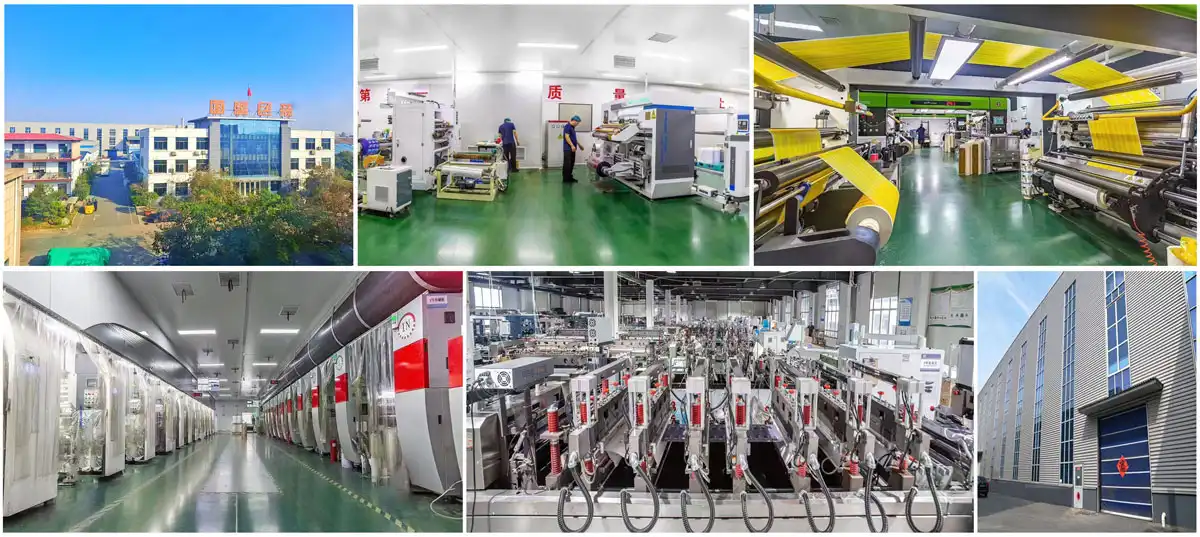
Picking the correct spout pouch packaging maker has a direct effect on how well the product works, how well the supply chain works, and how well the product does in the market. Guoshengli Packaging has been working with flexible packaging for 25 years and has 7 printing lines, 6 sealing machines, and 49 turning machines that all do the same high-quality work at large scale. Our ISO 9001, BRC, FDA, and SGS certifications make sure that we follow international food safety standards. Our All-PE mono-material options make it possible to recycle without sacrificing barrier protection. With our production capacity, we can meet tight deadlines for both digital printing (7–10 days) and rotogravure printing (15–20 days). We provide custom solutions for food brands, beverage companies, supplement makers, and pet food makers in North America, Europe, and the Asia-Pacific region. These solutions are made to fit your filling equipment, product features, and target markets. You can talk to our team at sales@guoshengpacking.com about your needs and ask for samples that show how precise engineering and quick service can make packaging that you don't have to worry about.
References
1. Robertson, G.L. (2016). Food Packaging: Principles and Practice. CRC Press, Boca Raton, Florida.
2. Marsh, K. & Bugusu, B. (2007). "Food Packaging—Roles, Materials, and Environmental Issues." Journal of Food Science, 72(3), R39-R55.
3. Selke, S.E., Culter, J.D., & Hernandez, R.J. (2004). Plastics Packaging: Properties, Processing, Applications, and Regulations. Hanser Publishers, Munich.
4. Coles, R., McDowell, D., & Kirwan, M.J. (2003). Food Packaging Technology. Blackwell Publishing, Oxford.
5. Yam, K.L. (2009). The Wiley Encyclopedia of Packaging Technology. John Wiley & Sons, Hoboken, New Jersey.
6. Emblem, A. & Emblem, H. (2012). Packaging Technology: Fundamentals, Materials and Processes. Woodhead Publishing, Cambridge.
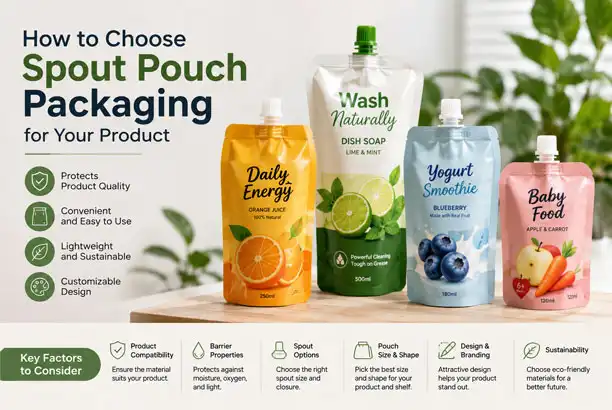
Choosing the right bottle shape juice pouch for your brand involves evaluating barrier performance, structural design, printing capabilities, filling compatibility, and supplier reliability. These specialized flexible packages replicate some of the visual and handling appeal of rigid bottles while delivering lightweight convenience, distinctive shelf presence, and customizable branding opportunities. Procurement managers should prioritize laminate structures that match the required oxygen, moisture, and light protection, confirm compatibility with the actual filling and thermal process, and verify manufacturer certifications such as BRCGS Packaging Materials and ISO 9001 together with appropriate food-contact compliance documentation for the intended market.
Understanding Bottle Shape Juice Pouches and Their Advantages
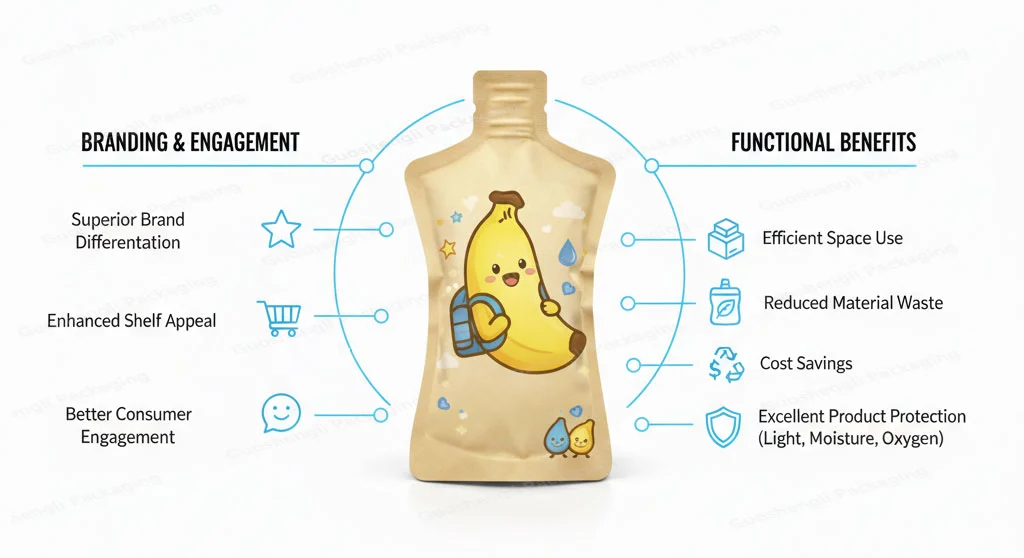
The world of drinks packaging has changed significantly. Standard rigid bottles and conventional flat pouches do not always meet the needs of brands that want distinctive presentation, efficient transport, convenient use, and flexible customization. Bottle shape juice pouches provide an alternative that combines a bottle-inspired appearance with the material efficiency and design flexibility of modern flexible packaging.
What Makes Bottle Shape Juice Pouches Different
Precision die-cutting technology is used to make bottle shape juice pouches that resemble rigid containers while retaining the advantages of flexible laminated packaging. Unlike standard stand-up pouches, these shaped pouches use a customized outline that can help products stand out on crowded retail shelves. The bottle-like shape can also provide a familiar holding area when the dimensions and pouch geometry are properly designed. This design approach helps beverage brands create stronger visual differentiation in competitive retail environments.
The multi-layer composite structure may range from PET/PE for applications with moderate barrier requirements to PET/NY/AL/PE or other high-barrier laminates where stronger oxygen, moisture, aroma, or light protection is required. A properly specified and sealed structure can help protect flavour, colour, and oxygen-sensitive nutrients, but final shelf life depends on the complete product formulation, filling process, thermal treatment, storage conditions, and package integrity. Bottle shape juice pouches can also use substantially less packaging mass than many rigid glass formats, potentially reducing transport weight and empty-package storage volume depending on the complete supply-chain configuration.
Core Advantages for Beverage Brands
One of their strongest advantages is their distinctive retail presentation. Large printable front and back areas allow brands to use bright graphics, product information, and visual storytelling to attract consumers at the point of sale. Up to 11-color rotogravure printing can support detailed graphics and consistent branding for suitable production runs.
Convenience features can also improve product usability. Easy-tear notches can help consumers open selected non-spouted formats without scissors or other tools. Compared with glass bottles, flexible pouches do not shatter, which can make them practical for lunchboxes, outdoor use, travel, and portable beverage applications. Their light weight and compact format can also make them convenient for backpacks, gym bags, and other mobile-use situations when the pouch construction is validated for the intended handling conditions.
Sustainability factors increasingly influence business-to-business and consumer purchasing decisions. Modern bottle-shaped juice pouches may be developed using "Recycle Ready" mono-material PE/PE structures for selected applications. However, barrier, sealing, thermal-process compatibility, filling-line performance, and shelf-life requirements must be validated for the actual product before replacing a conventional multi-material laminate.
Typical Applications Across Market Segments
Premium organic NFC (Not-From-Concentrate) juice brands may use bottle-shaped pouches to create distinctive presentation and communicate freshness or premium positioning. Where required, aluminium-foil or other high-barrier layers can reduce exposure to oxygen and light, which may help protect oxidation-sensitive flavour, colour, and nutrients during storage.
Kids' beverages can also benefit from shaped pouches. Parents may value the lightweight and non-shattering format for school lunches or outdoor activities, while children may respond positively to colourful and easy-to-hold designs. Suitability for children should still consider cap or spout design, pouch dimensions, opening method, and any applicable safety requirements.
Sports nutrition and portable beverages require packaging that can tolerate real handling conditions. Bottle-shaped juice pouches should therefore be validated for drop impact, compression, temperature changes, and internal pressure conditions that may occur during distribution and use. Product quality and package integrity should be confirmed using the actual filled pouch rather than an empty sample alone.
Smoothies and blended drinks present particular filling and flow challenges because of their higher viscosity and possible particulates. Bottle-shaped juice pouches can be designed for these products when the pouch opening, spout, seal system, and filling equipment are properly matched. Selected structures may also be suitable for elevated-temperature filling, but the maximum filling temperature, holding time, laminate, adhesive, sealant, spout system, and thermal process must be validated for the specific application.
Key Criteria to Consider When Choosing a Bottle Shape Juice Pouch
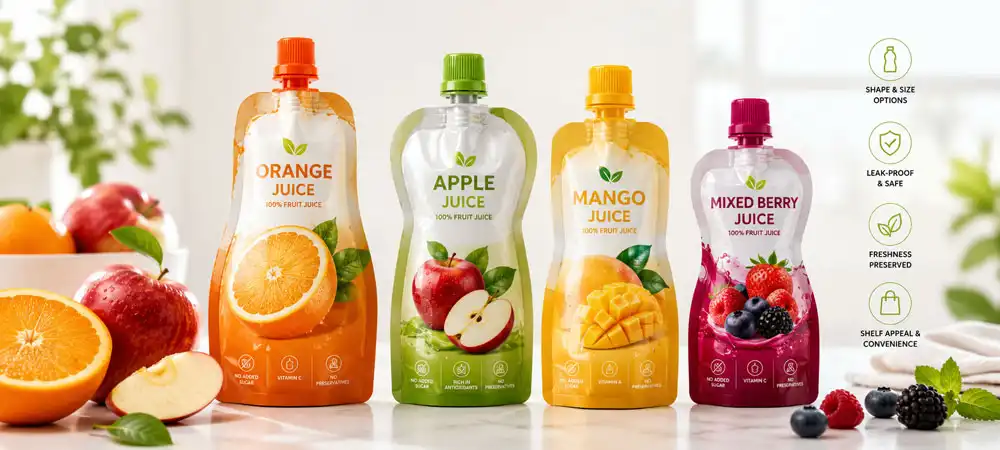
To choose the right packaging option such as a bottle shape juice pouch, buyers need to carefully consider the materials used, how the structure performs, how it will be filled, and how it meets applicable regulatory requirements. Each choice can affect product protection, consumer experience, production efficiency, and long-term brand reliability.
Material Selection and Barrier Performance
Ingredients influence taste, shelf life, colour, aroma, and nutrient stability. PET may be used as an outer layer for printability, dimensional stability, and mechanical performance, while food-contact polyethylene (PE) is often used as a sealant layer because of its heat-sealing properties and suitability for many beverage-contact applications.
For oxygen- or light-sensitive beverages, aluminium foil, metallised films, EVOH, or other barrier technologies may be considered depending on the shelf-life target and processing conditions. Barrier targets should be specified using OTR and WVTR values under defined test conditions rather than by material name alone. Aluminium foil can provide essentially opaque light protection when the foil layer remains intact, while the complete pouch structure should still be evaluated for flex resistance, seal integrity, and distribution performance.
Environmentally conscious brands may also consider selected PLA- or PBAT-based structures where a defined industrial-composting route and appropriate certification are available. These materials should not be assumed to provide the same barrier, sealing, or thermal performance as conventional beverage laminates. Sustainability claims should therefore be supported by appropriate testing, certification, and end-of-life infrastructure.
Structural Design and Functional Features
Choosing spouted or non-spouted layouts is an important design decision. Fitted spouted bottle juice pouches can support controlled pouring, reclosure, and repeated use when the fitment system is properly engineered. Spout retention and seal integrity should be validated using appropriate pull, torque, leak, and handling tests for the intended cap, pouch, and filling process. For aseptic applications, the pouch, fitment, and filling system must also be compatible with the validated sterilization and aseptic process used by the filler.
Simple single-serve designs without spouts may use easy-tear notches for lower-cost applications. The tear notch should be positioned and manufactured so that the pack remains secure during distribution while still opening predictably for the consumer. Poor notch design can contribute to premature tearing or difficult opening.
Seal width, seal temperature, pressure, dwell time, material compatibility, and quality control all affect leak resistance. With bottle-shaped juice pouches, manufacturers should use appropriate package-integrity testing for the die-cut profile and sealing geometry. Leak, burst, pressure-based, or other validated test methods may be used depending on the application. Burst testing can help assess package and seal strength, but distribution performance should also be validated through suitable filled-pack compression, drop, and transport testing.
Different consumers and use occasions may require different pack sizes. Single-serve formats such as 150–250 ml can suit children and on-the-go beverages, while larger 500–1000 ml formats may be suitable for selected multi-serve products when the pouch is designed for the required weight, handling, and reclosure needs. Custom die-cutting allows brands to develop simple bottle shapes or more distinctive outlines, although extreme shapes should still be evaluated for filling efficiency, seal geometry, and handling performance.
Regulatory Compliance and Certification Requirements
International food-contact requirements require appropriate material documentation, migration testing, and traceability. For products intended for the United States, food-contact layers and components should comply with applicable FDA requirements for their intended conditions of use. For products intended for the EU market, plastic food-contact layers should be assessed against Regulation (EU) No 10/2011 where applicable, together with the broader EU food-contact materials framework and relevant migration requirements.
BRCGS Packaging Materials certification can demonstrate that a packaging manufacturing site operates against recognized requirements covering product safety, quality, legality, and operational controls. Procurement managers can use certifications such as BRCGS Packaging Materials as part of a wider supplier-evaluation process that also reviews food-contact documentation, process controls, testing capability, and traceability.
Organizations with ISO 9001 quality management certification use structured quality-management processes intended to support consistent production and continual improvement. For growing brands and export programmes, repeatable quality controls and documented specifications are important for maintaining batch-to-batch consistency.
Independent SGS or similar third-party laboratory testing can support verification of material composition, migration, barrier, seal, or other agreed performance requirements. The required records should be defined by the product, target market, customer specification, and regulatory framework rather than assuming that one generic test report covers every application.
Comparing Different Bottle Shape Juice Pouch Options in the Market
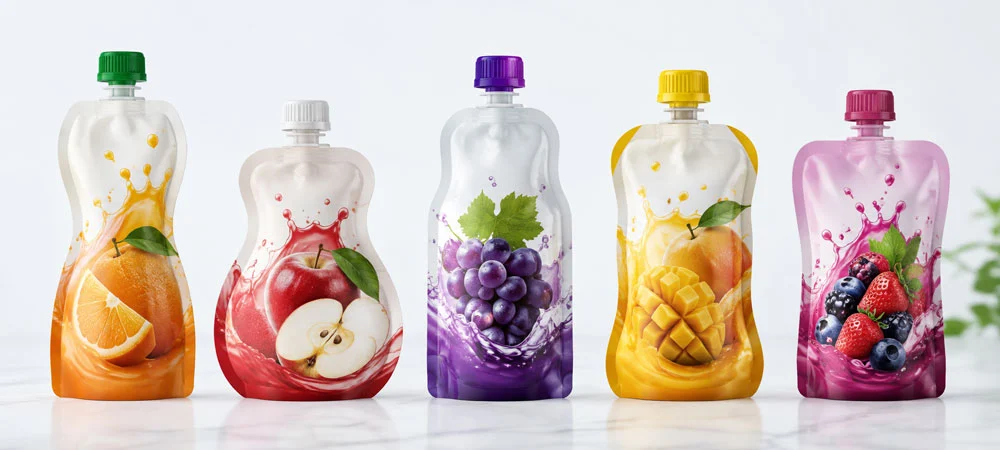
When buying teams understand how different packaging options perform, they can make better decisions that balance cost, functionality, visual impact, production efficiency, and strategic requirements.
Cost Efficiency Analysis
Bottle shape juice pouches can provide an efficient packaging option compared with some rigid formats, but the actual commercial advantage depends on the application. Glass bottles can involve higher package weight and breakage risk, while rigid PET bottles may require additional storage space and dedicated bottle-forming or sourcing arrangements. Carton systems and other rigid or semi-rigid formats may also involve specialized filling and equipment requirements.
Compared with many rigid alternatives, flexible bottle shape juice pouches can use less packaging mass and occupy less space before filling. Their lighter weight and compact unfilled format may reduce storage and transport costs, although actual savings depend on the filled product weight, carton utilization, pallet configuration, transport route, and distribution model.
Production lead times depend on the printing method, material structure, die-cutting requirements, artwork, and production schedule. Digital printing can support lower-volume launches, multiple SKUs, and market testing without conventional printing cylinders. Rotogravure printing requires cylinder preparation but is generally more suitable for larger-volume repeat production where high print consistency and efficient unit economics are important. The commercial break-even point depends on pouch dimensions, artwork, number of designs, tooling, and production volume rather than a single fixed quantity.
Evaluating Manufacturer Capabilities
Production capability affects a supplier's ability to support brand growth. Integrated printing, laminating, slitting, and converting equipment can help manufacturers manage large and repeat orders more consistently. Guoshengli Packaging operates multiple pouch-making machines together with seven printing machines and six laminating machines to support flexible packaging production across different formats.
Strategic suppliers can provide more than transactional production. Manufacturers with die-cutting and pouch-development capabilities can help brands develop bottle-shaped formats from design through sampling and production. Rotogravure printing with up to 11 colours can support detailed graphics and consistent brand presentation for suitable production runs.
MOQ requirements affect inventory and cash flow. Depending on pouch size, material structure, die-cut tooling, number of designs, and printing method, lower-volume projects may be possible through digital printing or selected production routes. Established bottle shape designs can also reduce some tooling and development requirements for new projects.
Expert filling-line coordination can reduce expensive production delays. Production teams should confirm compatibility with the actual premade-pouch filling, spout-filling, capping, or rotary filling equipment, including pouch dimensions, opening method, fitment position, sealing conditions, and handling sequence. Automated trials should verify pouch feeding, opening, positioning, filling, sealing, and discharge stability on the intended equipment.
Private Label and Customization Options
Private-label solutions can help brands enter new markets more efficiently when an existing validated bottle shape can be adapted to the new product. Using an established pouch shape can reduce tooling and development work, although artwork, material structure, food-contact requirements, and filling compatibility still need to be confirmed for each project.
Full customization programmes help brands differentiate through distinctive shapes, graphics, finishes, spouts, and functional details. Collaborative development should consider consumer use, technical feasibility, filling-line requirements, and production constraints. Prototypes and samples can be used to evaluate design concepts before committing to full production tooling, reducing development risk and helping confirm alignment with the intended brand presentation.
Procurement Best Practices and How to Find the Right Supplier
Strategic sourcing means evaluating a supplier's manufacturing capability, quality systems, compliance support, technical expertise, and long-term partnership potential in a structured way.
Identifying and Verifying Reliable Suppliers
Supplier evaluation should begin with relevant credentials and supporting documentation. Check ISO 9001 and BRCGS Packaging Materials certificates for validity and scope, and review applicable food-contact declarations, migration reports, or third-party laboratory testing where required. FDA should be treated as a regulatory compliance framework for applicable food-contact materials rather than as a general manufacturer certification.
Production facility inspections can provide useful information about manufacturing capability, quality control, housekeeping, personnel practices, and material handling. Buyers can review equipment, traceability, process controls, laboratory capability, and the consistency of sample and production runs.
Customer references or case examples may also help demonstrate supplier performance where customer confidentiality allows. Buyers can ask about experience with similar beverage applications, export markets, repeat-order consistency, delivery reliability, technical response, and the ability to scale production.
Sample requests are essential for validation. Order samples that reflect the intended material, size, printing, spout, and use conditions as closely as possible. Check seal integrity, barrier requirements, pouch dimensions, handling, and filling-equipment compatibility. Share samples with fillers or co-packers early so that machine and process requirements can be confirmed before production.
Negotiation Strategies and Contract Terms
Price varies according to order quantity, material structure, tooling, printing method, and order frequency. Larger repeat orders may improve unit economics and production planning, but the total cost of ownership should also consider freight, inventory, storage, tooling, waste, and the cost of non-conforming packaging.
Lead times should include artwork approval, cylinder or tooling preparation where applicable, material availability, printing, laminating, curing, converting, inspection, and production scheduling. Digital printing can support faster short-run development for selected projects, while rotogravure is generally used for larger repeat programmes.
Quality requirements should be defined as part of the purchasing specification. Where relevant, buyers may specify OTR, WVTR, seal strength, dimensions, tolerances, printing requirements, fitment performance, and package-integrity testing. Sampling plans, acceptance criteria, and procedures for handling non-conforming material should also be agreed in advance.
Logistics planning can help control supply and freight costs. Ocean freight can be economical for planned replenishment, while air freight may be used for urgent requirements when commercially justified. Actual transit time depends on origin, destination, carrier, customs clearance, and delivery terms, so logistics planning should use realistic route-specific information.
After-sales service can help distinguish strategic suppliers from transactional ones. Clear communication channels, response expectations, technical support, and structured corrective-action processes can reduce disruption when issues occur. Regular review of production, quality, and forecasting can also support more stable long-term cooperation.
Sustainable Sourcing Considerations
Manufacturers can support environmental management through documented systems, process controls, waste reduction, and emissions management. Where ISO 14001 certification is relevant, buyers can verify the current certificate and its scope. Printing and laminating processes may generate VOC emissions, and properly designed RTO systems can capture and thermally oxidize VOCs according to the equipment design, operating conditions, and applicable environmental requirements.
Packaging recyclability can also support corporate environmental objectives when the complete structure and local infrastructure are considered. Mono-material PE/PE designs may improve compatibility with suitable mechanical recycling systems for selected applications, but recyclability depends on the full structure, barrier layers, inks, adhesives, fitments, labels, and the target-market recycling system. Where environmental comparisons are important, a product-specific life-cycle assessment can provide a stronger basis for evaluating sourcing, manufacturing, distribution, use, and end-of-life impacts.
Companies increasingly focus on carbon reduction because of customer, investor, and regulatory expectations. Lightweight flexible juice pouches may reduce packaging mass and transport weight compared with some rigid formats, but actual emissions benefits should be evaluated using the complete supply chain. Buyers can also consider suppliers' energy efficiency, waste reduction, emissions management, and renewable-energy use where relevant.
Conclusion
Choosing the right bottle shape juice pouch requires more than selecting an attractive shape. Buyers should evaluate the beverage formulation, target shelf life, filling and thermal process, pouch or spout configuration, barrier structure, seal system, filling-equipment compatibility, and applicable food-contact requirements. These factors determine whether the package can perform reliably through production, storage, distribution, and consumer use.
Recyclable or lower-material structures can support sustainability objectives for selected applications, but they should be validated against barrier, sealing, mechanical, and shelf-life requirements before replacing conventional laminates. Environmental claims should also reflect the complete package and the actual collection, sorting, recycling, or other end-of-life route available in the target market.
Companies seeking long-term supply should evaluate manufacturers based on technical capability, quality systems, food-contact documentation, production consistency, testing support, and responsive communication. A well-specified bottle shape juice pouch should balance product protection, filling-line performance, brand differentiation, commercial cost, and sustainability goals rather than optimizing only one factor.
FAQ
1. What materials provide the best barrier protection for bottle shape juice pouches?
High-barrier structures may use aluminium foil, metallised films, EVOH, or other barrier technologies depending on the juice, filling process, and shelf-life target. PET can contribute printability and dimensional stability, PA may be selected where additional toughness or puncture resistance is required, and PE or CPP may serve as heat-seal layers. Barrier performance should be specified through OTR and WVTR values under defined test conditions rather than relying on material names or universal threshold values. Mono-material PE/PE structures may be suitable for selected applications, but their barrier, thermal, sealing, and shelf-life performance should be validated against the actual product and process.
2. How can I ensure leak-proof performance in bottle-shaped juice pouches?
Reliable leak performance depends on the laminate, seal geometry, pouch shape, fitment system, filling process, and quality controls. For each structure, seal temperature, pressure, dwell time, and seal width should be optimized and validated. Manufacturers should use appropriate package-integrity methods such as leak, burst, pressure-based, or other suitable testing according to the pouch design. For spouted formats, pull, torque, fitment-seal, and handling tests can help confirm retention performance. Buyers should request a defined quality-control plan and validate the actual filled pouch under representative distribution conditions.
3. What are typical minimum order quantities for custom-printed bottle shape juice pouches?
Minimum order quantities depend on pouch dimensions, die-cut tooling, material structure, number of designs, printing method, and required features. Digital printing can support lower-volume market tests, multiple SKUs, and selected limited-edition projects because conventional printing cylinders are not required. Rotogravure is generally more suitable for larger-volume production, although the commercial break-even point varies by artwork, pouch size, number of colours, and cylinder cost. Manufacturers with suitable equipment can recommend the most practical production route based on the project rather than applying one fixed MOQ to every bottle shape juice pouch.
Partner with a Trusted Bottle Shape Juice Pouch Manufacturer
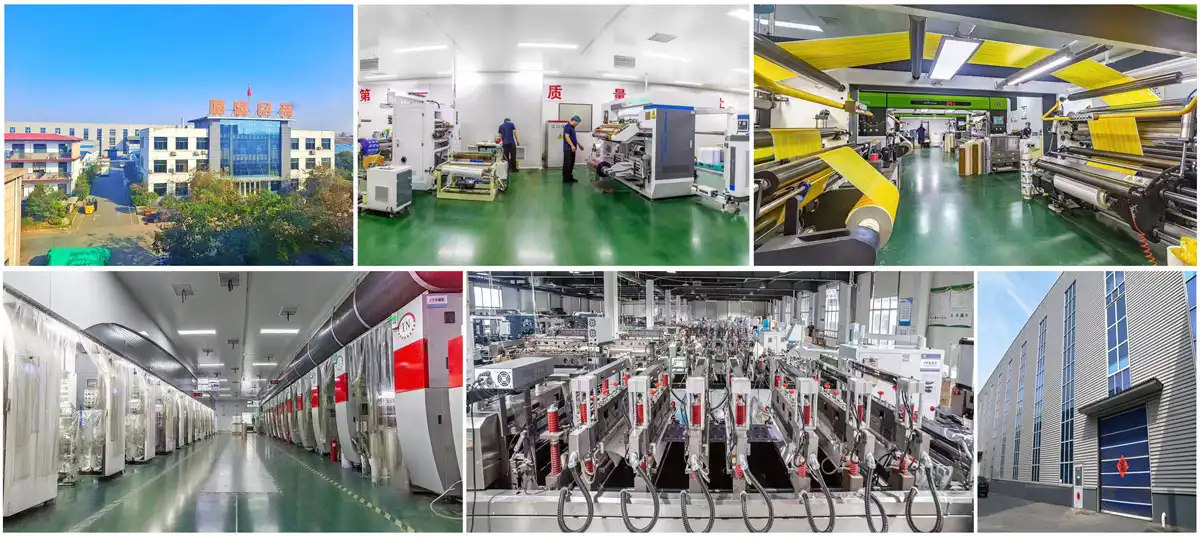
Guoshengli Packaging brings more than 25 years of experience in flexible packaging and works with beverage brands that need reliable bottle shape juice pouch solutions. Our quality systems include ISO 9001 and BRCGS Packaging Materials certification together with food-contact compliance documentation and third-party testing support for applicable target markets. Our production capabilities include seven printing machines and rotogravure printing in up to 11 colours, supporting detailed graphics and consistent branding across suitable production runs.
MOQ and lead time depend on pouch dimensions, material structure, die-cut requirements, printing method, number of designs, and functional features. Digital printing can support selected lower-volume projects and faster artwork changes, while rotogravure is suitable for larger repeat programmes. Recyclable material options can also be evaluated where they meet the required product protection, filling, sealing, and end-of-life criteria.
Get in touch with our technical team at sales@guoshengpacking.com to request samples, discuss customization options, and evaluate how our experience as a bottle shape juice pouch supplier can support your product. We can help review pouch structure, material selection, printing, fitment requirements, filling compatibility, and sampling before full production.
References
-
Robertson, G. L. (2016). Food Packaging: Principles and Practice (3rd ed.). CRC Press.
-
Marsh, K., & Bugusu, B. (2007). Food packaging—roles, materials, and environmental issues. Journal of Food Science, 72(3), R39–R55.
-
Yam, K. L. (Ed.). (2009). The Wiley Encyclopedia of Packaging Technology (3rd ed.). John Wiley & Sons.
-
Coles, R., McDowell, D., & Kirwan, M. J. (Eds.). (2003). Food Packaging Technology. Blackwell Publishing.
-
Brody, A. L., & Marsh, K. S. (Eds.). (1997). The Wiley Encyclopedia of Packaging Technology (2nd ed.). John Wiley & Sons.
-
Soroka, W. (2009). Fundamentals of Packaging Technology (4th ed.). Institute of Packaging Professionals.